
It has been less than a week since Europe’s new Entry/Exit System went live, and the first major casualty has already occurred. On Sunday, April 12, just two days after the system officially launched at airports across the Schengen zone, more than 120 passengers were left stranded at Milan’s Linate Airport after missing their flight home. The cause was not a mechanical issue, a weather event, or an air traffic control problem. It was a border control queue so long and so slow that the vast majority of passengers on the flight simply never made it through in time.
Of the 156 people booked on an easyJet flight from Milan to Manchester, only 34 managed to board. The other 122 were left at the airport, scrambling to find alternative routes home, paying hundreds to thousands of dollars out of pocket for new flights, and in some cases waiting in conditions so difficult that passengers reportedly fainted from the heat. Some travelers were offered replacement flights departing five days later. Others spent over two thousand dollars to reach their destinations a full 24 hours behind schedule.
This is the opening chapter of Europe’s new biometric border system, and it is not the smooth debut that European Union officials had hoped for. For Americans who travel to Europe regularly or have trips planned for the rest of 2026, what happened at Milan Linate on Sunday is more than a news story about someone else’s bad day. It is a preview of what the new normal at European borders could look like, and it carries direct implications for how American travelers should plan their trips.
What Actually Happened at Milan Linate
The sequence of events at Linate on Sunday tells the story more clearly than any abstract explanation of the new system could. Passengers had been warned by their airline to allow extra time at the airport, and many took that advice seriously. One family arrived at the departure area three full hours before their scheduled departure. A teenage traveler and her companion showed up three and a half hours ahead of their flight. By any reasonable standard, these were not people who cut it close. They did everything right.
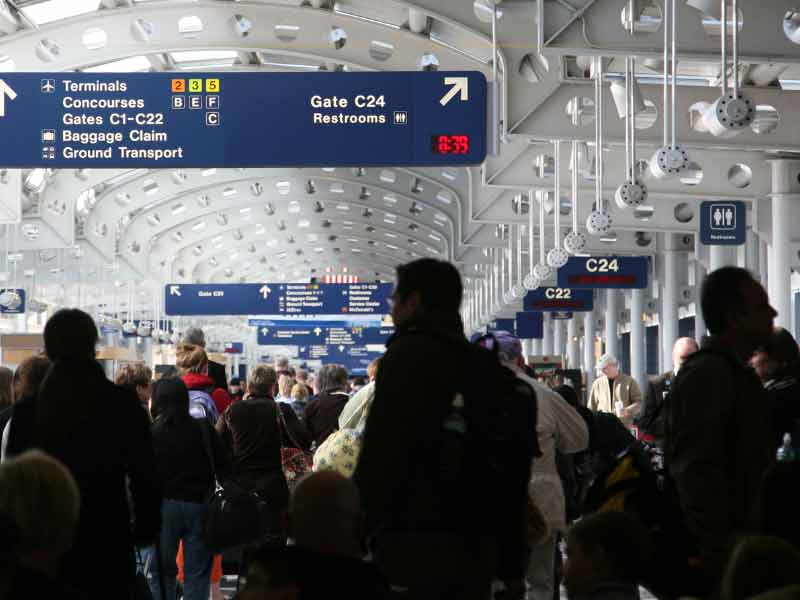
What they encountered at border control was a queue of staggering proportions. The new Entry/Exit System requires non-EU travelers to have their biometric data collected at the border, including four fingerprints and a facial scan. For travelers going through this process for the first time, the registration takes longer than a traditional passport stamp. Multiply that additional time by the number of passengers departing from a busy airport on a Sunday afternoon, and the arithmetic of the delay becomes clear. The line moved slowly, then more slowly, then barely at all.
Water was brought to passengers waiting in the queue, but only when the situation had already reached a critical point. By the time many travelers reached the front of the line, their flights had already pushed back from the gate. One traveler described being told at the front of the queue, with only minutes left before departure, that the flight to Manchester had already gone. Approximately 30 people had made it through. Around 100 had not.
The conditions in the queue were reported to be genuinely difficult, with the heat and the extended wait combining badly enough that some passengers became unwell and required assistance. For people who had spent hours on their feet in a crowded, warm terminal, having already traveled before this connection, the physical toll of the wait compounded the logistical nightmare of missing the flight.
The Financial Fallout That Passengers Are Now Dealing With
Missing a flight under any circumstances is expensive and disruptive. Missing a flight because of a border control system failure, when no fault lies with the traveler, is both expensive and infuriating. The financial consequences for the passengers stranded at Linate on Sunday ranged from significant to severe.
One family with two adults and a teenage child was offered a rebooking option that would have gotten them home five days later, with an additional fee of several hundred dollars on top of the original ticket. Unwilling to wait nearly a week, they instead spent the equivalent of more than two thousand dollars on connecting flights through another European city that still landed them at their destination a full day after their original arrival time. The combination of replacement flights and additional accommodation costs turned what should have been a straightforward trip home into a multi-thousand-dollar ordeal.
A teenage traveler whose mother was waiting for her at home ended up on replacement flights that landed at a different airport entirely, far from her original destination. Her mother paid the equivalent of around 650 dollars for the alternative arrangements. The airline’s response to one stranded passenger who reached out by email was an offer of compensation equivalent to about 15 dollars, a figure that the passenger described, with considerable understatement, as insufficient to cover even a meal at the airport while waiting for the next available flight.
These are not isolated horror stories from a freak event. They are the direct financial consequences of a border system that was not processing passengers quickly enough to allow a sold-out commercial flight to depart with most of its booked passengers on board. For Americans traveling to Europe, the lesson embedded in these numbers is straightforward: the cost of missing a connecting flight or a final leg home can be enormous, and the current state of EES implementation at some European airports makes that risk genuinely elevated.
Why the System Is Struggling This Early
Understanding why EES is producing these kinds of delays requires looking at what the system actually demands of border infrastructure and why some airports are better prepared for it than others.
The Entry/Exit System replaces the traditional passport stamp with a digital registration that captures biometric data from every non-EU traveler crossing a Schengen border. The first registration is the longest, because it involves collecting fingerprints and a facial scan that are then stored in the system. Subsequent crossings are faster because the traveler’s data already exists and only needs to be verified rather than newly collected.
The problem is that every traveler passing through a European airport right now is going through their first registration. There is no existing population of registered travelers that can move through the system quickly. Every single non-EU passenger is a new entry into the database, and every registration takes more time than a passport stamp did. At an airport processing thousands of departures on a busy Sunday, that additional time per passenger creates a compounding delay that can overwhelm a border control operation that was dimensioned for the old, faster process.
The situation is made worse by the fact that not all Schengen countries were equally prepared for the April 10 launch date. Reports ahead of the rollout indicated that several major travel nations, including France, Greece, Poland, and Spain, were considered far from ready to implement the new system at full capacity. When border control infrastructure is not fully scaled to handle the new requirements, the per-passenger processing time increases further, and the queues grow faster.
Milan Linate was one of the airports where the gap between the system’s demands and the available infrastructure showed up most visibly on the first weekend of operation. It is unlikely to be the last.
The Airline’s Response and What It Reveals
EasyJet’s public response to the Milan Linate situation was careful in its framing but revealing in what it acknowledged. The airline confirmed that passengers experienced longer than usual waiting times and stated that it had advised customers to allow additional time at the airport. It said it had been holding flights where possible to give passengers extra time and had offered free flight transfers to those who missed their connection.
What the airline also said, with notable directness, was that it is urging European border authorities to make full use of the permitted flexibilities in EES implementation to avoid what it described as unacceptable border delays. That language reflects a frustration that is widely shared across the aviation industry. Airlines cannot control how quickly border authorities process their passengers. They cannot hold flights indefinitely without creating cascading delays across their entire network. And they cannot prevent the financial and logistical consequences that fall on passengers when the gap between border processing capacity and passenger volume is too large.
The permitted flexibilities the airline referenced relate to provisions within the EES framework that allow border authorities to prioritize speed of processing in certain circumstances, essentially allowing them to move faster through the registration steps when queue conditions demand it. Whether and how those flexibilities are applied varies between countries and airports, and the inconsistency of their use has been a point of contention since the rollout began.
For passengers who find themselves in the situation that the Linate travelers faced, the practical reality is that compensation from airlines for delays caused by border control issues is limited. The airline can offer rebooking and in some cases cover additional costs, but the fundamental disruption of missing a flight because of a government border system is not something that comes with a guaranteed financial remedy that makes passengers whole.
What Americans Should Do Differently When Traveling to Europe Now
The Milan Linate situation is a concrete demonstration that the EES rollout is creating real disruption at real airports for real travelers, and the system is only days old. As more airports bring the new infrastructure online and as the volume of first-time registrations builds through the spring and summer travel season, the pressure on border control processing is likely to intensify before it eases.
For Americans with European travel planned in the coming months, the most important adjustment is a significant revision to arrival timing at departure airports. The traditional guidance of arriving two hours before an international flight was calibrated for a system that processed passengers at the old speed. That buffer is no longer sufficient at airports actively implementing EES, and the Milan Linate example shows that even three hours may not be enough during peak travel periods.
Four hours before departure is a reasonable planning target for any European airport currently implementing EES, particularly on weekends and during high-season travel periods when passenger volumes are at their peak. That is a significant chunk of time, and it changes the logistics of a travel day in ways that require advance planning around transportation to the airport, accommodation checkout times, and any other activities planned before departing.
Booking direct flights rather than tight connections through European hub airports reduces the risk that an EES delay at one border crossing cascades into a missed connecting flight. When connections are unavoidable, building in the longest feasible layover rather than the minimum acceptable one provides insurance against a border queue that runs longer than expected.
Travel insurance that explicitly covers trip delays and missed connections is worth reviewing before any European trip this year. Standard policies vary significantly in what they cover and under what circumstances, and verifying that your policy includes meaningful protection for the specific scenario of missing a flight due to border control delays is a more relevant question than it has ever been.
The Bigger Picture for American Travelers
The Entry/Exit System is here and it is not going away. The disruptions at Milan Linate and the growing pains being reported at other European airports are not reasons to cancel European travel plans. They are reasons to approach European travel this year with more preparation, more time built into every step of the journey, and a clearer understanding of what the new border process actually involves.
American travelers who go through EES registration for the first time this year will be registered in the system for three years, meaning subsequent trips to Europe during that period will move through border control faster as their data is already on file. The disruption is most concentrated in this initial period when every traveler is a first-time registrant and border infrastructure is still being calibrated.
What happened on Sunday at Linate should serve as a clear signal that the transition to the new system carries real costs for travelers who are not prepared for it. Arriving early, choosing itineraries with generous time buffers, and carrying travel insurance that covers the scenarios now more likely to occur than before are the practical responses available to Americans heading to Europe in 2026. The continent remains one of the world’s great travel destinations. Getting there and getting home just requires more planning than it did before April 10.