In an alarming incident that has raised serious questions about aircraft maintenance and passenger safety, travelers on a Delta Air Lines flight found themselves in the extraordinary position of having to physically hold up a collapsing ceiling panel during their journey. What should have been a routine flight from Atlanta to Chicago turned into a nerve-wracking experience that left passengers shaken and sparked widespread concerns about aircraft safety standards.
Mid-Air Ceiling Collapse Forces Passenger Intervention
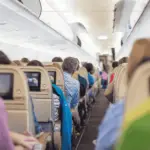
The troubling episode occurred on a Delta Air Lines domestic flight when ceiling panels began to detach mid-flight, forcing quick-thinking passengers to use their hands to prevent the structure from completely giving way. The aircraft, which was cruising at approximately 30,000 feet when the incident occurred, was carrying a full complement of travelers, including elderly passengers who could have been injured had the panels completely detached.
Multiple passengers were seen supporting the compromised ceiling structure with their raised arms while remaining seated, creating a scene more reminiscent of a disaster movie than a commercial flight experience. Eventually, flight attendants addressed the situation by securing the loose panels with bright yellow aircraft tape, a temporary fix that allowed the flight to continue safely but did little to reassure the concerned travelers.
Social Media Exposes the Incident

The incident might have remained largely unknown had it not been for social media. Footage of the passengers supporting the sagging ceiling quickly spread across various platforms, with one viral TikTok post garnering more than 208,000 views. The video clearly shows several passengers with their arms extended upward, physically supporting parts of the interior cabin ceiling that had come loose during the flight.
The video’s caption explained that a friend was aboard the Delta flight when the ceiling began to fail. After passengers manually held up the compromised sections for some time, cabin crew finally secured the panels with tape. The flight was eventually forced to return to its departure point in Atlanta, where passengers had to wait for a replacement aircraft to continue their journey to Chicago.
Compensation Controversy
Adding to passengers’ frustration was Delta’s reported compensation offer following the incident. According to the social media posts, affected travelers were offered just 10,000 air miles—valued at approximately $120—for their trouble, a sum many considered inadequate given the nature of the experience and the additional two-hour delay they faced while waiting for a replacement aircraft.
This compensation figure has sparked considerable online debate about appropriate remediation for passengers exposed to potentially dangerous situations and significant disruptions. Many commenters pointed out that the value offered seemed disproportionately small compared to the stress and inconvenience caused by a structural failure on an aircraft.
Technical Debate: Cosmetic Panel or Safety Hazard?
The incident has triggered discussions among aviation professionals and enthusiasts about the nature of aircraft ceiling panels and their importance to flight safety. Some comments on the viral video, purportedly from aviation industry workers, suggested that the panels in question were “purely cosmetic” and not critical to the aircraft’s structural integrity or flight capabilities.
One self-identified aircraft mechanic commented that such panel failures were not surprising, suggesting potential quality issues with the components. Others maintained that while the panels may not be structural elements essential to flight safety, falling interior components still present a very real danger to passengers—particularly if they were to strike someone during turbulence or detach completely.
The debate highlights the distinction between components critical to an aircraft’s airworthiness and those that, while not essential for flight, remain important for passenger safety and comfort. Many observers pointed out that even “cosmetic” panels can cause injuries if they fall on passengers, and the psychological impact of seeing parts of an aircraft interior failing at high altitude shouldn’t be dismissed.
Psychological Impact of In-Flight Incidents
Beyond the physical danger posed by failing interior components, the psychological effect on passengers witnessing parts of an aircraft apparently “falling apart” at cruising altitude cannot be overstated. As one commenter aptly noted, regardless of whether a component is technically classified as cosmetic or structural, “emotionally seeing a plane fall apart at 30,000 feet is not cool.”
Aviation psychologists have long recognized that incidents during flight can trigger intense anxiety reactions even among confident flyers. The feeling of helplessness, combined with the awareness of being thousands of feet above the ground in a sealed metal tube, can amplify stress responses to even minor technical issues.
For many passengers on this flight, the experience likely triggered genuine fear responses that may have lasting effects on their comfort with air travel in the future. Some aviation experts suggest that airlines sometimes underestimate this psychological dimension when calculating appropriate compensation for incidents that didn’t result in physical injuries.
Aircraft Maintenance Standards Under Scrutiny
This incident comes at a time when the aviation industry faces increasing scrutiny over maintenance practices and aging aircraft fleets. Major carriers like Delta operate hundreds of aircraft, many of which have been in service for decades with regular refurbishments and updates.
Interior components, while not subject to the same rigorous safety standards as engines or flight control systems, are nonetheless expected to remain securely attached throughout normal flight operations. The spectacle of passengers physically holding up failing ceiling panels has led some industry observers to question whether maintenance standards for cabin interiors are being consistently upheld.
Aviation safety experts note that while the interior panels themselves may not affect an aircraft’s ability to fly safely, their failure can indicate broader maintenance issues or aging infrastructure that deserves attention. Additionally, loose panels can potentially interfere with emergency equipment or procedures during a crisis.
Passenger Rights and Expectations
The incident highlights the sometimes contentious relationship between passenger expectations and airline responsibilities. Most travelers reasonably assume that all parts of an aircraft—whether essential to flight operations or merely part of the cabin interior—will remain securely in place throughout their journey.
Consumer advocates point out that passengers purchase tickets with the expectation of both safe transport and a certain standard of comfort and security. When these expectations are violated, as in the case of failing ceiling panels, the question of appropriate compensation becomes complex.
While airlines are typically required to compensate passengers for canceled or significantly delayed flights under various regulations, there are fewer standardized requirements for addressing the kinds of unusual situations exemplified by this incident. The reported compensation of 10,000 air miles (worth approximately $120) falls into a gray area where the airline has acknowledged the disruption but perhaps not fully accounted for the stress and inconvenience caused.
Industry-Wide Implications
This single incident, while fortunately not resulting in injuries, raises broader questions that could have ramifications across the commercial aviation sector. Safety regulators might use events like this to reassess inspection requirements for aircraft interiors, potentially leading to more stringent standards or more frequent checks of attachment points for ceiling panels and other interior components.
For airlines, the incident serves as a reminder that in the age of ubiquitous smartphones and social media, any in-flight irregularity can quickly become public knowledge, potentially affecting brand reputation and passenger confidence. The video of travelers physically supporting the aircraft ceiling has already been viewed hundreds of thousands of times, creating a public relations challenge beyond the immediate technical issue.
Maintenance teams across multiple airlines might also use this incident as a learning opportunity, reviewing their own procedures for inspecting and securing similar components to prevent comparable failures in their fleets.
Balancing Safety, Economics, and Passenger Experience
As the commercial aviation industry continues to navigate post-pandemic recovery and economic pressures, incidents like this highlight the delicate balance between operational economics and passenger safety and comfort. Airlines face significant challenges in maintaining aging fleets while keeping ticket prices competitive and meeting shareholder expectations.
Aviation safety experts emphasize that while the visual drama of a failing ceiling panel may seem alarming, most modern aircraft have multiple redundant safety systems for all critical components. The real danger in situations like this often comes from potential secondary effects: passengers being struck by falling panels, interference with emergency equipment, or the distraction created for flight crew members who must address the situation while continuing to operate the aircraft safely.
For passengers, the incident serves as yet another reminder of the complex reality behind modern air travel—a system that remains statistically very safe but occasionally reveals its vulnerabilities in ways that can be both frightening and disruptive.
The aviation industry has historically used even minor incidents as opportunities for system-wide improvements. Whether this ceiling panel failure leads to meaningful changes in maintenance procedures, inspection protocols, or passenger compensation standards remains to be seen, but it has certainly renewed conversations about what travelers should reasonably expect when they fasten their seatbelts and prepare for takeoff.