
Ryan Reynolds put Wrexham on the international tourist map a few years ago, when he and Rob McElhenney bought the local football team. More and more visitors have started coming to the city for football matches, many of them flying all the way from the States. And you know what? On a match day, it’s pretty hard to get tickets to see the game.
But Wrexham is so much more than its football team. I visited Wrexham at the beginning of September, expecting to see the city and explore the local attractions. And whilst there are plenty of interesting things to do and see in and around Wrexham, what stood out to me was the community. It’s the people who work together with so much pride in sharing Wrexham with visitors.
Wrexham is not just a city, but also a wider county borough in North Wales. In this two days in Wrexham itinerary, besides the football, I’ll take you along to explore both the city and the surrounding countryside, which offer some pretty amazing experiences. I mean, have you ever canoed over an aqueduct before, 126 feet above the ground?
Table of Contents
How to Get to Wrexham

I travelled to Wrexham from London on a lazy Sunday afternoon. I took a direct train from London Paddington to Crewe, where I changed for Chester. From here, a 10-minute connection took me to Wrexham. On my way back on a weekday, as I spent a bit of time exploring Chester, I caught the direct train from Chester to London Paddington. The entire trip duration is less than 2 hours.
You can travel to Wrexham by train also from Manchester and Birmingham via Chester.
If you’re planning two days in Wrexham, travelling by train is a convenient option for reaching the city. However, if you also want to explore the surrounding countryside and some of the attractions outside the city centre, you’ll need to plan your transport for those journeys separately or book a private tour that you can customise.
Where to Stay in Wrexham
The Lemon Tree – Sam

Sam owns the Lemon Tree Hotel and Restaurant, warmly welcoming his guests into a unique establishment set inside an old church. But don’t worry when the night falls. Since taking over the place, he has never seen a ghost.
I don’t know about you, but I would rather stay in a hotel with character when I am travelling. And sleeping in a building with history behind it, with walls which have probably seen quite a lot, makes a different experience from your usual hotel. Due to the central location, The Lemon Tree is also a great base for exploring the city and the surrounding area during your two days in Wrexham.
My room, facing the front of the building with its arched church door and limestone facade, was very cosy. I loved the comfortable bed which offered me a fantastic good night’s sleep after a full day exploring the city. In the morning, I woke up and made myself a cup of coffee which I drank in bed, before heading downstairs for breakfast.
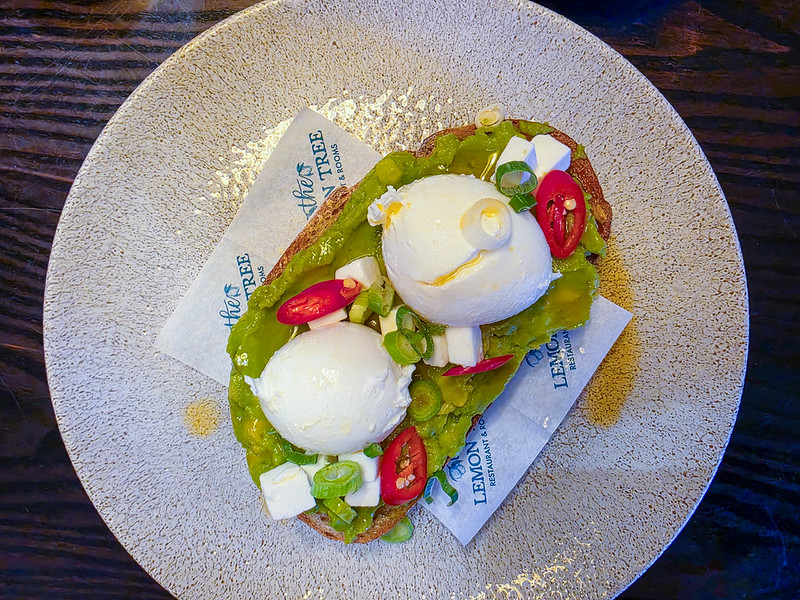
The menu for breakfast has plenty of options, from lighter dishes to a hearty full English. As I wasn’t that hungry, I opted for avocado and poached eggs on toast, served with feta cheese and slices of red chillies. It was delicious.
What makes a stay at the Lemon Tree so special is Sam himself. He seems to be everywhere, always ready to lend a helping hand whenever needed. One minute he is in the kitchen preparing breakfast, and the next he is putting together picnic boxes for our canoeing trip at Pontcysyllte Aqueduct. He even stepped in to help chef Alex prepare lunch for us on his day off at Bank Bistro, and he was also responsible for the wonderful spread at Stori Brymbo .
I don’t think Sam knows how to sit still! He is always finding something to do, someone to help or ways to make his guests feel welcome. And I think that’s why when I think back at my stay at the Lemon Tree, I smile. You might come to Wrexham for the football, the history or the surrounding countryside, but it’s people like Sam who make you feel at home, even when you’re miles away from your own.
Day 1 in Wrexham
A Street Art Introduction to Wrexham – Liam

A few years ago, Wrexham invested in local artists and invited them to express their creativity on walls and empty spaces around the city. Today, the project has grown into an art trail that tells stories of Wrexham and its culture through art, kindling emotions without needing spoken words.
Liam is a local artist with a small stall in Tŷ Pawb market, who coordinated the entire project. He also has a few pieces of his own around town, but he doesn’t brag about them. This was Liam’s first public tour around Wrexham and he did an incredible job. He has so much knowledge, not only about the artworks around the city but the local history in general. Listening him talk about Wrexham was such a pleasure. There is so much pride in the way he speaks about the city’s heritage and, of course, its football team. You can tell that the art trail wasn’t just a project for him but also a way to give life to otherwise empty walls, in the most beautiful way.
The mural that impressed me the most, the one that tells best a heartbreaking story though a simple, black and white image, is the one of a miner holding a canary in a cage. It’s a tribute to the 1934 Gresford mining disaster which took the lives of 266 people. The mural was created by Josh Colwell from Murwalls and, despite its complexity, took only a few days to complete.

Another mural I loved was Hiraeth, a Welsh word expressing a deep longing for home, or a sense of homesickness for Wales. The word is spelt out using local symbols, including patterns inspired by Wrexham Lager and the Hippodrome, which locals will recognise and identify with. I really liked the idea of using familiar details from the city to express a feeling that can be difficult to put into words. As someone who left my homeland and is living abroad, I identified with it in some way.
On Argyle Street, you’ll find several murals celebrating the 1876 Art Treasures Exhibition, which brought some of the most expensive and important works of art of the time to Wrexham. For four months, visitors could admire more than 1,000 pieces, including works by Rembrandt, Canaletto and Turner. In a corner of the mural there’s a reminder of the Wrexham sauce, which in its glory days was more famous than the Worcestershire sauce. We all agreed that it should be brought back into present-day.
Wrexham Brewery – Connor

Wrexham Brewery was established in 1882 by two Bavarian immigrants, Ivan Levinstein and Otto Isler, who brought their knowledge of German brewing traditions to North Wales. They chose Wrexham for its good-quality water, railway connections and the availability of deep cellars, which were useful for keeping the beer cool. The brewery grew into an internationally recognised business, exporting its lager far beyond Wales.
One of the fun facts I learned at the brewery was the story of a British soldier who found a bottle of Wrexham Lager at the palace in Khartoum. In 1898, he removed the label and sent it back to the brewery. It’s incredible that a bottle of beer brewed in North Wales travelled so far and ended up in such an unexpected place. Another interesting fact is that the brewery’s pub was the first in the UK to sell chilled beer, back in 1922.
I was lucky to go on a brewery tour with Connor, the master brewer, who learned the craft from Martyn Jones, who bought the original name for £1 back in 2001, when Carlsberg decided they don’t want the brewery anymore. The story of Wrexham Lager has had its ups and downs over the years. The original brewery closed in 2000, but the name and brewing tradition were brought back to life in 2011, when locals worked to revive the brand using its original recipe.

I couldn’t help noticing the similarities with Wrexham AFC. In both cases, passionate people were determined not to let something so important to the city disappear. They fought to keep these names alive, and today, both have found a new lease of life.
And then there’s the Titanic connection. Wrexham Lager supplied the White Star Line, the shipping company that operated the Titanic, and the beer is widely believed to have been served on board the ship during its ill-fated maiden voyage in 1912.
The brewery itself is very small, but production is growing, and you can see the operation expanding, with more stainless-steel brewing tanks appearing in the yard year after year. Connor speaks with passion about what he does and the work that goes into each batch of beer. He explained the ingredients that go into the brewing vessels and how each stage contributes to the finished product.
It’s easy to pick up a bottle of beer in a shop without giving much thought to where it comes from. With everything in Wrexham, there is a story and passionate people behind what makes a brand so much more than just a name.
Bank Bistro – Alex

Alex opened the doors of Bank Bistro on his day off and, with a helping hand from Sam, put on a delicious lunch for us. Alex has a family history in the pub trade that goes back generations. His grandfather owned three pubs in Wrexham, including the Golden Lion, which was the first in the city to serve food.
Of course, every good pub needs a story of its own! At the Golden Lion, there was a parrot called Cocky who used to sit on the bar, pinch customers’ nuts and drink their beer. I can only imagine the conversations that must have taken place around that bar, with Cocky helping himself to whatever took his fancy! And there’s the underground tunnels, but shhh, that’s still a secret.
Alex and Sam prepared a fantastic lunch for us, pairing the food with Wrexham beer. As the brewery doesn’t have a tasting room, Alex took it upon himself to create a menu that will pair with the lagers brewed here. We enjoyed teriyaki pork belly with corn purée, alongside whipped feta with za’atar and broccoli, with a side of zingy patatas bravas. Each of the elements was paired with one of the three beers brewed by Wrexham Brewery: Lager, Pilsner and Export Lager.
Visit St Giles’ Church – Alan, Petra and Catherine

The current St Giles’ Church was financed by Lady Margaret Beaufort, Henry VIII’s grandmother, and rebuilt on the foundations of a religious building dating back to 1220. It is believed that the medieval building, with its 135-metre-high tower constructed between the 15th and 16th centuries, is the third church to stand on this spot.
Usually, church guided tours are quite solemn, full of facts that we usually forget as soon as we step out the door. I have never been on a church tour more fun and entertaining than at St Giles’ Church. Alan, Petra and Catherine are an incredible team that made me wish the guided tour would go on forever. Here I am, a month later, in front of my computer, remembering all those facts that make St Giles’ so special, with a smile on my face.
Take, for example, the serving goat painted in the picture commemorating the tercentenary of the Royal Welch Fusiliers from 1989. Commissioned by the regiment and designed by Joseph Nuttgens, the painting shows soldiers in the different uniforms worn between 1689 and 1989, along with some of their battle honours. The goat is an active member of the regiment, with its own rank, house and wage.

If you look closely around the church, you will also find Gib, the church’s toy cat, which was sitting on the organ during my visit. St Giles’ once had what was considered the finest organ in Europe, back in 1894. Unfortunately, it was melted down, and the church went without an organ for 150 years.
There are plenty of other quirky details around the church, including a mermaid sculpture on one of the columns, dating back to the 1400s. Catherine has also conducted her own research into some of the stained glass panels that went missing from the church and managed to track them down all the way to Japan.
Some of the most important artefacts held by the church are a first-edition King James Bible, dated 1611, and a 1598 Danish Bible from the church’s chained library. No wonder St Giles’ Parish Church is one of the Seven Wonders of Wales!
Ringing the Bells – Diane

Whilst all of us were struggling to climb the uneven, narrow spiral staircase of the church tower, trying not to miss a step along the way, Diane was already at the top, unlocking doors and preparing the room for our arrival. She moved around as though climbing those stairs was the easiest thing in the world, whilst I was trying to catch my breath, wondering how much further we had to go!
We did climb all those steps to admire the beautiful 360 unspoilt view over Wrexham and the surrounding hills, but not just for that. We were there to have a go at ringing the bells ourselves. And wow, it’s hard! I don’t think I managed to pull hard enough to actually ring the bell. I just moved it a little bit. There I was, putting all my effort into the rope and hoping I was doing it right, whilst Diane made the whole thing look effortless.
She was pulling the rope with the strength of ten men, ringing the bells over and over again as she’s been doing her whole life. She became a bell ringer in 1955! She mentioned that they are in desperate need for bell ringers so, if you fancy having probably the most unique job in Wrexham, do apply!
The New Wrexham Football Museum

The new Football Museum of Wales and Wrexham Museum opened its doors for the first time, following years of redevelopment, on my first day in the city. Its brings together the city’s history, combined with Wales’s football heritage.
The museum is located inside the historic County Buildings on Regent Street, which have been transformed into a modern visitor attraction. Wrexham has a long history with football, as the Football Association of Wales was founded here in 1876. The new museum celebrates this connection, telling the story of Welsh football from grassroots clubs to the national teams, with plenty of interactive displays, memorabilia and historic objects along the way. But you don’t need to be a football fan to enjoy the museum. The attraction is divided into two main areas, each with its own story to tell. One side is dedicated to football, whilst the other explores Wrexham’s history, from its industrial and mining past to its communities.

I loved the section dedicated to women’s football. It’s great to see the women’s game given proper attention within a national football museum, with its own stories forming part of the wider history of the sport. Women’s football has often received far less recognition than the men’s game, so I was really pleased to see it represented here.
There are also plenty of interactive elements throughout the museum, making it a great place to visit with children. In fact, I couldn’t resist having a go myself! I was the first one to crawl through a tunnel and try out the interactive displays. I think these hands-on experiences make a real difference, because instead of simply looking at objects behind glass and reading information panels, you get to take part in the experience.
Dinner at the Boat at Erbistock

The Boat at Erbistock is one of Wrexham’s best riverside gastropubs, with a breathtaking location on the banks of the River Dee, surrounded by woodland on either side. The outdoor terrace overlooks the river and on warm summer days this would be the perfect location for a romantic dinner. Unfortunately, it was raining when I visited, so we had to settle for one of the cosy rooms inside the pub instead. Not that I was complaining, as the interior was rustic and very inviting, with wooden beams on the ceiling and nature-inspired decor throughout the pub.
The menu at the Boat brings together local favourites with a twist. For starters, I went for the root vegetable bhajis, accompanied by harissa and lime yoghurt, with roasted vegetables on the side. I liked the sweet-spicy combination of the dish, tempered by the fresh yogurt.

For the main course I chose the Cheshire venison steak, served with potato terrine, broccoli and an indulgent port and blackberry sauce. The steak was cooked perfectly, pink in the middle, which made it very tender. The blackberry sauce brought a lovely sweetens that paired so good with the rich gamy taste of the venison.
For dessert, I was happy I chose the panna cotta with amaretto biscuits and rum infused mandarins, as I don’t think I could have eaten another bite. But you know, there’s a second stomach for desserts that will accept light options.
Day 2: Beyond the City
The Turf and The Racecourse Stadium – Bryan and Wayne

The Turf is probably one of the most famous pubs in the UK, and thanks to Welcome to Wrexham, people now travel from all over the world to have a pint here. Some hope to bump into Ryan Reynolds, Rob McElhenney or another celebrity coming to visit. Others simply want to see the pub they have watched so many times on Netflix. The Turf has become an attraction in its own right, and an essential stop for anyone interested in the Wrexham story.
We arrived at The Racecourse Ground early in the morning, just as the doors were opening. We grabbed a coffee from the food truck in the car park and met Bryan and Wayne, two familiar faces to anyone who has watched the documentary. At this time of day, The Turf was still quiet. The cleaning crew was finishing mopping the floors, getting everything ready for another day of welcoming football fans and visitors. We sat down with our coffees and listened to Bryan tell us the fascinating story of Wrexham AFC, from its difficult years to its unexpected journey into the hands of two Hollywood actors.
The club was owned by its supporters before Ryan Reynolds and Rob McElhenney came along. Wrexham had been run by the Wrexham Supporters Trust since 2011, after years of financial difficulties that had put the club’s future at risk. When the Hollywood duo expressed an interest in buying it in 2020, supporters were very cautious. This was their club, and they wanted to make sure it would remain part of the community rather than become a short-lived celebrity project. Reynolds and McElhenney presented their plans to the supporters, promising to invest at least £2 million in the club and explaining their ambition to turn Wrexham into a global name while making a positive difference to the local community.

There were also important questions about the future of the stadium. The Racecourse Ground had been owned by Wrexham Glyndŵr University since 2011, when the university stepped in to help safeguard it during a difficult period for the club. In 2022, Wrexham AFC bought the stadium’s freehold, bringing ownership back to the club. The agreement included a commitment to keep the Racecourse Ground as Wrexham AFC’s home until at least 2115, unless the stadium could no longer meet the club’s requirements. It was an important reassurance for supporters who wanted to see the club grow without losing the place that had been its home for generations.
Listening to Bryan explain these events made me realise how much the club means to the people of Wrexham. The Netflix series may have introduced the town to millions of viewers, but the story began long before the cameras arrived.
The Turf itself has been part of that story for well over a century. It is thought to date back to the early nineteenth century, and it has a rather unusual claim to fame: it is the only pub in the UK built within the grounds of a football club. It is also widely recognised as the oldest public house at any sports stadium in the world. Wrexham AFC was formed in 1864, and the pub played an important role in the club’s early history. In its earlier days, footballers even used the pub as their changing rooms.
Wayne Jones, the landlord, has become a familiar face through Welcome to Wrexham documentary. Wayne has spent years building the pub into a welcoming place for regulars, football supporters and visitors alike. The attention that came with the takeover and the documentary has brought a huge increase in visitors, but the pub remains closely connected to its local community.
Bryan brings another side to the experience. He runs tours of Wrexham, sharing the story of the club and of the town through the eyes of someone who was born and raised here. His knowledge is impressive, but he is also extremely passionate. He speaks about the club with so much affection and understands the people and history behind its success. His tour is so personal and it gives you a much better sense of why Wrexham means so much to its supporters.
Getting tickets to a Wrexham match can be difficult, especially with the club’s growing international following. Visitors travel from across the UK and overseas hoping to watch the team play, and demand has put pressure on the stadium’s capacity. This is why currently the stadium is undergoing a major transformation. The new stand is being built to replace the old one behind one of the goals, with plans for a capacity of up to 7,750 seats. Once completed, the redevelopment is expected to take the stadium’s total capacity to just over 18,000 and restore its four-sided layout.
Stori Brymbo – Nikki

Nikki is a force of nature. With an incredible amount of effort, passion and determination, she has helped bring the story of Brymbo to life in one of Wrexham’s newest tourist attractions. She is a bundle of smiles and positive energy, with a warmth that made me feel we’ve been friends since forever, even though we’ve just met.
Stori Brymbo opened just a few months ago on the site of the former Brymbo Iron and Steelworks, which closed in 1990. For generations, the works provided jobs and life in the local community. Its closure left a huge hole, both economically and emotionally, after much of the site was abandoned.
Today, the story is taking a different direction. Stori Brymbo is supported by Brymbo Heritage Trust, a registered charity working to preserve the area’s natural, industrial and social heritage while creating new opportunities for the people who live here. The idea is to do more than turn an old industrial site into a visitor attraction. The project brings historic buildings back into use and creates space for education, events, volunteering and community activities. It connects the area’s past with its future, giving local people a reason to feel proud of their heritage and somewhere for visitors to understand the place beyond its industrial ruins.

Our visit began at the Fossil Forest, where we met Dr Tim Astrop, the palaeontologist leading the work to uncover and study this extraordinary site. It is hard to imagine what lies beneath the ground until you learn that the fossilised remains here date back around 314 million years, long before the dinosaurs roamed the Earth. The fossil forest was discovered by accident in 2003 during work at the former steelworks. Excavations revealed more than 20 fossilised tree trunks, complete with remarkably preserved root systems.
Dr Tim explained how students and researchers continue to work on the site, carefully uncovering layer after layer to learn more about the ancient landscape. The fossils formed during the Carboniferous period, when this part of the world was close to the equator and covered in dense, swampy forests. Over millions of years, the plant material helped form the coal that would later fuel the area’s industry.
From the fossil forest, we followed the path uphill, where we met another character from the past. Dressed in black trousers, a red coat, a white shirt with lace at the neck and cuffs, and a top hat, he leaned on a wooden walking stick and looked as though he had stepped straight out of another century. He led us through the story of Brymbo and introduced us to one of the people who changed the industrial history: John Wilkinson.

Known as “Iron-Mad” Wilkinson, he was an ironmaster and inventor born in 1728. He became famous for his innovations in cast iron manufacturing, including machinery that could bore more accurate cylinders for steam engines. His work helped make James Watt’s improved steam engine possible, and his influence extended across Britain’s growing iron industry. Wilkinson established the ironworks at Brymbo in the eighteenth century, laying the foundations for the industrial story that would continue on this site for generations to come.
One of the more unusual details we learned was that Wilkinson issued his own trade tokens. They were linked to his own shops, where workers could spend their earnings locally, keeping the cash inside the company. He is the only person outside of the monarch to have had his face on a coin.
Canoe Over Pontcysyllte Aqueduct

You have probably heard of the famous aqueduct where you can canoe 126 feet above the ground, with no safety railings on the canal side. But did you know it is in North Wales, just outside Wrexham? If you are looking for unusual things to do during two days in Wrexham, this is an experience you are going to remember for a long time.
Pontcysyllte Aqueduct is one of the most impressive feats of engineering in Wales. Designed by Thomas Telford, with William Jessop as consulting engineer, it was completed in 1805 to carry the Llangollen Canal across the River Dee valley. The structure is 307 metres long and rises 38.4 metres above the river, making it the tallest navigable aqueduct in the world. It has 18 stone piers supporting an iron trough that carries the canal water across the valley.
Pontcysyllte Aqueduct is a UNESCO World Heritage Site, recognised in 2009 for its importance in the history of engineering and the Industrial Revolution. Back when it was built, the canal was used to transport materials such as coal, iron, limestone and slate. Today, instead of carrying industrial goods, it brings visitors across the valley by narrowboat, canoe and kayak. It is often called “the stream in the sky”, and once you see it, you understand why.
As someone who has a fear of heights, it took courage to step in the canoe, on a tour run by T&R Outdoors. We shared a boat between two people, with the one sitting in the back responsible for steering. We started on a quiet stretch of the canal, with narrowboats moored along the banks. It was a great introductory paddle, before we reached the aqueduct, to get used to the canoe and the steering.
Once our instructor gave us the green light, meaning no other boat was coming from the opposite direction, we started our journey over the aqueduct. I am not going to lie, the adrenaline kicked in as soon as I looked to the side and seen the drop below. We tried to keep the canoe as close as possible to the pedestrian walkway, but sudden gentle gusts of wind would move us closer to the bare edge. I knew it’s safe and the worst thing that could happen was flip the canoe and get wet. Which was anyway pretty much impossible. My heart stood still a few times, but I continued paddling, taking in the view without looking down. The way back was much more relaxed.
If you don’t fancy jumping in a canoe, you can always walk across the aqueduct. But you know what they say, in life, you only regret the things you don’t do. The canoe gives you a different perspective and it’s so much fun once you get over the “omg, I’m so up high feeling”.
Erddig Historic House

Located just outside Wrexham, Erddig is a historic country house surrounded by gardens and a large estate. It was home to the Yorke family for almost 250 years, and today it is looked after by the National Trust. The house dates back to the late 17th century, with later additions transforming it into the residence you can visit today. It is known for its well-preserved interiors, impressive collection of furniture and decorative objects, and the stories of the people who lived and worked here.
People working at Erddig had a very interesting relationship with the owners of the house. In many historic houses, the focus is on the wealthy family who owned the property. At Erddig, the family was pretty much bankrupt even if they had such a beautiful estate. The people working here have their own place in history and I thought this is what bring thats human element that gives life to the property even today. As I walked through the ground-floor hallway I was struck by the different portraits of cooks, butlers, carpenters – all working at Erddig at some point through time. Some of the older potraits almost looked Photoshopped, if I dare using this word, with basic modifications in the most rudimentary way, which look unusual to the modern eye.

The photographing tradition began in the 1790s, when Philip Yorke I commissioned portraits of six members of staff. Over the following generations, the family continued to commemorate their servants through paintings, photographs and poems. The collection spans across 200 years and is considered one of the most remarkable records of domestic service in a British country house. Of course, it is difficult to know exactly what the family intended with these portraits. The National Trust notes that the reason behind this unusual tradition is not entirely clear. The Yorkes took a personal interest in their staff, and generations of the same families worked at Erddig, suggesting that these relationships could be close. At the same time, domestic service involved long hours and demanding work, and the family did not necessarily pay the highest wages. The portraits leave room for questions about the relationship between employer and employee, which makes them all the more interesting.
Chirk Castle

You could easily spend hours exploring 700 years of history at Chirk Castle, discovering the landscaped gardens or getting lost within the majestic rooms filled with historic objects. The castle was built around 1295 by Roger Mortimer, under the orders of Edward I, as part of a chain of fortresses designed to control the Welsh borderlands. It wasn’t originally intended to be a family home, but that changed in 1595, when Sir Thomas Myddelton bought the castle and began transforming it into a more comfortable residence. The Myddelton family lived here for more than 400 years, leaving their mark on the building and its interiors. Today, Chirk Castle is cared for by the National Trust, which looks after both the castle and its extensive gardens.
The weather wasn’t quite on our side during my visit. One moment the sun was shining, and seconds later the rain and wind were back. That seems to be Wales in autumn for you! We decided to warm up with a cup of hot coffee and a slice of freshly baked bara brith cake at the garden cafe, before exploring the grounds. If you’ve never tried it, bara brith is a traditional Welsh fruit loaf, made with dried fruit and soaked in tea to give it a rich flavour. It’s usually sliced and served with butter, making it a lovely treat alongside a hot drink. Ours had just come out of the oven, which made it even better on this cold day.
Once warmed up, it was time to explore the castle itself. Inside, you’ll find everything from medieval defensive features to elegant rooms filled with paintings, furniture and tapestries. The contrast between the castle’s original purpose and the more refined interiors added by later generations is striking. The Long Gallery, for example, dates back to the 17th century, whilst the State Rooms were remodelled in the 18th century with neoclassical decor.

There are some fascinating objects to look out for, too. The castle’s collection includes a Japanese chest dating from around 1600, decorated with intricate lacquerwork and mother-of-pearl, as well as a 1742 harpsichord made by Burkat Shudi. The library also holds a copy of Y Beibl Bach, a small Welsh Bible published in 1630, which helped make the written Welsh language more accessible to ordinary households.
One of the most interesting rooms of the castle, in my opinion, was actually empty. It had the most gorgeous view over the garden, and I could easily imagine sitting there with a book or a cup of tea, watching the seasons change outside the window. Our guide explained that this had been a private room used by the family, and that the last members of the Myddelton family had left their private quarters a few years earlier. The family agreed to vacate the remaining private areas as part of an arrangement with the National Trust that secured the future of the castle’s historic collections. The room had been left much as it was, apart from the furniture being removed. I tried imagining how the room must of looked like when it was still in use, but with only the wallpaper still present on the walls, my imagination was left to run wild.
I also noticed a small frame on the wall with a handwritten note inside. Dating from 1651, it recorded amounts of money hidden at Chirk Castle during the time of Oliver Cromwell.
Chirk Castle is well worth adding to your two days in Wrexham itinerary, especially if you enjoy history, architecture and beautiful gardens.
Stay at The Hand in Llanarmon – Jonathan and Jackie

Jonathan and Jackie moved to Llanarmon from London. Jackie worked in education, whilst Jonathan, born in North Wales, in music. The couple left their careers in London and moved to Wales to change the rush of the capital to a more slow-paced life. They bought the Hand in Llanarmon and transformed it into a slice of heaven, as the title of their published book, who they kindly gifted us, describes it. And it really is a slice of heaven. The tiny village only has a handful of houses, surrounded by the most beautiful scenery, with rolling green hills on which sheep graze peacefully. Being here makes you slow down without even realising it. The noise and rush of everyday life disappear, and you find yourself enjoying the simple things, like looking out at the hills from the hot tub in the garden, or sitting down for a meal without checking the phone.
We were welcomed by Jackie and Jonathan in the front room of the pub which feels like an intimate living room, centred around a fireplace. We clinked glasses of bubbly and chatted along among friends until it was time for dinner. Everything at The Hand aims to celebrate Wales. Jonathan, Jackie and chef Grant Mulholland put on a fantastic Welsh celebration for us with a three-course menu that brought together some of the best local flavours.

The starter was a Welsh rarebit with a twist, served on Welsh cakes with a dressing of Ceiriog Valley honey and a dark fruit chutney. I loved the idea of combining these flavours. The sweetness of the honey and fruit worked beautifully with the savoury cheese, creating a dish that was a little unexpected. It was a very interesting combination of sweet and savoury flavours that could have worked just as well as a dessert as it did as a starter.
The main event was the Welsh lamb rump, served with Glamorgan sausage, Cenarth cheese in cider, poached golden beetroot, cauliflower purée and braised leeks, alongside Caerphilly cheese Dauphinoise potatoes. Absolutely fantastic! For dessert, I enjoyed a great bara brith, caramel and Welsh ale cake, with a local Penderyn whisky caramel.
At the end of the evening, I couldn’t have wished for a more cosy room. The large king-size bed in the middle of the room was inviting me in, promising a very good night sleep, which it delivered. The room was decorated with French-style furnishings including vintage night stands and dressing table. The bathroom has the most elegant free-standing bathtub, which I took full advantage of.
Final Words
Wrexham surprised me. I travelled here knowing nothing more than the fame of the football team. I didn’t know what to expect. And to say that Wrexham has exceeded my expectations would be too generic and too bland. Wrexham is a community of people who, by working hard together, are creating magic in offering an entire experience to the visitor who might just end up here because of the football. There are so many things to do in and around Wrexham. So, even if you’re coming here just to see your favourite team, extend your stay and explore the city and its surroundings. You won’t regret it!
Like it? Pin it!

Disclaimer: Some of the links on this website are “affiliate links.” This means that if you click on the link and do a purchase, I will receive an affiliate commission at no extra cost for you. This helps me keep my website running and continue to share my travelling knowledge with you. I thank you for booking your flights or hotels using the links on my website. Regardless, I only recommend products or services I use personally and believe will add value to my readers.