Before visiting Newcastle, I knew very little about the region’s food. Like many people, I associated the city with football, the River Tyne and, of course, Greggs. So when I found out that this year’s Media Getaway was going to be in Newcastle I was excited not only to discover a city I had never visited before, but also to dive headfirst into its culinary scene.
Over three wonderful days, I explored the lively streets of Newcastle, the famous Grainger Market, but also had the chance to go beyond the city, North, and step into Northumberland for a day. I tasted as much as I could along the way, trying to find that traditional taste of Northumberland and discover what to eat in Newcastle and beyond. This article is the result of this delicious journey. And it wasn’t just the food that impressed me, but also the warmth and welcome of the locals, who are so proud of the land they live in and happy to share its stories.
The Cuisine of the Northumberland

For centuries, Northumberland was a rugged borderland where farming communities relied on hearty meat dishes to sustain them through long winters and uncertain times. Anglo-Saxon traditions, medieval farming and generations of butchers all helped build local flavours around quality local meat, rich pies and satisfying comfort food.
At the same time, Northumberland’s spectacular coastline provides an abundance of outstanding seafood. Fresh crab, lobster, oysters and fish feature heavily on local menus, while the famous smoked kippers of Craster have become one of the county’s most iconic delicacies. Add excellent local cheeses, independent bakeries, craft breweries and a growing number of innovative restaurants, and you’ll quickly realise that there is far more to the region than its famous stotties and sausage rolls. Though, as someone who always found the Greggs sausage roll to be a little bit underwhelming, the Geordie Banger proved me differently.
If you’re wondering what to eat in Newcastle or looking to discover the most typical food in Northumberland, these are the dishes, flavours and food experiences that made my first visit so memorable.
What to Eat in Newcastle and Beyond
Newcastle Staples
Geordie Bangers and Sausage Rolls

If there is one dish that I, and probably you as well, always associates with Newcastle, is the humble sausage roll. After all, Newcastle is the birthplace of Greggs, the bakery chain that turned the sausage roll into a national obsession. But while Greggs may have introduced generations of Britons to this beloved snack, the North East has plenty of places where the sausage roll is elevated to an art form.
The origins of the sausage roll can be traced back centuries, with meat wrapped in pastry appearing in European cuisines long before the modern version emerged in Britain. As industrialisation transformed the country during the 19th century, portable, affordable foods became increasingly popular among workers, helping the sausage roll become a staple of bakeries across the UK. Today, it remains one of Britain’s favourite savoury snacks, and nowhere felt more fitting to start my culinary journey through Newcastle than with one.
My first meeting with the “real” sausage roll was Geordie Bangers, a stall tucked inside Newcastle’s historic Grainger Market. The cheerful team behind the counter immediately welcomed us with samples, insisting that we try not only their famous sausage rolls but also their homemade sausages as well as their onion mince pie.

The sausage roll itself was exceptional. The filling was generous, wrapped in a light, flaky pastry that managed to stay crisp without becoming greasy. Geordie Bangers offers several varieties, from the classic Cumberland to more adventurous flavours such as jalapeño, but I opted for the traditional version. The sausage meat was rich and succulent, seasoned with sage, leek and onion, to create a perfect combination of warmth that really puts a smile on your face when you taste it. Alongside it, I tasted one of their signature Geordie bangers, beautifully charred from the grill and even better when dunked into mustard. Just when I thought I couldn’t eat another bite, the team insisted I try their onion mince pie. And I’m glad they did. The balance between the rich meat filling and the sweet sharpness of the onion was just wonderful.

The business has been family-run since 2013, when founder David McDonald drew on generations of butchery experience and family sausage recipes to create a range with a distinctly Geordie twist. That heritage and passion shines today through in every bite, I promise.

Another excellent place to try one of Newcastle’s finest sausage rolls is Pink Lane Bakery, just a few minutes’ walk from the train station. Their award-winning version is quite different from the traditional Geordie Bangers roll, but every bit as delicious. The first thing I noticed was the aroma of rosemary, followed by the smoky richness of pancetta woven through the filling. It was impressively large too, easily substantial enough to serve as lunch on its own. Apparently there’s always a queue here, and on the day I visited there was no exception. They bake everything on site, in the tiny bakery, but they have no seating areas. I grabbed my sausage roll to go, crossed the road to Charlotte Square to enjoy it overlooking Newcastle’s old city walls.
Local Northumbrian Cheeses in the Market

The first super exciting stop of the food tour around Northumberland for me, a massive cheese lover who is also lactose intolerant but suffers for it, was at Matthew’s Cheese, an institution in Grainger Market that has been serving the local community for more than 80 years. The shelves are full of local Northumbrian cheeses as well as a curated selection of British and European varieties. Only the best make it on the shelves here.
As much as I enjoy discovering local dishes when I travel, I am equally fascinated by regional produce, and Northumberland has some excellent cheesemakers. Our tasting focused on a selection of local cheeses, each with its own distinctive character and story. The first cheese I tried was Elsdon, a hard-pressed goat’s cheese produced by the Northumberland Cheese Company. Matured for around three months, it has a pure white colour and a delicate flavour that gradually develops into a refreshing tang. Goat’s cheese can sometimes be overpowering, but this one felt wonderfully balanced and approachable, with a clean finish that left me wanting another bite.
Next came Redesdale, another Northumberland Cheese Company creation. Rich and velvety in texture, it had a sweeter profile than I expected, followed by a pleasant tang that lifted the flavour. I could see it easily disappearing first from any cheeseboard.

Tynedale followed, and this was where the flavours became more assertive. With its smooth, cheddar-like texture and full-bodied character, it delivered a great depth of flavour that lingered on the palate.
One of the most interesting cheeses of the tasting was Berwick Edge, made at Doddington Farm near Wooler in Northumberland. Inspired by traditional Dutch Gouda-making techniques and aged for around a year, it develops a rich, complex flavour with hints of caramel sweetness alongside its stronger savoury notes. Despite its bold taste, the texture remains smooth, making it easy to keep going back for another piece.
My personal favourite, however, came from just across the border in Scotland. Captain’s Claret is a mature cheddar infused with claret wine, creating a wonderfully creamy cheese with a rich and intense flavour. Of all the cheeses we tasted, this was by far the strongest. The wine added an extra layer of depth that complemented the mature cheddar beautifully.
Brownies from Pet Lamb Patisserie

A notable mention to the brownies from Pet Lamb Patisserie in Grainger Market. They weren’t open on either of the days I was in Newcastle, but they kindly sent us rich brownies to try out. And let me tell you, they were delicious. So rich, and gooey – just as I like brownies.
Fusion Trends at Stack

While traditional Northumbrian dishes remain an important part of the region’s culinary identity, Newcastle has also embraced influences from around the world, with local chefs creating exciting fusion flavours that sit comfortably alongside local favourites.
A perfect example of this can be found in Newcastle’s Chinatown. The city is one of only a handful in the UK to have an official Chinatown, centred around Stowell Street and marked by its impressive Chinese archway. Even if it’s only one street long, as soon as I stepped on it I could immediately smell the inviting aroma of five spice and roasted garlic.
It was still a little early for dinner during our afternoon food tour, so rather than settling into one of the restaurants on Stowell Street, we headed to nearby STACK Newcastle to sample a different take on Asian-inspired cuisine.
Housed within the historic Worswick Chambers, a late Victorian building originally constructed between 1891 and 1898, STACK is breathing new life into one of Newcastle’s architectural landmarks. The restored building has become a vibrant social hub filled with independent food vendors, bars and live entertainment, showcasing the multicultural side of the city’s food scene. Keeping with the Chinatown theme, I ordered the crispy Peking duck bao bun from Bao Down, which arrived with a very generous meat filling topped with hoisin sauce, cucumber, spring onions and sesame seeds. The dish came accompanied by seasoned fries, with a light spicy kick. Simple delicious and, starting to notice a trend here, a huge portion again.
Beyond the City
On the third day of Media Getaway I joined a foodie tour around Northumberland, exploring both the coast and the inland. I discovered places that I would love to return to and explore more. We met Fran from Newcastle Tour Company in the city centre. She guided us the entire day, starting with a walk through Grainger Market where we tasted the earlier mentioned Geordie Bangers and Northumberland cheeses. I have to mention Fran because she was simply amazing. For the entire length of the tour she didn’t stop talking, sharing with us not just foodie facts but also local stories, traditions, and history of the lands we were passing through. She was like a human encyclopedia and I am so happy we had her as our guide, storyteller, and ambassador to Northumberland.
Seafood in Seahouses

With miles of dramatic coastline and fishing villages that have relied on the North Sea for centuries, fresh fish and shellfish are at the heart of the region’s cuisine.
Our first destination of the day was Seahouses, a cute fishing village on the Northumberland coast. The weather could not have been more perfect. The harbour was buzzing with visitors soaking up the sunshine, locals strolling alongside the promenade, and the irresistible smell of fish and chips from not one, not two, but three fish and chip shops clustered in the village centre. The road down to the harbour was lined with independent shops selling puffin souvenirs, seashell decorations and everything seaside décor.
Seahouses is also the main gateway to the Farne Islands, a group of rocky islands lying just a few miles offshore. Today they are famous for their wildlife, attracting thousands of puffins, grey seals and seabirds every year. In the 7th century, St Cuthbert chose to live here as a hermit, seeking solitude among the windswept islands. Legend says he became so close to nature that the birds gathered around him without fear, and even today one of the local seabirds, the eider duck, is affectionately known as “Cuddy’s Duck” in his honour.
We stopped for lunch at The Beach House, a beautiful seaside hotel blessed with one of the finest views in the village. From our table we could see the Farne Islands on the horizon, the lighthouse standing against the sea, the long stretch of golden beach below us, and, in the distance, the silhouette of Bamburgh Castle.

The chef had prepared a seafood feast showcasing the very best of the Northumberland coast. It began with freshly shucked local oysters, served on crushed ice with a vinaigrette and a bottle of Tabasco on the side for anyone who fancied a little extra heat.
As I’m allergic to crab, the chef kindly prepared a separate plate for me, with beautifully fresh local fish, smoked salmon and Craster kipper pâté. Smoked in the nearby fishing village of Craster using traditional methods that have been passed down for generations, the kippers are one of Northumberland’s most famous delicacies.
As we enjoyed our lunch overlooking the sea, the chef pointed towards a fishing boat making its way back from the Farne Islands, mentioning it is carrying the catch of the day. The traps are set on the other side of the island, and at this time of the day, the seafood was making its way to the shore, to end up on the diners’ plates for dinner.
Sustainable Lunch and Premium Whiskey at Ad Gefrin

Leaving the Northumberland coast behind, we headed inland towards the rolling Cheviot Hills, a landscape that couldn’t have been more different from the beaches and bays we had just left. Forming the natural border between England and Scotland, the Cheviots are a patchwork of green hills, heather-covered moorland and farms stretching as far as the eye can see.
It is a peaceful place today, but for centuries these hills witnessed constant conflict. During the Middle Ages, the Anglo-Scottish border was one of the most dangerous places to live. Families known as the Border Reivers regularly raided villages on both sides of the frontier, stealing livestock and defending their own clans in an endless cycle of feuds. Survival often depended on loyalty to your family rather than to any king.
It felt fitting that our next stop celebrated another important chapter of the region’s history. Ad Gefrin, located in the market town of Wooler, takes its name from the Anglo-Saxon royal palace of Yeavering, once the seat of the kings of Northumbria and one of the most significant royal centres in early medieval Britain. The vision behind Ad Gefrin is not to just produce English whisky, but to reconnect visitors with Northumberland’s ancient heritage through food, drink and storytelling.

The striking building itself reflects that ambition. Combining a modern whisky distillery with an immersive museum, its architecture draws inspiration from the great timber halls of the Anglo-Saxon kings while using contemporary materials to create a bright, welcoming space.
Lunch perfectly reflected Ad Gefrin’s philosophy of showcasing the best produce from Northumberland and the wider region. Instead of one large dish, we were served a beautiful selection of small plates that celebrated local ingredients and traditional flavours with a contemporary twist.
There were wonderfully crisp haggis bon bons served with caramelised onion, a pea, baby spinach and cheddar cheese quiche, and a rich game terrine accompanied by fig chutney and pickled red onion. Alongside these came smoked mackerel rillette with fresh sourdough bread, pistachio and apricot ham hock finished with parsley oil mayonnaise, gin-cured salmon gravlax made with Thirlings Gin and vibrant beetroot, and finally a delicate tuna tartare with preserved tomato and creamy avocado.

After our lunch, we explored the museum, which brings the lost royal court of Northumbria back to life through interactive displays and archaeological discoveries, offering context for the landscape we had been travelling through all day.

We then joined a guided tour of the distillery to learn how their whisky is made. As a relatively young distillery, Ad Gefrin’s own single malt is still quietly maturing in oak casks, patiently developing the complexity that only time can create. Rather than waiting years before releasing anything, they have created Tácnbora, a carefully crafted blended whisky made using whiskies matured in bourbon barrels, virgin American oak and Oloroso sherry casks. The result is a smooth and approachable whisky, layered with notes of vanilla, dried fruit, gentle spice and oak, offering a glimpse of the quality their future single malts will achieve.
Cakes Galore at the Running Fox Bakery

Our final foodie stop of the day was The Running Fox Bakery, a much-loved Northumberland institution that has earned a loyal following thanks to its homemade bakes, generous portions and warm Northumbrian hospitality. What began as a small bakery in a small remote village has grown into one of the county’s best-known independent bakery brands, with several locations across Northumberland. Despite its success, it has stayed true to its original philosophy: making everything by hand using quality ingredients and ensuring that nobody leaves hungry.
That quickly became apparent when our desserts arrived.
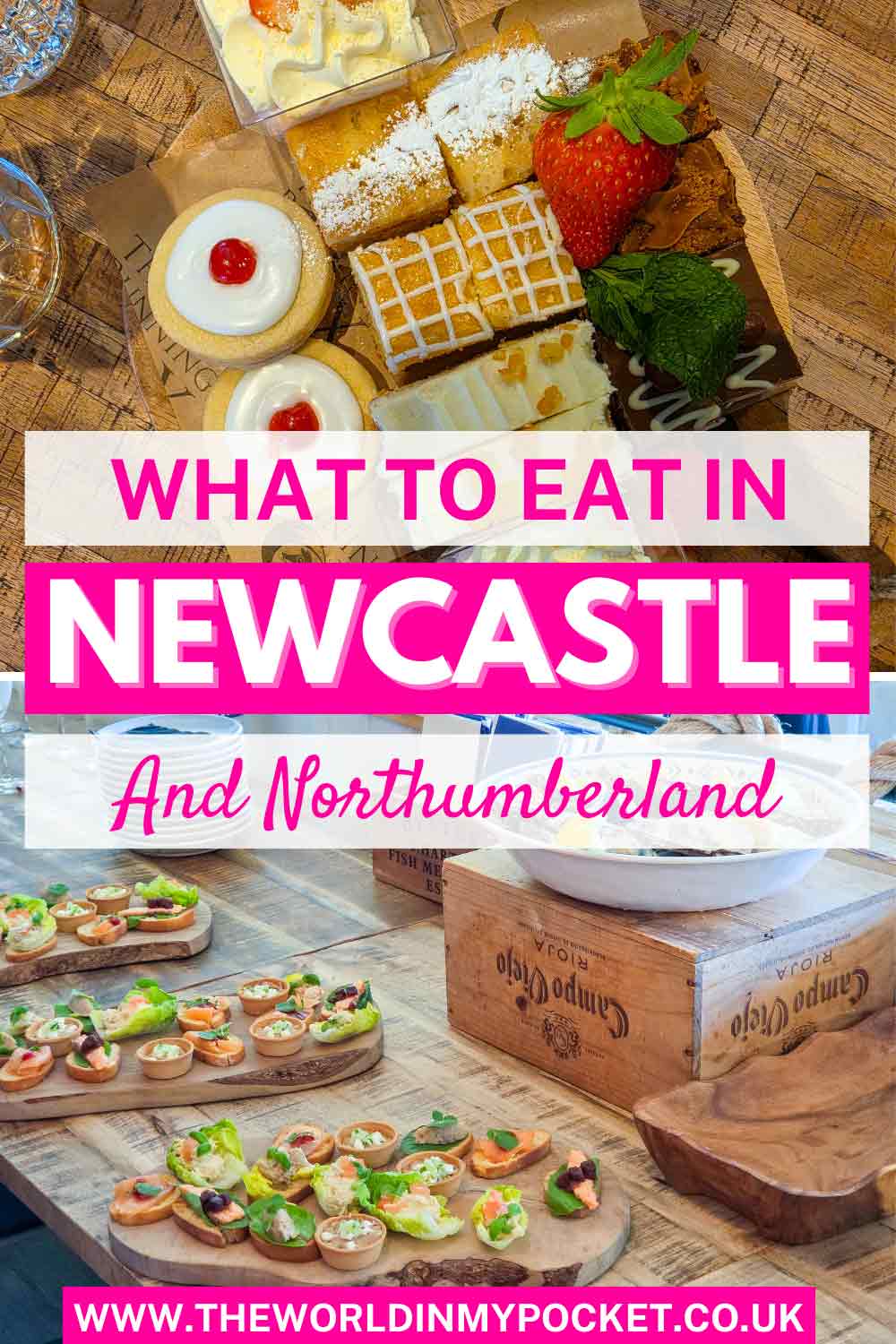
Rather than bringing out a single slice of cake, Kris, the owner presented each of us with an entire dessert platter. One glance at it was enough to make us all laugh. There was absolutely no chance anyone was going to finish everything in one sitting.
Fortunately, she knew that too.
After the platters reached the table, each of us received a very cute insulated picnic bag layered with a box, so we could take everything we couldn’t manage on the spot away with us.
The selection was pretty amazing. There was a creamy strawberry cheesecake, a traditional Empire biscuit sandwiched together with jam and topped with icing, a rich malt chocolate bite, a lemon and honey cake, a light Victoria sponge and an indulgent Biscoff brownie that disappeared much faster than I had intended.
Choosing a favourite was almost impossible, although the lemon and honey cake and the Victoria sponge stood for me.
Tasting Beer At Wylam Brewery

After a day spent travelling from Newcastle to the Northumberland coast and back through the Cheviot Hills, our final stop brought us back to the city for a well-earned drink. Waiting for us was one of Newcastle’s best-known breweries, Wylam, where we would discover that beer is just as much a part of the region’s food culture as seafood, cheese and hearty pies.
The brewery sits on the edge of Newcastle’s Town Moor, one of the largest urban commons in Europe. Covering around 1,000 acres, the Moor has remained unchanged for centuries and is still governed by ancient grazing rights. To this day, only Freemen of Newcastle, whose rights date back to medieval times, are entitled to graze cattle on the land. Not that anyone does I would think, as I haven’t seen a single one on the greens.
Wylam Brewery itself has an equally interesting story. Founded in 2000 in the village of Wylam, around ten miles west of Newcastle, the brewery quickly earned a reputation for producing modern, hop-forward beers inspired by the American craft beer movement. As demand grew, the brewery outgrew its original home and relocated to Newcastle, where it found an extraordinary new setting inside the Palace of Arts.

Originally built for the 1929 North East Coast Exhibition, the Palace of Arts is the exhibition’s only surviving permanent building. Once a showcase for the region’s artistic and industrial achievements, the beautifully restored Grade II listed building has found a new lease of life as both a working brewery and an impressive taproom.
Adam, the manager, poured a pint of Lush, one of one of Wylam’s most popular pale ales, for each of us. True to its name, it was wonderfully easy to drink, bursting with tropical fruit aromas balanced by gentle citrus notes and a refreshing finish, perfect to take along into the brewing room, where he explained the entire beer making process.
Final Words
Over the years, I’ve learned that the best way to learn about a new place is to sit down around a table, with locals. It’s not just about the flavours, but also about how food brings people together. And Newcastle and Northumberland made no difference. Before this trip, I knew close to nothing about the North East region of the UK. Now I know a little bit and I hope to return and find out more. Through not just food, but also the hospitable locals who are so welcoming and happy to share their stories and local traditions.
Fore more similar articles, check out my recommendations below:
Like it? Pin it!