
Last month I visited Durham for the first time, and let me tell you, I fell in love with the city. I spent two days in Durham and explored the spectacular cathedral city, as well as some of the nearby must-see attractions, like Beamish and Ushaw Historic House and Gardens.
I loved how vibrant Durham is. Beyond its impressive history and architecture, the city has a wonderful atmosphere, with independent shops, family run cafés and restaurants spilling out onto the pavements in front. As the shine made its appearance during my visit to Durham, the terraces were full of people enjoying coffee, lunch and spending time with friends or families.
I put together this 2 days in Durham itinerary based on my own experience, to show you why the city makes a fantastic city break from London and why you should consider it as your next staycation.
How to Get to Durham
Getting to Durham from London is much easier than you might expect. Despite being located in the North East of England, Durham is well connected to the capital, making it a great destination for a city break.
The easiest way to get to Durham is by train, directly from London’s Kings Cross station. If you are looking for a cheaper alternative, as we all know how expensive the long distance trains are, you can jump on the Lumo train to Newcastle. From there change to the local train, which takes just 10 minutes to reach Durham.
I travelled to Durham by train and then used local taxis and Ubers to move around, especially going to Beamish and Ushaw.
Where to Stay in Durham: Lumley Castle

Did you know you can stay in a real castle and embrace your inner princess when visiting Durham?
And I’m not talking about a castle that’s been turned into a modern building with a few historic features left behind, but an actual medieval castle where you climb stone staircases, sleep in rooms full of character and wake up feeling like a princess. If you’ve ever dreamed of living like royalty, even if it’s just for a night or two, Lumley Castle is the place to stay at.
The first thing I noticed when I checked in was Lady Poppet, the resident cat, who is a real lady, with a certificate of nobility. As a cat lover, that was a huge plus.
Built in 1388 by Sir Ralph Lumley, Lumley Castle has watched over the River Wear for more than six centuries. During that time it has been a family home, a place of refuge during turbulent periods of English history and, according to local legend, the setting of several ghost stories. Today, it has been beautifully transformed into a four-star hotel, allowing guests to experience a little of that history while enjoying all the comforts of a modern stay. Thankfully, I didn’t meet Lady Lumley, the resident ghost, during my stay here.
My room was on the first floor, reached by climbing a medieval spiral staircase that I thought belonged in a museum. Outside my door stood a carved stone lion guarding the corridor, while the window overlooked the castle’s peaceful inner courtyard.

The room itself couldn’t have been more different from a standard hotel room. A huge bed – fit for a princess of course – dominated the space, next to a large fireplace and facing a beautiful bay window that filled the room with natural light. Every corner seemed to reveal another original feature, from the panelled walls and squeaky floors to the heavy wooden furniture.
The biggest surprise, however, was the bathroom. For several minutes I walked around the room, not being able to find it. Eventually, I discovered that the door was cleverly hidden within the wall beside the wardrobe. Inside, the bathroom continued the castle’s historic character, complete with a beautiful Victorian-style toilet and walls decorated with antique murals. It felt so quirky!

Breakfast was served each morning in the Knights Restaurant, the castle’s atmospheric dining room. A continental buffet was laid out in the adjoining room, while hot dishes could be ordered from an à la carte menu. On my first morning, I chose avocado on toast topped with two perfectly poached eggs. The following day I couldn’t resist the eggs royale, which arrived with perfectly cooked eggs once again. It was the right start before heading out to explore Durham for another day.

I really felt like a princess staying here, and set time aside to actually explore the grounds and the castle, and not just use it as a place to just sleep at night.
Day 1 in Durham
A Step Back in Time at Beamish Museum

I had wanted to visit Beamish Museum for years. Every time someone mentioned it, I could only imagine how amazing this place is, but somehow, I never made it to this part of the country, so Beamish remained on my travel wish list. Until last month.
The idea of a living museum has always fascinated me, and that’s why I have visited quite a few in my travels around the world. They are a way to transport our imagination of how our ancestors used to live in the past, from our minds into reality. Even if it’s just a room, the inside of a house, a bakery where cookies are still baked following 1950’s cookbooks, or a farm from the 1940’s with a yard full of animals. Beamish is no different, and lived up to my very high expectations.
If you’re following my Durham itinerary, I’d recommend arriving as close to opening time as possible. Beamish is one of the North East’s most popular attractions, and queues can build quickly. I waited for half an hour in the queue, and I was there early. The museum covers more than 350 acres, with historic trams and buses connecting different areas, so you could easily spend an entire day here. But today, I am only going to spend half a day and try to see as much as possible.

Beamish is made up of several immersive areas, each recreating everyday life from a different period in North East England. There’s the Georgian landscape of the 1820s, an Edwardian town complete with shops and different businesses, a 1900s pit village, a 1940s farm, and a 1950s town that has a hairdressers where you can get your hair done. I wish I had time for that! Each area is brought to life by staff and volunteers wearing period clothing, most being more than happy to share stories about the places they are in.

The first place I visited was the railway station, which is the nearest stop after the visitor’s centre. I was hit by the unmistakable smell of burning coal and hot oil before I even saw the engines. For a brief moment I wasn’t in Durham anymore. I was back in my childhood. My parents worked for the Romanian national railway company, and my hometown happened to be home to the country’s only collection of preserved steam locomotives. Back then it wasn’t a tourist attraction but where old engines were stored and repaired. I spent countless afternoons wandering between them while my parents were at work. The mechanics all knew me, and usually let me climb aboard and even ride the engines between the workshops. My favourite part was always pulling the whistle. Standing at Beamish decades later, surrounded by the same familiar sounds and smells, brought back memories I hadn’t thought about in years.
After treating myself to some chocolate and a bag of wine gums from the confectionery in the 1900s Town, I walked into the travel agency. That’s where I met Harry, one of Beamish’s volunteers, who has been dedicating his time to the museum for the past 21 years. He proudly told me that he would be turning 80 in March and, when he heard that I was a travel writer, insisted that I write down his name so I wouldn’t forget him. I could have never, he was such a character!

What began as a conversation about the first voyages to Canada in the early 20th century soon turned into Harry sharing stories of his own. The eldest child in the family, he left school at the age of 15 to work in the coal mines, helping supporting his mother and siblings. I expected him to tell me how difficult the work had been, but instead he spoke about it with excitement. He remembered the cage dropping down the mine shaft at around 22 miles an hour and described the experience with a smile, as though he was recalling an exciting adventure rather than one of the hardest jobs imaginable.
Later that day, when I visited Beamish’s recreated 1900s Pit Village, I couldn’t help but picture Harry as a young miner starting his working life underground.
Before I left, Harry told me that the following day he would be volunteering in the bank instead of the travel agency. I had already visited the bank earlier that morning and admired the old coins on display, which prompted him to proudly show me his collection of replica coins and pocket watches he carried as part of his costume.

When it came to food around Beamish, there are plenty of options in each of the areas of the museum. I started the morning with a coffee in the cosy pub of the 1820s Landscape, stopped for a traditional pork pie in the 1900s Town pub, and finished with a Cornish pasty in the 1940s town. Enough to keep me full until dinner. If the queues wouldn’t have been too long for my time left at Beamish, I would have definitely loved to grab some fish and chips as well. I spotted two different places selling fish and chips, and the smell was trying so hard to lure me in. I did however buy a fish and chips Beamish fridge magnet, from the souvenir shop at the exit.
Visit Ushaw Historic House and Gardens

After spending the morning at Beamish, I made my way to one of Durham’s lesser-known gems, Ushaw Historic House.
Ushaw was founded in 1808 as St Cuthbert’s College, a Catholic seminary established to train priests after centuries of religious persecution in England. It was hidden behind the Victorian façade, so nobody knew what is going on behind the walls. Over the following two hundred years, it grew into one of the country’s most important centres of Catholic education, with impressive Victorian buildings added as the college expanded. Today, after the seminary closed, Ushaw has reinvented itself as a heritage attraction, preserving its remarkable architecture while opening its doors to visitors through exhibitions, cultural events, community activities, as well as accommodation. Yes, you can book a room and stay here overnight, having the entire grounds to yourself after closing hours.
One of the highlights of my visit happened by chance, when I met Sanjay, Ushaw’s marketing manager, at the entrance. Walking around the building with him and listening to how passionately he talked about the building and its history, made such a big difference compared to if I would have just visited by myself.
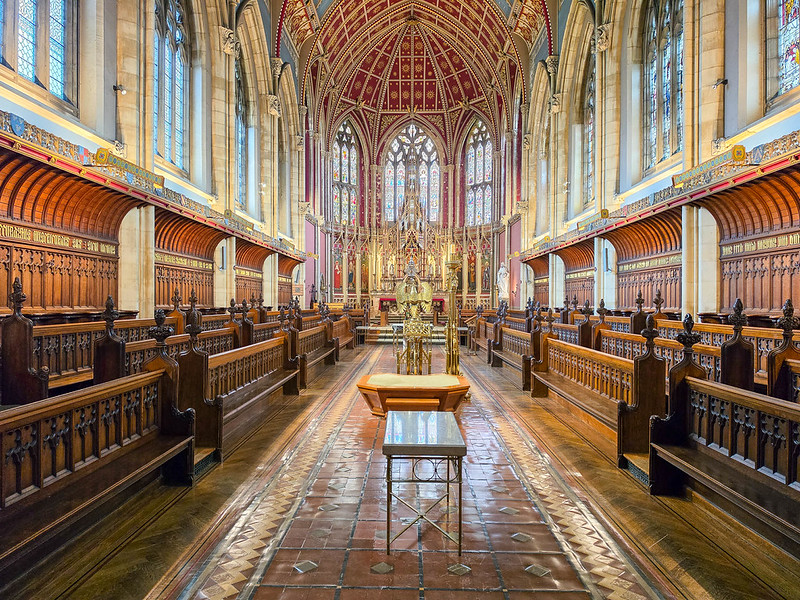
The first place we visited was the chapel, which was so beautiful it took my breath away. I have visited many churches and cathedrals in my life, and this chapel could easily rival the most beautiful I’ve ever seen. The vaulted ceiling was decorated with blue and red, something I haven’t seen before. The stained-glass windows behind the altar filled the space with a soft light, making the carved wood and limestone walls shine golden. It was so hard to imagine I was in a former college chapel and not in a mighty cathedral.

From there we walked through a long corridor to the workers’ chapel, built for the craftsmen and labourers who helped construct and maintain the estate. The contrast was striking. Much smaller and far more modest, it was still impressive through the large stained glass windows behind the stone carved altar.
Ushaw House doesn’t attract visitors solely because of its historic importance. While the architecture alone is worth the visit, the house hosts temporary exhibitions encouraging visitors to return. Once a year they also host an artist residency program where a couple of creators spend a month here to get inspired, and then their creations are displayed the following year.

During my visit, several rooms were filled with wedding dresses, most of them donated by employees and people connected to Ushaw. Some dated back to the early years of the twentieth century, offering a glimpse into changing fashions and family traditions over more than a century. As we walked around, preparations were also underway for a dinosaur exhibition aimed at younger visitors that was due to open the following weekend.
Ushaw is surrounded by a beautiful garden, where I spent a little bit of time after visiting the house. I just missed the rhododendron season, but the roses were already in bloom, adding a splash of colour to the woodland. The garden is tended by volunteers and you can see their passion in the landscaping and healthy flowers.
Dinner In a Real Castle

After a full day exploring Beamish and Ushaw, I returned back to my hotel, Lumley Castle, for a couple of hours to unwind before dinner. The castle is surrounded by woodland and there is a peaceful circular path between the forest, alongside a river, crossing a stone bridge. The late afternoon light was filtering through the leaves, catching the long grass and dotting the foliage with warm rays.
Back to the hotel, it was time for dinner at the award-winning Knights Restaurant. Located on the ground floor of the castle, the dining room was arranged around stone pillars that supported the medieval vaulted ceiling. The atmosphere was quite intimate, with dimmed lights and plenty of space between the diners.
To start, I chose the grilled scallops with chorizo, served on a homemade brioche bun with nduja mayonnaise, crispy onions and a drizzle of parsley oil. I loved the balance between the chorizo and spicy nduja mayo, which sometimes can be overpowering, and the delicate sweetness of the scallop.

For my main course, I couldn’t resist the 12-hour slow-cooked braised beef served with creamy mashed potatoes, buttered tenderstem broccoli and a rich Bourguignon sauce. The waitress congratulated my choice and told me it’s one of the most popular dishes on the menu. Looking around me, I could see quite a few other diners went for it. The beef was super tender, falling apart with the touch of my fork. There was so much flavour in each bite, and the sauce was making it even more delicious.
After dinner, I wasn’t quite ready for the evening to end. I wandered back outside and walked towards the golf course surrounding the castle. It was completely quiet, with not another person in sight. The sun was slowly disappearing behind the trees, covering the grounds in a warm orange light.
Day 2 in Durham
Visit Durham Cathedral

I started my second day in Durham with a visit to the city’s most famous landmark, Durham Cathedral. Sitting high above the River Wear alongside Durham Castle, it dominates the skyline from almost every angle. The best views are from the water, but about that, a little bit later.
Built between 1093 and 1133, Durham Cathedral is considered one of the finest examples of Norman architecture in the world. Together with Durham Castle, it forms a UNESCO World Heritage Site, recognised not only for its remarkable architecture but also for its importance in English history.

The interior is as impressive as the exterior, with massive stone pillars with intricate geometric patterns, stained-glass windows and large scale sculptures. But amongst all the grandeur, there are some hidden gems dotted around the Cathedral that will make you smile. Like the stained glass window sponsored by Marks and Spencer’s which depicts the Last Supper in sprouts form. Yes, you’ve heard that right.
The cathedral’s story begins long before the building itself. After St Cuthbert died in 687, his body was laid to rest on the Holy Island of Lindisfarne, where he quickly became one of the most important saints in northern England. However, when Viking raids threatened the monastery in 875, the monks fled, carrying St Cuthbert’s coffin with them to protect his remains.
For more than a century, they wandered across northern England searching for a safe place to settle. According to legend, their journey came to an unexpected end in 995 when the coffin suddenly became too heavy to move. Unsure what to do next, they overheard a milkmaid telling someone she was searching for her lost dun, or brown cow, which she believed had wandered to Dun Holm. Seeing this as a sign from God, the monks followed her to a wooded peninsula surrounded by the River Wear. There they built a simple church to house St Cuthbert’s shrine, and over time a settlement grew around it. That settlement would eventually become the city of Durham.

The Norman cathedral that stands today was begun in 1093 under Bishop William of St-Calais to provide a grander home for St Cuthbert’s shrine. It later became the resting place of another great figure of the North East, the Venerable Bede, whose tomb still attracts visitors from around the world. More than 900 years later, the cathedral continues to be a place of worship while welcoming millions of visitors each year.
I joined the guided tour with volunteer Charles, and it turned out to be one of the highlights of my visit. You know you’ve found an excellent guide when the tour overruns and nobody seems to mind. Charles had an incredible knowledge of the cathedral and somehow managed to answer every question that was thrown at him. What I enjoyed most, though, was his sense of humour. He filled the tour with fascinating stories and little details that brought the cathedral to life.
One of these stories relates to the Prior’s Clock. During the English Civil War, thousands of Scottish prisoners were held inside the cathedral after the Battle of Dunbar. In desperate attempts to keep warm during the harsh winter, they burned much of the cathedral’s wooden furniture. Remarkably, they left the medieval clock untouched. According to local legend, they spared it because it bears a carved thistle, Scotland’s national emblem.

I returned to the Cathedral later that day, because I had to leave as soon as the tour finished, to catch the river boat cruise. At that time, the Cathedral was almost empty of visitors. I found it very peaceful to walk at my own pace and look more closely to the places pointed by Charles during the tour. As I was about to leave, an orchestra composed of students started rehearsing for their evening concert. The space filled with sounds of violins, flutes, contrabasses and a piano. I found a seat and just listened for a while, feeling lucky to have such a private performance, just for me.
Enjoy a River Boat Cruise

Durham is beautiful and charming, but don’t miss explore the city from the water as well. The Prince Bishop River Cruiser has been run by Jamie for more than a decade. He isn’t just the owner of the boat, but also its skipper and a very knowledgeable guide.
The cruise lasts around an hour and offers some of the best views of Durham. Seeing the cathedral rising high above the banks of the River Wear is a completely different experience from admiring it from the streets. From the water, you really appreciate why the Norman builders chose this dramatic peninsula for one of England’s most impressive cathedrals.

One of my favourite parts of the cruise was learning about student life in Durham. The university has been at the heart of the city for almost 200 years, and many of its traditions are still very much alive today. Jamie told us about Rag Week, a long-standing student tradition that originally involved harmless pranks. In the late 1970s, Durham students took things a little too far when they managed to break into the city’s prison, leave a box of chocolates for the governor and then escape again without being caught leading to the event being banned for years after. These days, Rag Week has a much calmer reputation and focuses on raising money for local charities instead.
Rowing is another very important element of university life in Durham. As we cruised along the river, we passed several boathouses, each belonging to one of the university’s colleges and painted in its own distinctive colours. Jamie explained how a lot of students are taking rowing as their chosen sport, with the University having one of the highest performance programs in the country.
Have Lunch at Vennels Café

Curiosity made me follow a narrow alley with uneven steps between old buildings, discovering “that Durham quirky café”, as they proudly call themselves. I managed to get a seat in the little courtyard with bright yellow walls and ordered lunch: the soup of the day, a roasted pepper and tomato soup served with a grilled cheese sandwich and a fresh side salad. Delicious!
This little courtyard is home to Vennels Café, a place with far more history than I expected.
According to local stories, this is where the mustard we know today may have originated. Back in 1720, Durham resident Mrs Clements discovered that grinding mustard seeds into a fine powder produced a much stronger and smoother flavour than the coarse mustard commonly used at the time. By removing the husks and stems before milling the seeds, she created a mustard that was far more pungent and refined. As the story goes, she took her recipe to London, where it was served to King George I. He was said to enjoy it so much that the product was patented, helping to establish English mustard as we know it today.
Today, the historic building has been transformed into a cosy café serving breakfast and lunch, with an emphasis on homemade food. And when they say homemade, they really mean it. Everything is prepared in-house, from the soups and scones to the cakes.
Explore Durham at Your Own Pace

Durham is a city very easy to explore on foot and most of the attractions are walking distance to each other. My first wow encounter with the city was from the taxi, travelling from my hotel in Chester-le-Street to Durham Cathedral, when I spotted a glimpse of the castle on top of the hill, whilst crossing a stone bridge. From there, the streets became narrower and narrower, with pretty old buildings on each side. I spotted the market whilst at a traffic light and made a mental note that I have to come back here.
A lot of Durham’s charm comes from its beautiful architecture. Elegant Georgian buildings stand alongside medieval houses, while narrow cobbled streets open onto lively squares lined with independent cafés and shops. Everywhere you look, there’s a blend of architecture that just makes sense together.

The Market Place has been the heart of Durham for more than a Millennia. It’s a lively square surrounded by historic buildings, restaurants, street vendors and buskers playing live music. On one side there’s the market, where you can find everything for the home, from fresh fruits and vegetables to meat and fish, from pots and pans to garden products.
Final Words

Do you want to feel like a princess for a night? Durham can make that happen. Do you want to see one of the most impressive cathedrals in the UK? Durham has that too. Do you love discovering independent shops, cosy cafés and restaurants with centuries of history behind them? You will find plenty of those in Durham. Do you want to step back in time and experience a place where history is still very much alive? Durham is waiting for you.
For more similar articles, check out my reccomendations below:
Like it? Pin it!

Disclaimer: Some of the links on this website are “affiliate links.” This means that if you click on the link and do a purchase, I will receive an affiliate commission at no extra cost for you. This helps me keep my website running and continue to share my travelling knowledge with you. I thank you for booking your flights or hotels using the links on my website. Regardless, I only recommend products or services I use personally and believe will add value to my readers.