I went to Dresden for the first time last year, and if I’m being honest, it wasn’t originally the city itself that drew me in. I was there to attend the Dresden Carnival. Yes, Dresden has a Carnival, and a surprisingly spectacular one at that.
I arrived to Dresden by train from Prague and by the time I boarded the tram to get to my hotel, the sun starting setting. I remember crossing the city centre, looking on the window, passing seamlessly from a modern cityscape with glass buildings to the most unreal Baroque Renaissance scenery with blackened bricks and imposing statues. All in the time span of around 10 minutes. Because I had time before the carnival, I explored Dresden at my own pace. And this is how this one day in Dresden itinerary was born. But before I dig into it, I want to tell you a little bit about the Carnival, because it’s such an amazing opportunity to visit the city.
Inspired by the famous Carnival of Venice, Dresden’s Carnival dates all the way back to 1553, when Duke Moritz, Elector of Saxony, brought Venetian flair to his court. As the Grand Tour became increasingly popular, so did the celebrations. Italian opera performances, elaborate processions through the city, theatrical spectacles and even battle reenactments became part of Dresden’s winter calendar. By the mid 1600s, the Carnival had grown so large that it lasted an entire month.
All of that came to an abrupt halt in 1756 with the outbreak of the Seven Years’ War, after which the Carnival disappeared entirely. Until very recently.

In 2024, a group of passionate enthusiasts brought the Dresden Carnival back to life. There had been smaller attempts in the years before, but last year marked its full and official return. As someone who took part in it, I genuinely wouldn’t have guessed that this was only its second modern edition. The costumes, the atmosphere, the attention to detail all felt incredibly polished and so well organised that it felt it was going on for years.
While the Carnival was the main reason for my trip, I also carved out time to explore Dresden properly. If you only have a day in Dresden, this is how I’d recommend spending it.
Morning in Dresden
Breakfast at Conditorei Kreutzkamm

I like to start any city break with a proper sit-down breakfast, and Dresden didn’t disappoint. I was recommended Conditorei Kreutzkamm by my followers on BSky and I am so glad I managed to eat there.
The story of Kreutzkamm begins in 1825, when a 25-year-old Heinrich Jeremias Kreutzkamm applied for a licence to open a confectionery shop in Dresden. His idea was simple but ambitious: to create a café offering high-quality sweets at reasonable prices. It was his son, also named Heinrich, who truly brought that vision to life and turned Kreutzkamm into a household name.
From the outside, the café is surprisingly understated. Set in a shopping area, it’s easy to walk past without noticing it, especially if you’re distracted by shop windows or heading somewhere with purpose. But once inside, everything changes.
The interior has a turn-of-the-century feel, warm and slightly old-fashioned in the best possible way. Behind the counter, you’re faced with an almost overwhelming selection of cakes and pastries, all beautifully displayed. The smell of freshly brewed coffee fills the room, making decisions even harder.
I went for a sweet breakfast. There was no way I could resist those cakes smiling at me from the display. I chose a sour cherry pie, generously filled and perfectly balanced between sweet and tart, paired with a cup of hot coffee.
Schlossplatz and a Stroll Along Brühlsche Terrasse

After breakfast, I walked towards Schlossplatz, one of Dresden’s most historically dense squares. This is where the city’s political and royal power was concentrated for centuries, and even today it feels grand. The square is framed by some of Dresden’s most important buildings, including the Residenzschloss and the Hofkirche, and standing here gives you a real sense of how significant Dresden once was within Europe.

From Schlossplatz, I continued onto Brühlsche Terrasse, often called the “Balcony of Europe”. The terrace was originally part of the city’s fortifications, built in the 16th century to defend Dresden. In the 18th century, Count Heinrich von Brühl transformed it into a promenade, opening it to the public and turning a military structure into a space for leisure and views.
Walking along the terrace today, with the Elbe flowing below and historic buildings rising behind you, it’s easy to see why this spot became so beloved. There is a lot of beautiful architecture to observe along the way, and I easily spent a couple of hours just taking photos and gazing at all those small details on buildings. You can also opt for a very insightful city tour that will give context to the surrounding buildings and introduce you to the most important sights in Dresden in less than two hours.
Visiting the Frauenkirche Dresden

The Frauenkirche is impossible to miss. Back in 2009, when I went Interrailing around Europe for the first time, I remember spotting it from the train. For some reason our train stopped on a bridge, and all I could see was the impressive cupola of the cathedral. And that image stayed with me until today. Originally completed in 1743, it was considered a masterpiece of Protestant baroque architecture, something quite rare at the time. Its enormous stone dome was an engineering marvel and dominated Dresden’s skyline for centuries.
During the bombing of Dresden in February 1945, the Frauenkirche collapsed after burning for two days. For decades, its ruins were left untouched as a war memorial. Seeing photos of the rubble makes the reconstruction even more powerful. Completed in 2005, the rebuilding used original stones wherever possible, which is why parts of the exterior appear darker than others.
Inside, the church feels light, almost uplifting, with pastel colours and a circular layout that draws your eyes upward, towards the painted ceiling. The entrance is free but you can opt for a very affordable guided tour if you want access to the gallery of the church and learn more about the art inside.
Dresden’s New Square and Old Town Streets
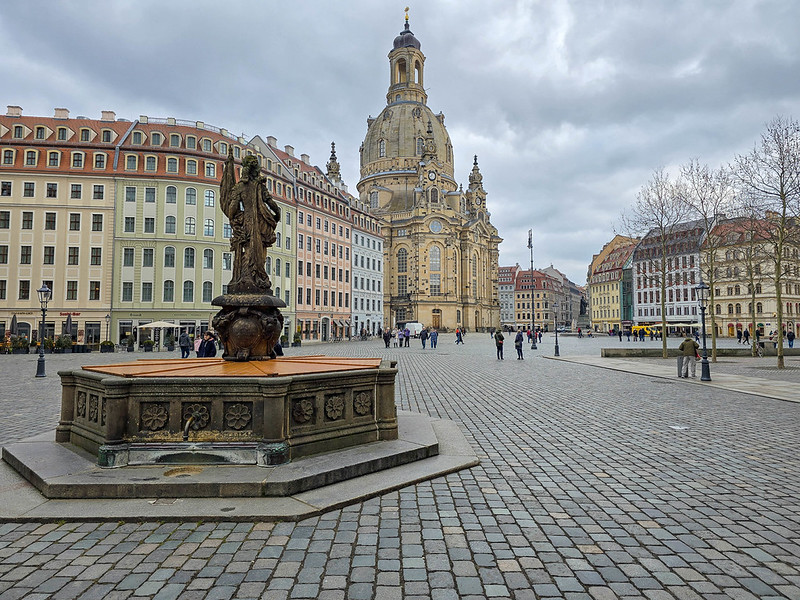
Wandering through Dresden’s main square and surrounding streets felt like changing centuries when I turned corners. Much of what you see today has been carefully reconstructed after World War II to be the same as before, and let me tell you, you can’t tell this city was almost eradicated from the face of the Earth!
This area was historically the heart of civic life, hosting markets, festivals and public gatherings. Even now, it buzzes with activity. It’s February and there is still some sort of winter market going on. Street musicians, cafés spilling onto pavements, and people lingering rather than rushing, all contribute to a relaxed atmosphere. Plus, the architecture around the square is, again, worth stopping for and observing for more than just a few seconds.
Visiting the Royal Palace

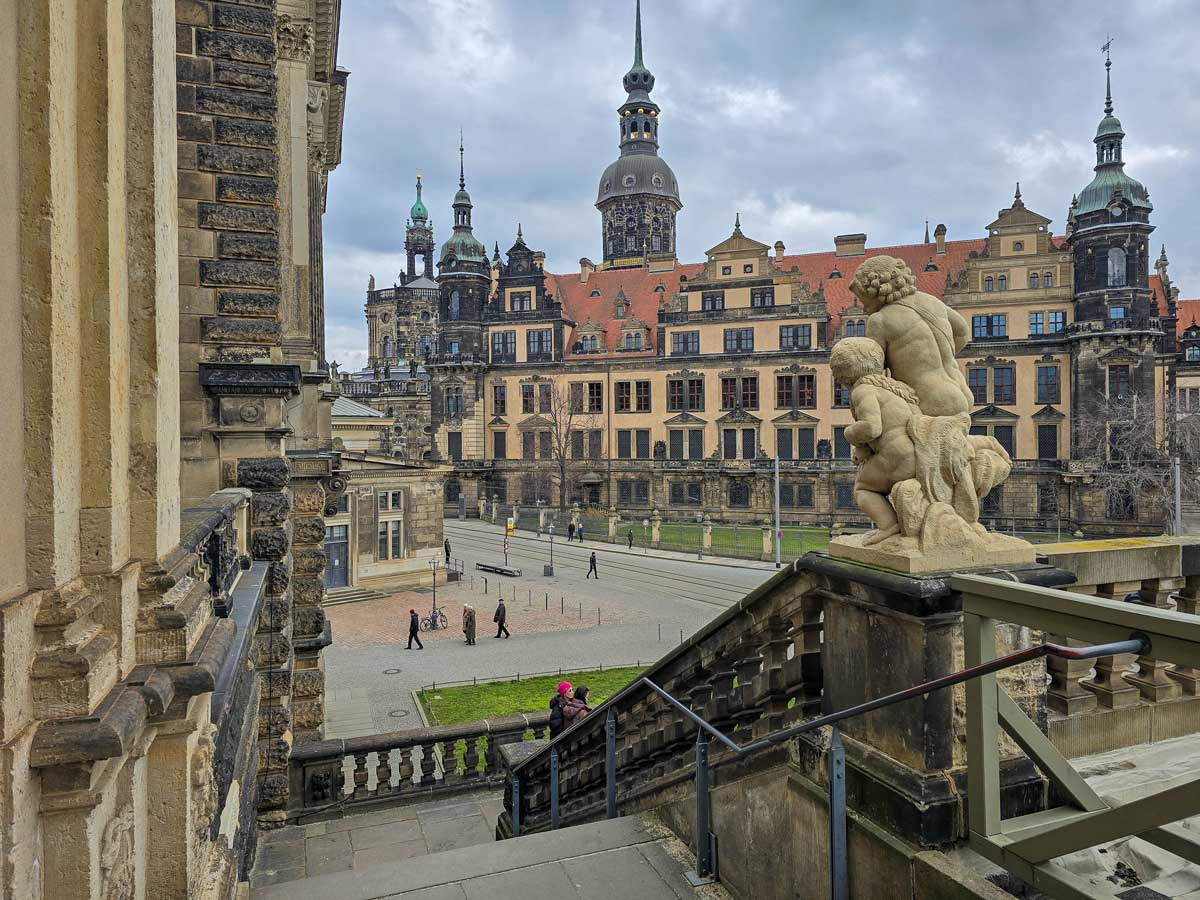
From the outside, the Residenzschloss already feels imposing, with its layered architectural styles revealing centuries of expansion, destruction and reconstruction. This was the seat of the Electors and later Kings of Saxony for more than 400 years, and it played a central role in shaping Dresden as one of Europe’s great cultural capitals.
Originally built in the 13th century, the palace evolved over time, absorbing Renaissance, Baroque and Neo Renaissance elements. Like much of Dresden, it was badly damaged during the bombing of 1945, and for decades it stood partially in ruins. The painstaking restoration that followed has turned it into one of the city’s most impressive cultural spaces, housing several museums and historic rooms.

Inside, the palace feels vast and surprisingly intimate at the same time. I moved through rooms filled with suits of armour and ceremonial weapons, original 16th century garments, intricate tapestries and regal portraits of Dukes and Electors of Saxony. I visited the palace as part of the Carnival, which made the experience feel almost surreal. As I wandered through the halls, people dressed in elaborate period costumes strolled past me, their masks and silk fabrics echoing the portraits lining the walls. It blurred the line between past and present in the most beautiful way.
The absolute highlight for me was the Small Ballroom. The room is breathtaking! The walls, polished to resemble marble, shimmer beneath a golden ceiling adorned with painted lions, musical instruments, delicate floral motifs and sculpted white angels watching from above. Low hanging crystal chandeliers, lit by softly flickering candles, bathe the space in a warm, honey coloured glow. I remember standing there and closing my eyes for a moment. In that silence, I could almost hear the distant echoes of music, imagine the rustle of silk gowns, and picture 16th century royalty dancing beneath the same ceiling.
Tip: If you buy the museum ticket for Dresden you can visit all of the 15 State Art Collections for the price of 2. The ticket is valid for 2 days, so if you plan to be in the city for a longer time, it’s worth buying it.
Lunch in Dresden
Lunch at Anna im Schloss
By lunchtime, I was ready for something substantial, and Anna im Schloss delivered exactly that.
The restaurant is named after Anna of Denmark, a fascinating figure in Saxon history. As the wife of Elector August of Saxony in the 16th century, she was known not only for her role at court but also for her interest in agriculture, horticulture and the welfare of her people. It feels fitting that a restaurant celebrating Saxon cuisine carries her name.
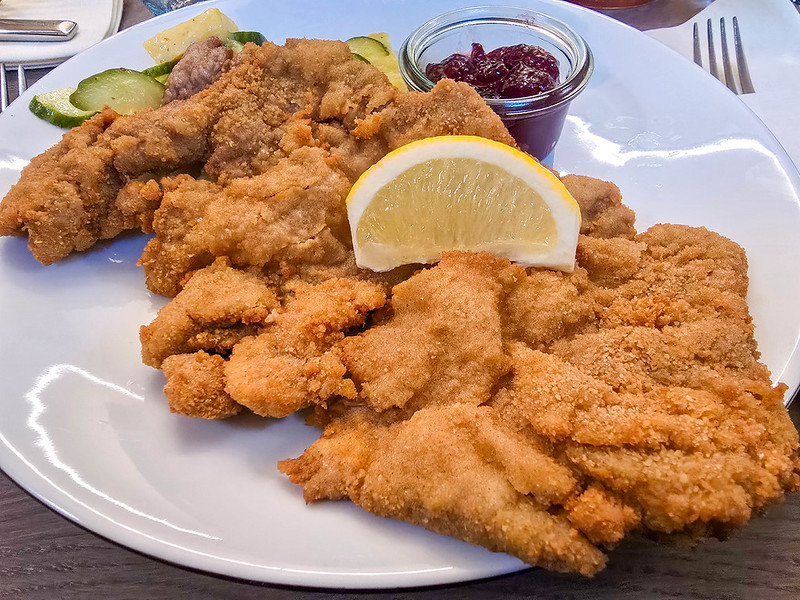
It wasn’t easy to choose something from the menu, as everything sounded delicious. In the end, I went for the Wiener Kalbsschnitzel, and judging by the number of people at our table who ordered the same, I wasn’t alone.
The veal cutlet was enormous, thin, perfectly breaded and fried to a golden crisp. It came with a potato and cucumber salad and a side of cranberries. The complement between the crispy schnitzel and the slightly tart cranberry jam was absolutely spot on.
Afternoon Exploring Dresden
The Stallhof

I have a very funny story about the Stallhof. I walked here first at night, on an evening stroll from my hotel to the city center, looking for some food. I’ve seen the gate opened and curiosity made me step in, only to jump of scare because of the giant statue right next to the entrance. Built in the late 16th century, the Stallhof was originally used for tournaments and court festivities. It’s considered one of the oldest preserved Renaissance courtyards in Germany.
Today, it’s calm and almost intimate, especially compared to the busier parts of the old town. It’s also not crowded, because you can easily pass by without noticing the entrance ways guarded by those giant statues that scared me.
The Fürstenzug

Just around the corner from the Stallhof, you’ll find the Fürstenzug, one of Dresden’s most famous walls. This enormous mural depicts a procession of Saxon rulers and is made from thousands of Meissen porcelain tiles.
Seeing it in person is impressive, not just because of its size, but because of the details. And no, it doesn’t fit in one photo, even if it’s taken with a wide angle.
Visiting the Dresden Zwinger
The Zwinger was one of the absolute highlights of my day in Dresden, and a place I could have easily spent hours in without ever feeling bored. This magnificent Baroque complex was commissioned in the early 18th century by Augustus the Strong, Elector of Saxony and King of Poland, a ruler known as much for his ambition as for his love of art and spectacle. Originally designed as an orangery and a setting for lavish court festivals, the Zwinger was meant to impress, and it still does.
Architecturally, the Zwinger is a masterpiece. Its symmetrical layout, ornate pavilions and wide open courtyards create a sense of harmony that feels almost theatrical. Sculptures crown the gates and balustrades, fountains bubble softly in the courtyards, and every façade seems to reward a closer look.
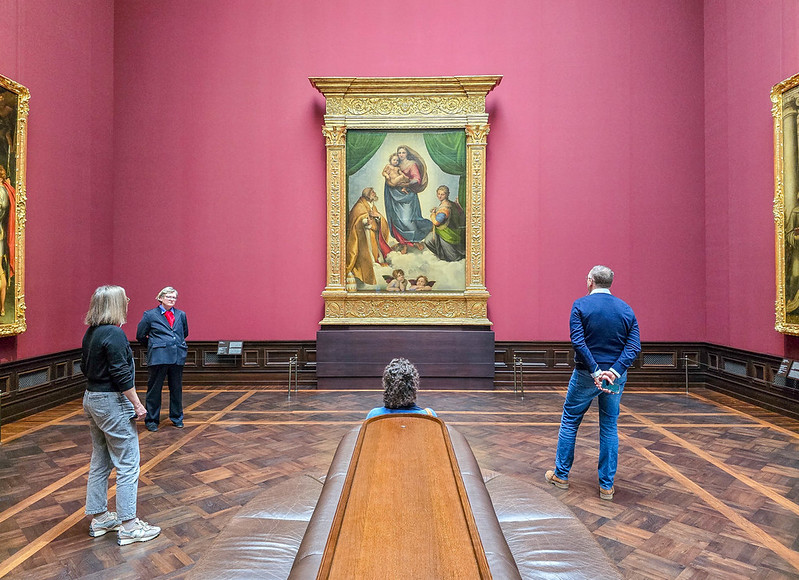
Inside the Zwinger are several world class museums, and even if you only choose one, it’s worth stepping indoors. The most famous is the Old Masters Picture Gallery, home to one of Europe’s most important art collections. Seeing Raphael’s Sistine Madonna in person was a genuine goosebumps moment for me. The softness of the figures, the calm intensity of her gaze, and those iconic cherubs at the bottom of the painting feel completely different when you’re standing in front of the real thing.
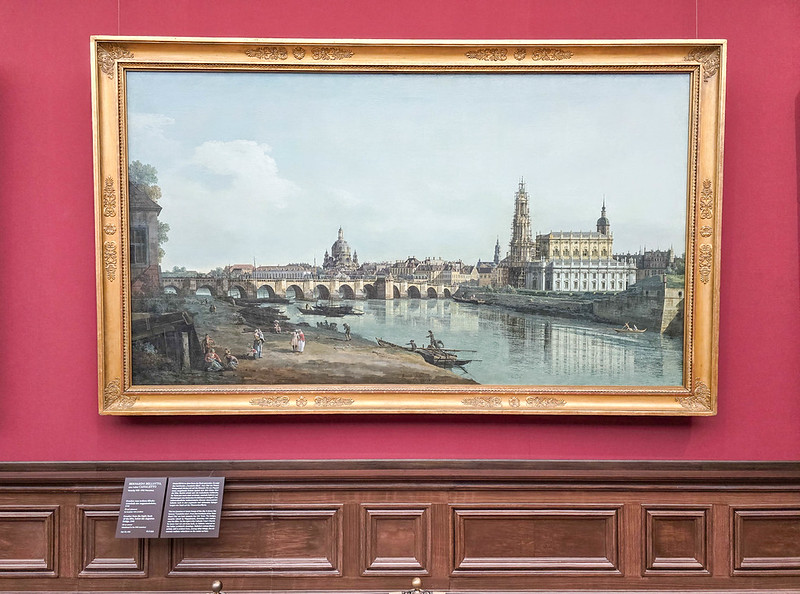
Among the Dresden paintings housed in the Old Masters Picture Gallery, one that really stopped me in my tracks was Dresden from the Right Bank of the Elbe below the Augustus Bridge by Bernardo Bellotto, better known as Canaletto. The painting captures the city with astonishing precision, showing the skyline of Dresden as it appeared in the 18th century. Looking from my hotel window, I could see almost the same skyline. The Frauenkirche, the Hofkirche, the palace buildings and the gentle curve of the Elbe all appear almost exactly where you see them today.
Dinner at Sophienkeller im Taschenbergpalais

Dining at Sophienkeller felt like going back in time. Located beneath the Taschenbergpalais, which was originally built for Augustus the Strong’s mistress, Anna Constantia von Cosel, the restaurant leans heavily into Saxon tradition.
The cellar-style setting reflects how people would have gathered centuries ago, sharing hearty food and drink in communal spaces. It’s theatrical without feeling gimmicky, and the focus remains firmly on traditional Saxon cuisine.
The suckling pig I ordered felt like the perfect choice in this setting. Rich, comforting and very traditional for the region, it matched the surroundings beautifully and it was a great end to a perfect day in Dresden.
Where to Stay in Dresden: Bilderberg Bellevue Hotel

During my stay, I stayed at the Bilderberg Bellevue Hotel Dresden, and it was an excellent choice.
The room was spacious, with a giant bed that felt especially welcome after long days of walking. I was greeted with chocolates and a handwritten note from the manager, which is always a lovely touch and instantly makes a hotel feel more personal.
Breakfast was included and offered a continental selection alongside several local meat specialities. Fresh juice and coffee were made to order and brought to the table in a personal pot, which I really appreciated.
In the evenings, I loved spending time by the pool. It was the perfect way to unwind after a busy day, especially during the colder months.
Final Thoughts on One Day in Dresden

Dresden surprised me in the best possible way. What started as a trip centered around the Carnival turned into a genuine appreciation for the city itself.
With just one day, you can experience history, culture, great food and a relaxed pace that makes Dresden feel very welcoming.
If you’re planning a short visit, this one-day itinerary gives you a taste of Dresden’s past and present, with enough time to enjoy it rather than simply tick boxes.
Like it? Pin it!
Disclaimer: Some of the links on this website are “affiliate links.” This means that if you click on the link and do a purchase, I will receive an affiliate commission at no extra cost for you. This helps me keep my website running and continue to share my travelling knowledge with you. I thank you for booking your flights or hotels using the links on my website. Regardless, I only recommend products or services I use personally and believe will add value to my readers.