
The first memory I have about the “Martisor” is from a very young age, 4 years old maybe. I remember my grandmother giving me this beautiful tiny glass squirrel, brown, with a white nose and two small round black bubbles as eyes. It was tied with a white and red string, and the fascinating thing about it was that you couldn’t wear it on your blouse because it had no needle, same as the other “Martisoare”. It was like a precious toy. I remember how proud I was of it and how special that was for me. Until, obliviously, I lost it.
Later, in school, there used to be competitions between girls, of who gets the most “Martisoare” from boys. Popular girls always went back home with their backpacks full.
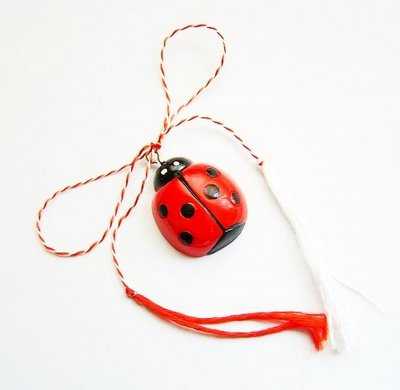 “Martisor” is a tradition that Romanians celebrate every year on the 1st of March. In each area of the country this custom changes slightly, so I am going to tell you about how I know it and how I celebrated it all my life.
The Legend says that this tradition dates from over 2000 years ago, when the Dacians were living on the territory of now Romania. Back then, 1st of March was the beginning of the year in the old Roman calendar and March (Martie – in Romanian) was dedicated to God Mars, the protector of marriage. On this day men were celebrating their wives by offering them gifts and women were wearing around their necks a coin tied with a bi-color string, red and white, to be beautiful, healthy and lucky the whole year ahead.
The white string represents the cold of winter, while the red string represents the warmth of spring and braided together they represent the conjunction of the contraries.
In our days, the coin has been changed with different feminine symbols like ladybirds, flowers, butterflies, but also with symbols of luck, like horseshoes or chimney sweepers (which in the Romanian tradition are lucky). They are all tied with the red and white string.
Every 1st of March boys and men buy this symbol of spring and offer it to the girls and women in their lives, as a symbol of their love and respect. Modern men also accompany it with flowers, especially bouquets of snowdrops, hyacinths or freesias. Women have to wear the “Martisor” on their chest and after 9 days, they tie it up to a flower in a garden or to the branch of a tree. It is said that by doing so, the women will blossom this year the same way as the flower or the branch will.
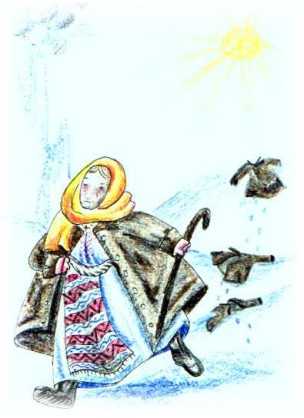 There are 9 days of “Martisor” and they are connected to the Legend of Baba Dochia, a Romanian mythological character – an old lady that lived in the mountains (Baba). She had a son, named Dragobete, that irremediably fell in love with a young and beautiful girl, that he married. Baba Dochia didn’t agree with this marriage so one day she sent the girl to the river to wash a black ball of yarn. She told her not to come back until the ball of yarn is white. The girl took the ball of yarn and went to the river but no matter how much she tried to wash it, the color was still black. Her hands were frozen and bloody.
Impressed by the pain the girl was going through, Jesus Christ appeared in her way and gave her a red flower, telling her to wash the yarn with it. She thanked him, took the flower and put it in the water. To her surprise, the yarn immediately changed color and became white. She happily went back home and told Baba Dochia what happened.
After hearing about the flower, Baba Dochia thought that spring has come. Where else would the girl have a flower from? She took her nine sheepskin coats and took her sheep to the mountains. The weather become warmer and warmer, so every day, Baba Dochia threw away one of her coats, until there was none left. And in that day, the weather changed and the cold came back. Baba Dochia froze, together with her sheep and transformed into stone.
In our days, girls choose one of the first nine days of March as their “Baba”. The tradition says that the year will go on the same as their chosen day will, if it’s sunny it’s going to be a good year. If it’s not, it won’t be such a good year. But of course, these are all traditions.
Do you have a spring tradition in your country? I would love to hear all about it!
How fascinating especially that the traditions are different for both men and women. I think it is important to seek out knowledge about other cultures particularly if you are visiting the country.
Yes, March is women’s month, they are the ones getting spoiled by men 🙂
As a former American baseball player, for years my main spring tradition was spring training in preparation for the upcoming season. It’s always wonderful to hear about the traditions of other cultures and I thank you for sharing.
I love learning about different countries’ traditions! Never heard of this one. Thanks for sharing!
Like others, I have not heard of this tradition before. In Minnesota, we have one similar but it is May first. Mayday baskets are handed out to friends, family, and even strangers. It makes the beginning of spring (I believe).
That’s very cute, a nice way to interact with other people. 🙂
Sounds so cool! I often stay in France and as far as traditions go, they have a lot. They’re wonderful, little festivals, food celebrations, and the best markets ever. I wish England had more of that!
I do like out little weekend market from the High Street. And I’ve been to Salisbury to a nice food market. In my little town we have a lot of events in summer, like folk festivals, motorbike shows, fireworks displays, etc.
Never heard of this, but this is great now that i know.
Never heard of that story/tradishion but love it. I actually don’t think we such a similar one in Austria!
How charming a story. It’s incredible just how much we don’t know about the world’s traditions. We humans a fascinating. Thanks for sharing this.
You’re welcome Indigo 🙂
Wow. I have never heard of this tradition before. It sounds like a fun way to celebrate. Do you do this every year with your family?
Everybody does it, every year. Literally everybody. The “Martisor” sellers start to sell them at mid February and they occupy all the sidewalks in the main areas of the cities. It’s madness 🙂
Wow, I’ve never heard of this tradition before. It’s definitely interesting, and the reasoning behind it all is fun to learn!