
There are very few things in travel that feel as universal as the neck pillow. Walk through any international departure terminal and you will see them everywhere: hanging from carry-on bags, draped around necks, stuffed into overhead lockers. They are one of the most purchased travel accessories in the world, and yet the overwhelming majority of people using them have been doing so incorrectly for their entire lives.
That is not an exaggeration. The way most travellers position a neck pillow, the way it is modelled on packaging, the way fellow passengers wear theirs, and the way it has been worn for decades is, according to growing evidence from sleep and ergonomics specialists, precisely backwards. Literally. The pillow that is supposed to help you sleep is, in its conventional orientation, one of the reasons you keep waking up.
The fix takes about three seconds and costs nothing. But understanding why it works requires taking a closer look at what actually happens to the human body when it tries to sleep upright at 35,000 feet.
What Happens to Your Body When You Sleep Sitting Up
Sleeping in a seated position is not something the human body does naturally or enthusiastically. It is a compromise, and a fairly uncomfortable one. When genuine sleep begins to take hold and muscles relax, the head does what gravity tells it to: it drops forward. This is not a personal failing or a sign of poor posture. It is simple physics acting on a head that weighs, on average, somewhere between four and five kilograms.
That forward drop is the enemy of in-flight sleep. The moment the chin moves toward the chest, one of two things happens. Either the neck muscles contract in response, pulling the head back up and jolting the person awake, or the head continues its descent into an angle that places significant strain on the cervical spine. Both outcomes are unpleasant. One interrupts sleep constantly. The other produces the kind of neck pain that can linger for days after landing.
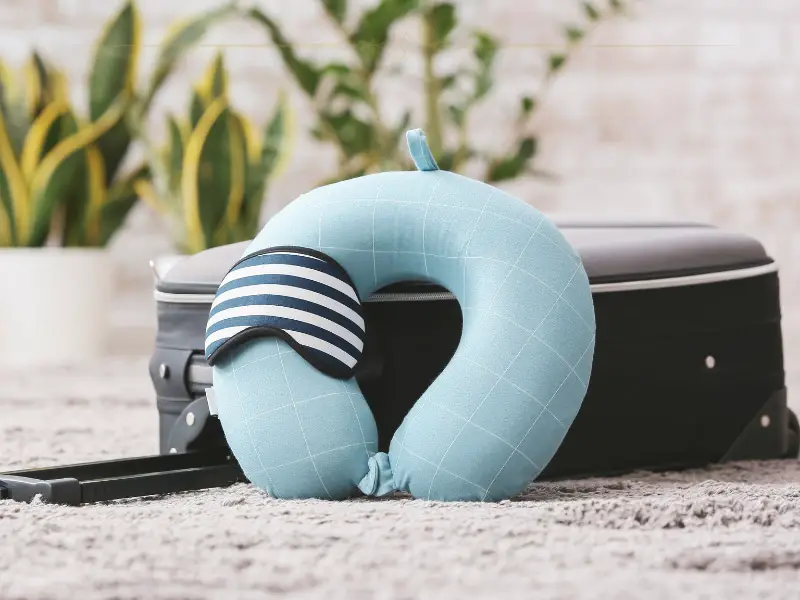
The conventional travel pillow, shaped like the letter C or a horseshoe, is designed to be worn with the opening at the front and the padded curve cradling the back of the neck. In theory, this provides support. In practice, it does very little to address the actual problem, which is the forward motion of the head during sleep. The back of the neck is not where support is needed. The front is.
The Technique That Changes Everything
The adjustment that sleep specialists and experienced long-haul travellers have been quietly passing around for years is straightforward. Take the pillow and rotate it 180 degrees so that instead of the curved section sitting at the back of the neck, it sits at the front, with the padded bulk resting under the chin and the open ends of the horseshoe pointing toward the back of the head.
In this position, the pillow does something the conventional orientation never could. It catches the chin before the head drops too far forward, acting as a physical barrier to the gravitational pull that ruins sleep in a seated position. The neck still gets some lateral support from the sides of the pillow, but the primary function shifts from decorative comfort to genuine structural support.
The difference, for most people who try it, is immediate and significant. The head-bob that has plagued every long-haul journey suddenly has nowhere to go. The muscles that would normally be fighting to keep the head upright can relax without consequence. And sleep, real sleep rather than the fitful half-conscious dozing that passes for rest on most flights, becomes a realistic possibility.
Why Nobody Told You This Sooner
The honest answer is that travel pillow packaging and marketing have never been particularly scientific. The image on the box shows someone with the pillow around the back of their neck, looking serenely comfortable, and that image becomes the template for how the product is used. Nobody questions it because it looks logical, and because everyone else is doing the same thing.
There is also the factor of environment. Airports and aircraft are not spaces that encourage experimentation or careful thought. Most people are managing luggage, boarding passes, security queues, and the general anxiety of travel at the same time. When they finally sit down and pull out their neck pillow, they put it on the way they always have and hope for the best.
The people who discovered the reversed orientation mostly did so by accident, through a combination of frustration and trial and error during particularly long journeys. Those who tried it and found it worked passed the information on to friends and fellow travellers. It has spread gradually, through word of mouth and occasional mentions in travel forums, rather than through any official channel or product update.
It is, in that sense, one of the more democratic travel discoveries of recent years. No new product required, no upgrade necessary, no additional cost involved. Just a different way of using something that has been sitting in the hand luggage all along.
Getting the Most Out of Your Pillow
The reversed orientation is the core of the technique, but there are a few additional considerations that can make a meaningful difference to the overall result.
Inflation level matters more than most people realise. A pillow that is fully inflated tends to be rigid in a way that pushes against the jaw uncomfortably. Letting out a small amount of air before settling in allows the pillow to conform slightly to the contours of the face and neck, which both increases comfort and improves the quality of the support it provides. Finding the right level takes a little experimentation, but it is worth the thirty seconds of adjustment.
The material of the pillow is also relevant, particularly for travellers who invest regularly in long-haul journeys. Inflatable pillows are convenient and packable, but they have limitations when it comes to the quality of support they can offer, since air shifts around under pressure in ways that solid material does not. Memory foam pillows are heavier and take up more space in a bag, but they respond to the shape of the head and neck in a way that tends to produce better results for extended sleep. For frequent travellers who prioritise rest, the trade-off in packing space is usually worth considering.
Adjustable closures on neck pillows, a feature that is now available on many mid-range and premium models, allow the wearer to tighten or loosen the fit around the neck. In the reversed orientation, being able to bring the two ends of the pillow closer together at the back means the chin support at the front stays in place even as the body shifts during sleep, rather than gradually sliding away over the course of a few hours.
Sleep and Modern Air Travel
The question of how to sleep on a plane has become increasingly relevant as flight routes grow longer and the demands placed on travellers intensify. Ultra-long-haul routes covering eighteen hours or more are now operated as a matter of routine by several major carriers. Business travellers routinely cross multiple time zones and are expected to function effectively upon arrival. Tourists who have saved for a once-in-a-decade holiday want to arrive feeling human rather than hollowed out.
The stakes around in-flight sleep quality, in other words, are not trivial. The condition in which a person arrives at their destination has real consequences for their ability to work, to enjoy themselves, and to recover from the physical demands of travel. Jet lag compounds the effects of poor sleep, and a traveller who has spent twelve hours in a middle seat fighting the head-bob is in a significantly worse position than one who managed to sleep for even a few hours in reasonable comfort.
This is the context in which a technique as simple as reversing a travel pillow becomes genuinely worthwhile. It is not a cure for the fundamental discomforts of economy class. It does not replicate the experience of a business class flat bed. But it addresses one of the most specific and consistent causes of disrupted sleep in a seated position, and it does so without requiring anything beyond what most travellers already own.
What to Pair It With
The reversed pillow technique works best as part of a broader approach to in-flight sleep rather than as a standalone solution. The cabin environment on most commercial flights is not naturally conducive to rest. The lighting is often too bright, the noise level is constant and irregular, and the air is dry in ways that affect comfort over time.
An eye mask is one of the most effective and underused tools available to economy class travellers. Blocking out the ambient light of the cabin, including the glow of other passengers’ screens, signals to the brain that sleep conditions have been met. Combined with the physical support of a properly positioned neck pillow, the effect is considerably greater than either element alone.
Noise-cancelling headphones or quality earplugs address the audio side of the equation. The constant low-frequency hum of aircraft engines is not just annoying. It represents a sustained form of sensory stimulation that keeps the nervous system from fully settling into rest. Reducing that background noise, even partially, makes a measurable difference to sleep quality.
Staying hydrated throughout the flight is another factor that tends to get overlooked in favour of more obvious comfort measures. Dehydration affects sleep quality and contributes to the general sense of physical discomfort that makes it harder to relax in the first place. Drinking water regularly, and limiting alcohol and caffeine in the hours before and during the flight, supports the conditions in which sleep becomes easier to achieve and maintain.
A Simple Change With a Real Payoff
Travel comfort has become an industry in itself, with a constant stream of new products, gadgets, and accessories promising to transform the flying experience. Most of them are incremental improvements at best. The reversed travel pillow is something different. It is a genuine rethinking of how an existing product is used, and it addresses a real and specific problem rather than a vague aspiration toward greater luxury.
The travellers who have adopted the technique consistently report the same experience: the first time they try it, they cannot quite believe they spent years doing it the other way around. The support feels immediately more logical, more stable, and more effective. The head stays where it is supposed to stay. Sleep follows.
For anyone with a long journey coming up, the experiment costs nothing and takes no time at all to try. Flip the pillow around, settle in, and find out what a difference three seconds of adjustment can actually make.