If you are flying out of a major American airport soon, there is something you need to know before you leave for the terminal. Security wait times at some of the country’s busiest airports have climbed to levels that would have seemed extraordinary even a few months ago, and the conditions driving those delays are not going away anytime soon. In fact, by most accounts, they are heading in the wrong direction.
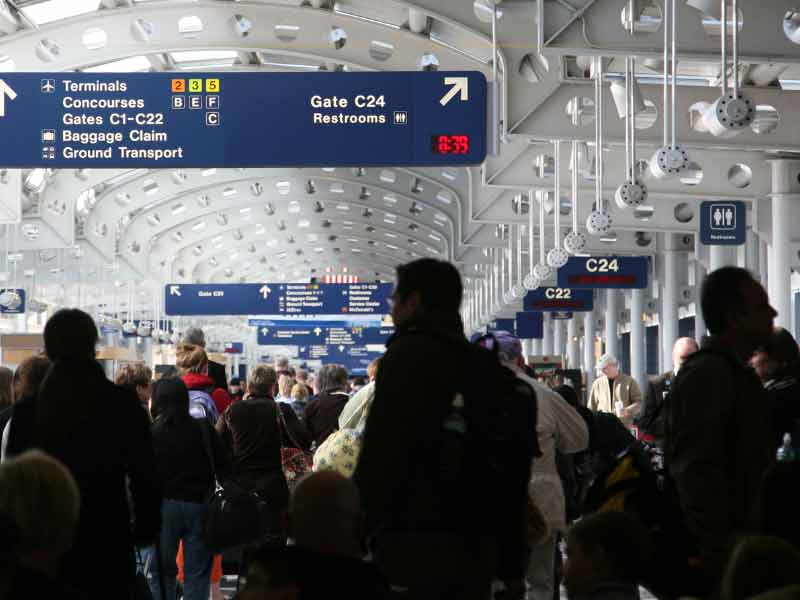
The collision of two factors, a partial government shutdown that has left Transportation Security Administration officers working without full pay and the annual surge of spring break travel, has created a pressure point at airport security checkpoints that is being felt from Houston to Atlanta to New York. Travelers who arrived at certain airports on Friday morning found themselves in lines that stretched far beyond the normal queuing areas, with waits that consumed hours rather than minutes. And the weekend ahead, with travel volumes expected to remain high, looks set to be even more difficult.
Understanding what is happening, which airports are most affected, and how to navigate the situation is not just useful right now. For anyone with a flight booked in the coming days, it could make the difference between making a departure and watching it leave without them.
Houston: Where Three-Hour Waits Became Reality
Of all the airports affected by the current security slowdown, Houston George Bush Intercontinental Airport has seen some of the most severe disruption. Data from the Houston Airport System showed wait times reaching as long as two hours across multiple terminals on Friday, a figure that by any reasonable standard represents a significant failure of the usual processing capacity.
Terminal E told an even more troubling story. Earlier on Friday morning, wait times at that terminal climbed beyond three hours, with footage circulating on local news showing queues that snaked well past the boundaries of the designated waiting area and into surrounding spaces. For travelers who arrived expecting a manageable checkpoint experience, the reality was something closer to a hours-long ordeal.
George Bush Intercontinental is one of the major hub airports in the United States, serving as a connecting point for a vast number of domestic and international itineraries. Delays of this scale do not stay contained to the passengers directly affected. They ripple outward through connecting flights, cascade through airline schedules, and create disruption that can persist long after the immediate bottleneck has cleared.
Atlanta and New York: The Ripple Effect Spreads
Houston was not alone. At Hartsfield-Jackson Atlanta International Airport, which holds the distinction of being the world’s busiest airport by passenger volume, the picture was similarly strained. The main security checkpoint and the north checkpoint were both reporting wait times of over an hour during the early afternoon, with the north checkpoint separately recorded at around 45 minutes at various points throughout the day.
Atlanta is a critical node in the American aviation network. Virtually any disruption at Hartsfield-Jackson has consequences that extend far beyond the city itself, given the sheer volume of connecting traffic that moves through it. When security processing slows significantly at that airport, the effects spread rapidly across dozens of routes and hundreds of onward connections.
LaGuardia Airport in New York issued a direct alert to travelers, acknowledging that TSA wait times were running longer than usual and advising passengers to arrive at the airport earlier than they normally would. The C terminal at LaGuardia was reporting waits of more than 20 minutes, a figure that in isolation might sound manageable but takes on different significance in the context of a broader system under strain and with conditions expected to deteriorate further.
At Harry Reid International Airport in Las Vegas, wait times reached approximately 30 minutes during the afternoon, slightly above the usual average for that airport of around 25 minutes. Las Vegas sits in an interesting position in this particular crisis. It is a major leisure destination that draws enormous volumes of spring break travel, meaning the demand side of the equation is running at full pressure precisely as the supply side, in the form of available TSA staffing, is contracting.
The App That Is Giving Travelers the Wrong Information
There is an additional complication that makes the current situation more dangerous for travelers who think they are staying informed. The MyTSA app, which is the official tool provided by the Transportation Security Administration for checking estimated security wait times at American airports, is currently providing information that does not reflect reality at several major airports.
The gap between what the app is showing and what is actually happening at checkpoints is not a minor discrepancy. At Houston George Bush Intercontinental, the MyTSA app was displaying an estimated wait time of zero to fifteen minutes at a point when the Houston Airport System’s own data was showing actual waits of around two hours. That is not a rounding error. It is the difference between showing up with comfortable time to spare and missing a flight entirely.
The same problem was present at Hartsfield-Jackson Atlanta. While the airport itself was reporting waits exceeding an hour as of early Friday afternoon, the MyTSA app was showing an estimate of fifteen to thirty minutes for the same checkpoint. A traveler relying on that figure to plan their arrival time would be operating on entirely false information.
The reason for the inaccuracy appears to be directly connected to the government shutdown. The normal data pipelines and staffing that support accurate real-time updates to the app have been disrupted along with everything else, leaving the app showing figures that are either outdated, incomplete, or simply not reflecting the current conditions on the ground.
The practical implication for anyone flying in the near term is straightforward: do not use the MyTSA app as a basis for planning your airport arrival time right now. Check directly with your departure airport through its official website or social media channels, which are more likely to reflect what is actually happening at the checkpoints.
Why This Is Happening: The Shutdown and Its Consequences
To understand how airport security queues ended up in this state, it is necessary to understand what has been happening to the TSA workforce over the past several weeks. The partial government shutdown that is currently underway has meant that TSA security officers, who are federal employees, have been working without receiving their full paychecks. For workers who rely on those paychecks to cover rent, food, and basic expenses, this is not an abstract inconvenience. It is a financial crisis playing out in real time.
The response has been predictable and entirely human. At least 366 security officers have resigned from the TSA since the shutdown began, according to figures from the Department of Homeland Security. Each departure reduces the pool of available staff to cover shifts at airports across the country, tightening an already stretched system.
Those who have stayed are not uniformly showing up. Absence rates that normally run at around two percent, reflecting the usual pattern of illness and personal leave in any large workforce, have escalated dramatically at affected airports. On one day this week, approximately one third of officers called out sick at New York’s John F. Kennedy Airport, Atlanta’s Hartsfield-Jackson, Houston’s Hobby Airport, and New Orleans’ international airport. On Wednesday, TSA data showed that more than ten percent of the agency’s entire national workforce failed to report for duty.
At Hartsfield-Jackson and George Bush Intercontinental specifically, the absence rate on Wednesday reached around 40 percent of the staff at each airport. Running a major international airport’s security operation with 40 percent of your normal complement of officers is not something that can be compensated for through operational adjustments or minor process changes. The math simply does not work, and the result is what travelers experienced on Friday morning: lines that stretched for hours and queues that overflowed their designated spaces.
The language coming from within the TSA workforce reflects the severity of the situation. Officers who have spoken with media this week described a workforce that has reached a breaking point, with the missed paychecks from last weekend accelerating a deterioration in morale and attendance that has been building since the shutdown began.
Spring Break and the Shutdown: The Worst Possible Timing
Even without a staffing crisis, this particular weekend would represent a significant test of airport capacity. Spring break travel is one of the peak periods in the American aviation calendar, generating passenger volumes that rival the Thanksgiving and Christmas holiday seasons at many airports. Families, students, and leisure travelers fan out across the country and internationally in large numbers, filling flights that are already operating at high load factors.
The overlap between this peak travel period and a TSA staffing shortage of this magnitude is not merely unfortunate timing. It creates a specific kind of stress on the system that is qualitatively different from either factor operating in isolation. High passenger volumes alone can be managed through additional staffing and extended checkpoint hours. A staffing shortage alone, during a quieter travel period, can be absorbed through careful scheduling and redeployment of available resources. The combination of peak demand and drastically reduced capacity leaves very little room for the system to absorb pressure.
For travelers, the arithmetic of this situation suggests one clear response: add significant time to whatever buffer you would normally build into your airport arrival. The general guidance of arriving two hours before a domestic flight and three hours before an international departure was designed for normal operating conditions. Those conditions do not currently exist at the airports most affected by the staffing shortage.
Travel experts speaking publicly this week have broadly recommended that passengers at affected airports plan for arrival times of at least three hours before domestic departures and four hours before international flights for the foreseeable future. That is not excessive caution in the current environment. Given what has been documented at Houston, Atlanta, and elsewhere this week, it is a reasonable baseline.
Which Airports Are Carrying the Most Risk
Not every airport in the country is experiencing the same level of disruption. The problems have been most acute at large hub airports with high volumes of connecting traffic, where the combination of high passenger throughput and reduced TSA staffing creates the most severe bottlenecks.
Hartsfield-Jackson Atlanta, George Bush Intercontinental in Houston, John F. Kennedy in New York, and LaGuardia have all featured prominently in the disruptions documented this week. These are among the busiest airports in the country, and they are also the airports where the departure of even a significant fraction of the TSA workforce creates the most visible and immediate impact on the passenger experience.
Smaller regional airports are generally in a somewhat better position, partly because their absolute staffing numbers mean that even proportionally similar absence rates translate to fewer open lanes, and partly because passenger volumes are lower to begin with. That said, the staffing shortage is a national problem, and travelers at smaller airports should not assume they are entirely insulated from its effects.
The airports serving major spring break destinations are facing particular pressure from the demand side of the equation. Las Vegas, Miami, Orlando, and similar leisure-focused airports are seeing volumes that reflect the season, even as their staffing levels reflect the ongoing crisis.
What Can You Do Right Now
In the absence of a resolution to the government shutdown, the structural causes of the current disruption are not going to change in the next few days. The practical options available to individual travelers are therefore about managing their own experience within a system that is operating under significant stress.
Arriving early is the single most important step. Given the documented inaccuracy of the MyTSA app, checking wait times directly through airport official channels before leaving for the terminal is essential. Enrolling in or using an existing TSA PreCheck or Global Entry membership, for those who have it, provides access to dedicated lanes that tend to move faster even during periods of general disruption. Packing carry-on bags in a way that minimizes the likelihood of a secondary screening, keeping electronics and liquids easily accessible, and wearing shoes that come off and on quickly are all small steps that reduce the time spent in the screening process itself.
None of these measures can fully insulate a traveler from a situation in which an airport is operating at a fraction of its normal staffing capacity. But in a system where margins are already razor-thin, small efficiencies compound. Arriving prepared and arriving early remain the most reliable tools available until the underlying staffing crisis finds a resolution.