London is often associated with royal landmarks, red buses, and historic streets, yet the city’s lesser-known attractions reveal a far more unconventional side. Beyond the famous tourist routes lies a capital filled with hidden tunnels, underground bars, interactive theatre, unusual nightlife concepts, and late-night cultural spaces that transform ordinary sightseeing into something far less predictable.
Some travelers come for the history, while others are drawn to London’s evolving nightlife and entertainment scene, where technology and social interaction now shape many modern attractions. For those looking to discover a different side of the British capital, London delivers unusual moments around nearly every corner.
Exploring London’s Immersive Entertainment Scene

London has become one of Europe’s leading destinations for interactive entertainment. Across the city, travelers can visit live-action theatre productions, themed escape rooms, and multi-sensory attractions that blur the line between fiction and reality. Rather than sitting back and watching a performance unfold, visitors become part of the action, creating moments that feel personal and unpredictable.
In recent years, gaming culture has grown into a major part of London’s nightlife identity. Modern gaming venues combine advanced technology, live interaction, and luxury settings to create sophisticated social spaces for both tourists and locals. The rise of casino gaming in London reflects changing entertainment trends, with many visitors drawn to venues focused on atmosphere, visual design, and social interaction.
At the same time, advancements in digital casino gaming have changed how players access this type of entertainment. Many people now look for the same atmosphere associated with famous Las Vegas venues from the comfort of home through the Las Vegas online casino, where mobile access allows casino gaming anytime and anywhere.
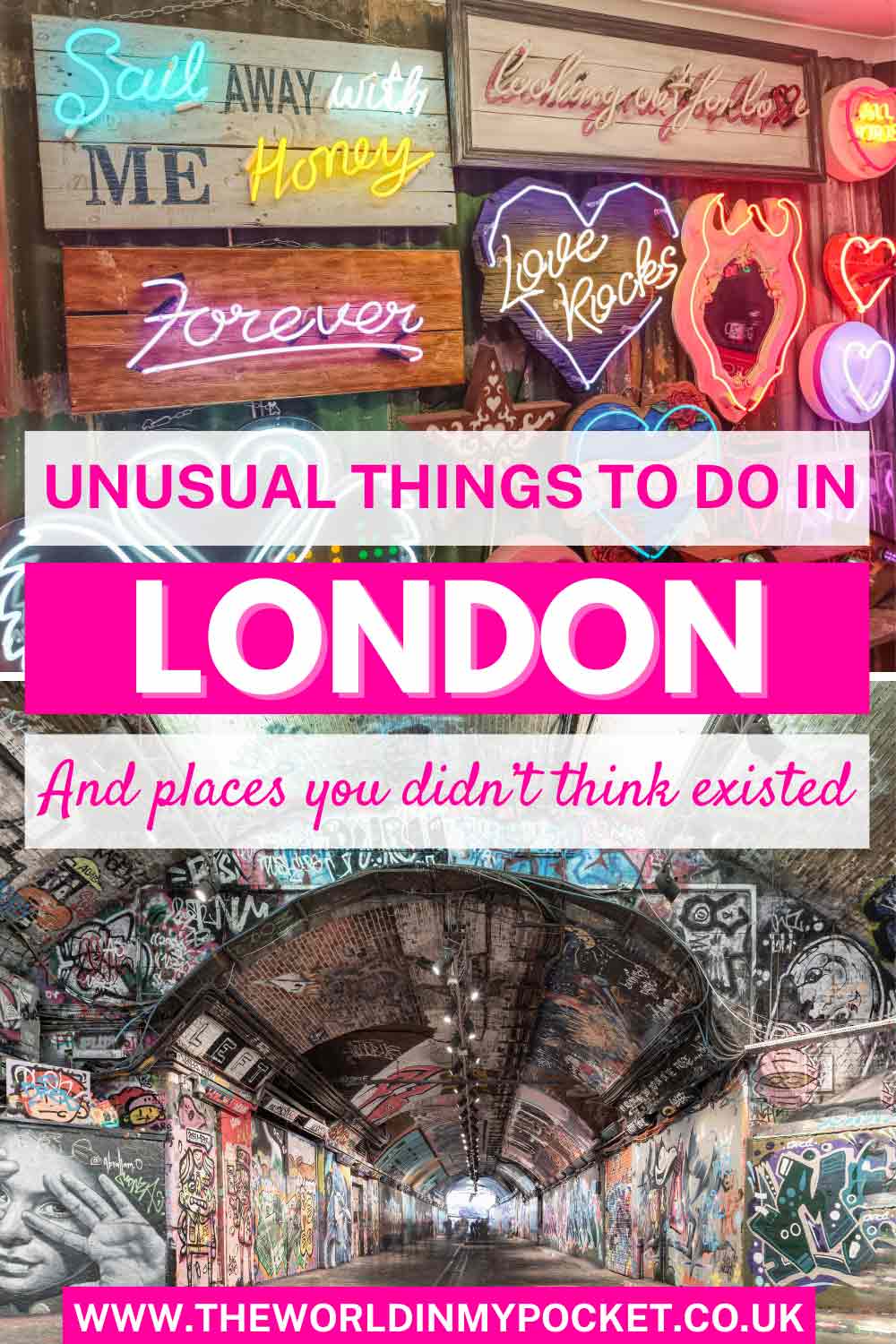
Leake Street Graffiti Tunnel: Where Street Art Takes Over

Tucked beneath Waterloo Station, the Leake Street Graffiti Tunnel is one of London’s most visually striking hidden spots. Unlike traditional galleries with fixed collections, this tunnel changes constantly. Artists arrive regularly to paint over older work, meaning the walls you see today will look completely different in a month. The result is a living, breathing showcase of urban creativity that never gets stale.
The tunnel stretches for around 300 meters, giving artists considerable space to work on large-scale pieces. You’ll find everything from intricate lettering to bold figurative murals. Some pieces are political, others purely decorative, but all of them reflect genuine skill. Entrance is free, and the tunnel is open around the clock, making it an accessible stop at almost any point during your visit to London.
Dennis Severs’ House: A Georgian Time Capsule in Spitalfields
Dennis Severs’ House on Folgate Street in Spitalfields operates on a concept that is hard to explain but easy to feel once you’re inside. The house is set up as though its fictional Georgian inhabitants, a family of Huguenot silk weavers, have just stepped out of the room. Half-eaten meals sit on tables. Candles flicker. Coats are draped over chairs. Visitors move through ten rooms in near silence, absorbing the atmosphere rather than receiving a lecture.
Severs, an American artist who moved to London in the 1970s, spent years curating every detail of the house before his death in 1999. The property is now managed as a heritage site, with evening candlelit tours considered the most atmospheric way to visit. It operates on limited hours, so booking ahead is strongly recommended. For anyone interested in how London’s historical layers sit beneath its modern surface, this house makes that visible in an unusually direct way.
The Seven Noses of Soho: A Walking Puzzle Through the Streets
In the mid-1990s, artist Rick Buckley attached a series of plaster casts of human noses to buildings across Soho and the surrounding area as a quiet act of artistic rebellion. Most Londoners walk past them daily without noticing.
Tracking them down turns an ordinary afternoon into something far more engaging, a self-directed trail through one of London’s most storied neighborhoods. The exact number and locations of the noses have shifted over the years as some have been removed or damaged.
That uncertainty is part of what makes the hunt compelling. You’ll cover streets in Soho, Covent Garden, and nearby areas, which means you’ll also pass through some of London’s best independent cafés, bookshops, and curiosity stores along the way. It’s a low-cost, high-reward way to see the city on foot.
Sir John Soane’s Museum: London’s Most Eccentric Collection

Hidden in a row of townhouses near Lincoln’s Inn Fields, Sir John Soane’s Museum offers one of the most unusual museum experiences in London. The former home of architect Sir John Soane is packed with thousands of objects collected during his lifetime, including classical sculptures, architectural models, paintings, antiquities, and curiosities gathered from across Europe and beyond. Every room feels densely layered, with hidden compartments and folding walls revealing unexpected treasures.
What makes the museum particularly distinctive is that it remains largely unchanged from the way Soane arranged it before his death in 1837. Narrow passageways, mirrored surfaces, and carefully controlled natural light create an atmosphere that feels more like exploring a private labyrinth than visiting a traditional museum. Despite its central location, it remains far quieter than many of London’s larger cultural institutions. Entry is free, making it one of the city’s most rewarding hidden cultural attractions.
God’s Own Junkyard: Neon Wonderland in Walthamstow
Located in an industrial area of Walthamstow, God’s Own Junkyard is a dazzling collection of neon signs, illuminated artworks, and vintage movie props that transforms an ordinary warehouse into a glowing visual spectacle. Created from the collection of artist Chris Bracey, whose work appeared in films, music videos, and commercial projects, the space contains hundreds of brightly lit pieces stacked from floor to ceiling.
Walking through the venue feels like stepping inside a futuristic film set. Religious imagery sits beside retro advertising signs, while colorful slogans and abstract designs create a constantly shifting landscape of light. The attraction has become particularly popular with photographers, but it remains enjoyable even for casual visitors looking for something completely different from London’s historic landmarks. An on-site café allows guests to linger among the displays while taking in the unusual surroundings.
Eel Pie Island: London’s Hidden Artistic Enclave
Sitting quietly in the River Thames near Twickenham, Eel Pie Island is one of London’s most intriguing hidden communities. Accessible only by a narrow footbridge, the island has a long history connected to music, art, and counterculture. During the 1960s, its famous hotel hosted performances by legendary rock bands and helped establish the area as a center of creative experimentation and alternative culture.
Today, the island remains largely residential, but it continues to attract interest because of its thriving community of artists and craftspeople. Several times each year, local studios open their doors to the public, allowing visitors to explore workshops, galleries, and creative spaces rarely seen by outsiders. The combination of riverside scenery, artistic heritage, and relative isolation gives the island a character unlike anywhere else in the capital, making it a memorable stop for travelers seeking London’s lesser-known side.
Like it? Pin it!
Disclaimer: Some of the links on this website are “affiliate links.” This means that if you click on the link and do a purchase, I will receive an affiliate commission at no extra cost for you. This helps me keep my website running and continue to share my travelling knowledge with you. I thank you for booking your flights or hotels using the links on my website. Regardless, I only recommend products or services I use personally and believe will add value to my readers.