Every December twenty-fifth, something unusual happens in European aviation. The continent’s largest low-cost carrier, responsible for roughly one in every ten flights across Europe on a typical day, completely disappears from the skies. No departures. No arrivals. Not a single aircraft in the air bearing the distinctive blue and yellow livery.
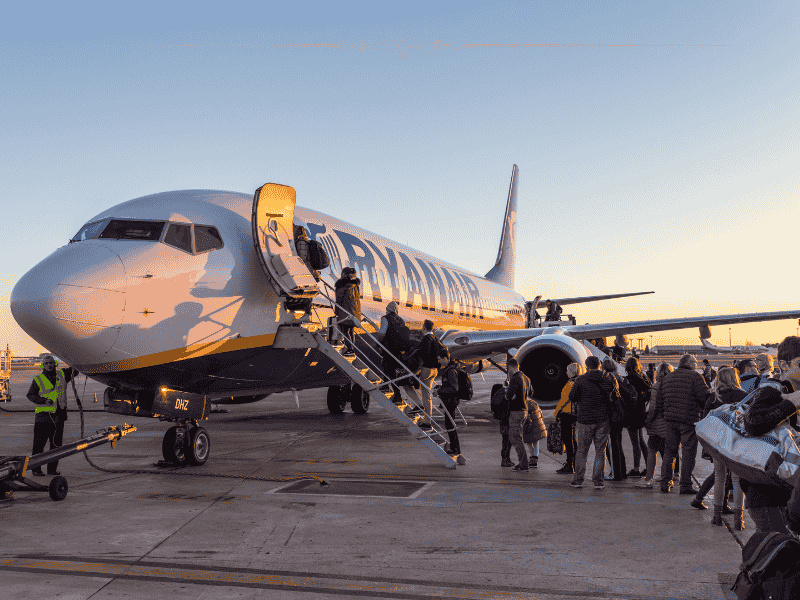
Ryanair, which normally operates over 3,000 flights daily during peak season, reduces that number to absolute zero on Christmas Day. The Irish airline has maintained this tradition for decades, making it one of the most predictable yet remarkable scheduling decisions in commercial aviation. While millions of passengers fly on other carriers during the holiday, Ryanair’s fleet sits parked at airports across the continent.
The shutdown represents a massive operational pause for an airline that prides itself on efficiency and maximizing aircraft utilization. In an industry where planes generate revenue only when they’re in the air, voluntarily grounding an entire fleet for twenty-four hours seems counterintuitive. Yet Ryanair has never wavered from this policy despite the obvious financial costs and competitive disadvantages it creates.
Understanding why requires looking beyond simple business calculations. The Christmas Day shutdown reflects a complex mix of cultural values, religious traditions, economic realities, and strategic positioning that says as much about Ireland as it does about airline operations. It’s a decision that affects millions of travelers, reshapes European flight patterns for twenty-four hours, and temporarily hands market dominance to competitors who keep flying.
The Numbers Behind the Shutdown
The scale of Ryanair’s Christmas Day suspension becomes clear when examining flight data. On December twenty-fourth, 2025, the airline operated approximately 1,720 flights across its European network. These services connected hundreds of cities in thirty-three countries, carrying tens of thousands of passengers to their holiday destinations.
The final departure of Christmas Eve leaves Kerry Airport on Ireland’s southwest coast at six-thirty in the evening, bound for Dublin. It’s a short hop of just 140 nautical miles, taking about fifty-five minutes gate to gate. This domestic Irish flight serves as the symbolic closing of Ryanair’s operations before the holiday shutdown. Unlike typical late-night flights that might depart at eleven or midnight, Ryanair wraps up operations hours earlier on Christmas Eve to allow crews to reach their homes.
After that final Dublin arrival, silence. For the next twenty-four hours, Ryanair’s website shows no available flights. The booking system simply skips December twenty-fifth entirely, moving directly from Christmas Eve to Boxing Day options. Travelers attempting to purchase tickets for Christmas Day find the date grayed out, unavailable regardless of route or price considerations.
The resumption of service on December twenty-sixth comes swiftly and at scale. The airline schedules approximately 2,700 flights for Boxing Day, nearly matching normal daily operations. The first departures begin at five forty-five in the morning from multiple cities including London, Krakow, and Sofia. By mid-morning, the airline is back to full operational capacity as though the Christmas pause never happened.
This twenty-four-hour gap means Ryanair foregoes revenue from roughly 500,000 potential passengers. At average ticket prices, the lost revenue approaches forty million euros. Add the opportunity cost of grounded aircraft, unused airport slots, and competitive disadvantage, and the financial impact grows substantially larger. Yet the airline absorbs these costs year after year without apparent concern.
Ireland’s Deep Catholic Roots
To understand Ryanair’s Christmas shutdown, you need to understand Ireland. The airline’s headquarters sits just outside Dublin, placing it firmly within a nation where Catholicism has shaped culture, politics, and daily life for centuries. According to the most recent census data, nearly seventy percent of Ireland’s population identifies as Roman Catholic, though actual church attendance has declined in recent decades.
Christmas holds special significance in Irish Catholic tradition. It’s not just a cultural holiday but a deeply religious observance marking the birth of Jesus Christ. Families attend midnight mass on Christmas Eve or morning services on Christmas Day. The day itself is spent at home with extended family, sharing meals, exchanging gifts, and maintaining traditions passed down through generations.
The concept of working on Christmas Day runs counter to these deeply ingrained cultural norms. While essential services like hospitals and emergency responders obviously operate, most businesses close entirely. The expectation that Christmas should be spent with family, not at work, remains powerful across Irish society regardless of individual religious beliefs.
Ryanair’s Irish identity extends beyond just its legal headquarters. The airline was founded in Ireland, carries the Irish flag on its aircraft, and employs thousands of Irish citizens. CEO Michael O’Leary, despite the airline’s pan-European operations, has maintained Irish cultural values in certain operational decisions even as the company has grown into one of Europe’s largest carriers.
The Christmas shutdown serves as a visible demonstration of these values. By giving all staff the day off, Ryanair acknowledges that some traditions matter more than revenue optimization. It’s a decision that resonates in Ireland, where the airline’s willingness to honor Christmas Day earns goodwill that might offset negative publicity from other controversial business practices.
Other Irish carriers follow similar patterns. Aer Lingus, Ireland’s national airline, also suspends operations on Christmas Day. The practice has become so standard in Irish aviation that Dublin Airport itself closes to passenger traffic on December twenty-fifth, the only day all year when the airport doesn’t handle commercial flights. Skeletal crews remain on duty for emergency operations and aircraft maintenance, but the terminals stand empty.
This collective shutdown by Ireland’s aviation industry on Christmas Day reflects how deeply rooted the tradition remains. Even in an increasingly secular and globalized economy, certain cultural touchstones persist. For Irish aviation, Christmas Day is one of those touchstones.
The Economic Calculations
While cultural and religious factors drive the Christmas Day shutdown, Ryanair also evaluates economic realities when making this decision annually. The airline’s business model depends on filling aircraft to maximize revenue per flight. Empty seats mean lost money that can never be recovered. Christmas Day presents challenging economics that make the shutdown less costly than it might initially appear.
Travel demand on December twenty-fifth typically runs well below normal levels. People want to be at their destinations for Christmas, not in transit. They fly on Christmas Eve to arrive in time for family gatherings or wait until Boxing Day to begin holiday travels. The day itself sees low passenger numbers across most routes as people stay put wherever they’ve gone.
Operating flights on low-demand days creates financial losses rather than profits. Aircraft still require fuel, crews still need payment, airports still charge fees, and maintenance still accrues costs. When a plane flies half-empty or worse, the revenue from sold tickets often fails to cover operational expenses. Running these flights means accepting losses to maintain schedule continuity.
By shutting down completely, Ryanair eliminates all these costs for twenty-four hours. No fuel expenses. No crew wages. No airport fees. No aircraft wear requiring maintenance. The grounded planes don’t generate revenue, but they also don’t consume resources. From a pure cost accounting perspective, the shutdown saves money compared to operating money-losing flights.
The airline compensates for the Christmas Day gap by increasing capacity on surrounding days when demand runs higher. December twenty-third and twenty-fourth see elevated flight schedules as people rush to reach holiday destinations. Boxing Day and the days following Christmas feature increased services as travelers return home or continue to other destinations. By concentrating flights when demand is strongest, Ryanair maximizes revenue during the holiday period despite the one-day shutdown.
Competitors operating on Christmas Day face their own economic challenges. Airlines like Wizz Air and EasyJet maintain reduced schedules on December twenty-fifth but must still cover fixed costs with fewer passengers. Their flights run less than half capacity on average. While they capture some traffic that would otherwise choose different dates, the profitability of Christmas Day operations remains questionable.
Industry analysts suggest that Ryanair’s shutdown may actually be more profitable than operating at the load factors competitors achieve on Christmas Day. The cost savings from a complete pause likely exceed the revenue that could be generated from sparse holiday traffic. This economic logic reinforces the cultural motivations for maintaining the tradition.
How Other Airlines Respond
Ryanair’s absence from European skies on Christmas Day creates temporary opportunities for competing carriers. The airline’s normal market dominance evaporates, allowing others to capture passengers who might otherwise fly Ryanair. Understanding how competitors respond reveals different strategic approaches to holiday operations.
Turkish Airlines becomes Europe’s busiest carrier on Christmas Day by default. Operating over 1,300 flights, the Istanbul-based airline fills the gap left by Ryanair’s shutdown. Turkey’s Muslim-majority population doesn’t observe Christmas as a religious holiday, allowing the airline to maintain normal operations while European competitors reduce service. Turkish Airlines captures connecting traffic between Europe and Asia, Africa, and the Middle East that might normally route differently.
Air France runs approximately 900 flights on Christmas Day, making it the second-busiest European carrier. The French airline maintains substantial service despite Christmas being a major holiday in France because global demand for international connections continues. Long-haul flights between Europe and destinations worldwide require coverage that can’t simply pause for twenty-four hours.
Wizz Air, Ryanair’s closest low-cost competitor, operates about 800 flights on Christmas Day with reduced capacity. The Hungarian airline lacks Ireland’s Catholic cultural influence and serves markets in Eastern Europe where Orthodox Christmas arrives on January seventh. While demand is lower than normal days, Wizz Air considers the market presence valuable enough to maintain operations.
EasyJet flies approximately 540 flights on Christmas Day, cutting capacity by nearly sixty percent compared to typical days. The British airline reduces service dramatically but doesn’t eliminate it entirely, balancing staff preferences for time off against maintaining some customer service continuity. Their Christmas Day flights focus on the most popular routes where demand persists.
British airline Jet2 follows Ryanair’s approach of complete shutdown. The leisure-focused carrier gives all staff Christmas Day off, positioning it as an employee benefit and family-friendly policy. Jet2’s business model centers on holiday packages to Mediterranean destinations where Christmas Day travel demand is minimal anyway.
Aer Lingus, Ireland’s flag carrier, also suspends operations on Christmas Day for the same cultural reasons as Ryanair. As an Irish company, Aer Lingus faces similar employee expectations and national traditions regarding Christmas observance. The airline wraps up final Christmas Eve flights before midnight and resumes service on Boxing Day.
The variety of approaches reveals that no single strategy dominates. Airlines choose based on home country culture, target markets, competitive positioning, and business model specifics. Ryanair’s complete shutdown represents one valid approach among several, each with its own logic and tradeoffs.
Impact on European Aviation
When Europe’s largest carrier by passenger numbers vanishes for twenty-four hours, the effects ripple across the continent’s aviation network. Ryanair typically operates one in every ten flights in European airspace on normal days. Its absence reshapes traffic patterns, airport operations, and competitive dynamics for Christmas Day.
Airports that depend heavily on Ryanair face dramatically reduced activity on Christmas. Secondary airports where Ryanair is the dominant or sole carrier see passenger traffic drop to tiny fractions of normal levels. Charleroi Airport in Belgium, London Stansted, and numerous Spanish coastal airports that Ryanair uses as bases experience near-ghost-town conditions on December twenty-fifth.
The reduction in flights eases pressure on air traffic control systems. Europe’s busy airspace gets a twenty-four-hour respite from one of its most intensive users. Controllers handle fewer flights, reducing workload and stress during what’s already a holiday period with reduced staffing. The lighter traffic creates more airspace capacity for remaining carriers.
Some passengers benefit from the reduced competition. Premium carriers see less price pressure on Christmas Day because Ryanair’s absence eliminates the low-cost option. Travelers who must fly on December twenty-fifth face less availability but also encounter lower demand on remaining flights, sometimes resulting in better seat selection and less crowded cabins.
The shutdown demonstrates Ryanair’s market power through its absence. The dramatic change in European flight patterns when one carrier stops operating highlights just how dominant Ryanair has become. No other airline creates such noticeable impact through a single day of non-operation. This market power carries implications for competition policy and regulatory oversight.
From an environmental perspective, the Christmas Day pause by multiple airlines creates a temporary reduction in aviation emissions. Fewer flights mean less fuel burned and fewer greenhouse gases released. While one day represents a tiny fraction of annual aviation emissions, the cumulative effect of multiple carriers reducing or eliminating service creates measurable environmental benefits.
The coordination of shutdowns by multiple Irish carriers and Dublin Airport creates a localized but complete pause in Irish aviation. Ireland becomes essentially unreachable by air on Christmas Day except for emergency flights. This isolation is voluntary and culturally driven, but it demonstrates how transportation infrastructure can simply stop when social consensus demands it.
The Recent Italian Fine
Ryanair’s Christmas shutdown tradition became newsworthy in December 2025 for reasons beyond just the annual operational pause. Italy’s Competition and Market Authority announced a massive fine of 256 million euros against the airline for alleged anticompetitive practices. The timing, just before Christmas, added insult to injury for Ryanair’s holiday season.
The fine relates to accusations that Ryanair abused its dominant market position by restricting how online travel agencies could sell its tickets. Italian authorities claim the airline imposed unfair conditions that limited competition and harmed consumers by reducing their ability to compare prices and booking options across different platforms.
At 256 million euros, the penalty ranks among the largest ever imposed on an airline by European competition authorities. The size reflects both the seriousness with which Italian regulators view the alleged violations and Ryanair’s substantial market presence in Italy. The airline carries millions of passengers to and from Italian airports annually, making Italy one of its most important markets.
Ryanair has contested the fine vigorously, arguing that its ticketing policies serve legitimate business purposes including preventing fraud and ensuring customers deal directly with the airline for service issues. The company plans to appeal the decision through Italian courts and potentially European Union judicial review if necessary.
The controversy over online travel agencies has simmered for years across the airline industry. Airlines argue they should control ticket distribution to maintain customer relationships and prevent unauthorized markups. Online agencies counter that they provide valuable comparison shopping and booking convenience that benefits consumers.
From a competition standpoint, authorities worry that powerful airlines using market dominance to control distribution channels reduces consumer choice and potentially leads to higher prices. If travelers can only book directly through airline websites, price comparison becomes more difficult and competitive pressure weakens.
The timing of the fine announcement raised eyebrows in aviation circles. Announcing a major penalty just days before Christmas, knowing the airline would be in shutdown mode, struck some observers as deliberately chosen for maximum publicity impact. Italian authorities deny any special timing considerations, claiming the decision timeline followed normal regulatory processes.
For Ryanair, the fine represents a significant financial hit and reputational damage in a crucial market. However, the airline’s strong financial position allows it to absorb even penalties of this magnitude without threatening operational stability. The company maintains substantial cash reserves and generates consistent profits that dwarf the fine amount.
The Christmas Day shutdown and the Italian fine are unrelated in direct causation but connected in highlighting Ryanair’s complicated relationship with European regulators and public perception. The airline succeeds by offering low fares through aggressive cost management and market strategies that sometimes clash with regulatory preferences or consumer protection standards.
What Travelers Need to Know
The annual Christmas Day shutdown affects anyone planning travel involving Ryanair during the holiday period. Understanding how the suspension works helps travelers avoid booking problems and make informed decisions about holiday travel timing.
First and most importantly, Ryanair’s booking system won’t allow purchasing tickets for December twenty-fifth. The date simply doesn’t appear as an option when searching for flights. This prevents customers from accidentally booking Christmas Day travel and then discovering their flight doesn’t exist.
Travelers needing to fly on Christmas Day must choose alternative carriers. Wizz Air and EasyJet operate reduced schedules that day with availability on major routes. Traditional carriers like Air France, Lufthansa, and British Airways maintain service though at lower frequencies than normal days. Checking multiple airlines becomes necessary when Christmas Day travel is essential.
Booking Christmas Eve or Boxing Day on Ryanair requires planning ahead. Demand for flights immediately before and after the shutdown runs higher than normal as the airline compresses several days of travel into two days of operations. Popular routes sell out weeks in advance. Waiting until the last minute means paying premium fares or finding no availability.
The timing of final Christmas Eve departures matters for connection planning. Ryanair’s last flights leave around six-thirty in the evening, much earlier than normal last departures that often run past midnight. Travelers planning to arrive somewhere on Christmas Eve need to ensure their Ryanair flight lands with enough time before evening celebrations begin.
Boxing Day service resumes early with first departures before six in the morning. Travelers waiting out the Christmas Day pause can catch flights immediately when operations restart. However, Boxing Day itself sees elevated demand from people traveling after Christmas celebrations conclude, so early booking remains advisable.
Travel insurance policies vary in how they treat the Christmas Day shutdown. Since the suspension is known well in advance and happens every year, it doesn’t qualify as an unexpected event requiring coverage. Insurance typically won’t compensate for choosing to book around the shutdown. Reading policy terms carefully before purchasing coverage prevents disappointment later.
Alternative transportation options exist for some routes during the shutdown. Train services operate on reduced schedules across Europe on Christmas Day but remain available for travelers willing to take longer journeys. Car rentals work for regional travel where driving distances are reasonable. Understanding all transportation options helps when air travel isn’t available.
The shutdown affects not just Ryanair flights but also connections involving the airline. Travelers booking complex itineraries mixing Ryanair with other carriers need to ensure no connections route through Ryanair on December twenty-fifth. Breaking journeys around the shutdown requires careful planning to avoid getting stranded mid-route.
Families traveling with children should explain in advance why Ryanair doesn’t fly on Christmas Day. The explanation provides opportunities to discuss different cultural traditions and how businesses make decisions based on values beyond just making money. For many kids, understanding that an entire airline shuts down for Christmas proves fascinating.
The Broader Cultural Statement
Ryanair’s Christmas Day shutdown transcends operational logistics to make a statement about values and priorities. In an era when many businesses operate continuously regardless of holidays, the deliberate choice to close for Christmas demonstrates that commercial activity can pause for cultural and religious observance.
The decision implicitly rejects the notion that profit maximization should override all other considerations. Airlines make money by flying planes. Grounding the entire fleet for twenty-four hours contradicts fundamental business principles in industries built on asset utilization. Yet Ryanair does it anyway because some things matter more than marginal revenue.
This value statement resonates differently across Europe’s diverse cultures. In strongly Catholic regions of Ireland, Poland, and Mediterranean countries, the shutdown aligns with local expectations about proper Christmas observance. In more secular Northern Europe, reactions might be more mixed, with some viewing it as admirable and others seeing it as unnecessary.
The policy also functions as employee relations strategy. Airline workers typically resent holiday scheduling requirements. Pilots, flight attendants, and ground staff miss family celebrations because planes must fly. By guaranteeing Christmas Day off, Ryanair offers a benefit that competitors can’t match. This improves recruitment, retention, and employee satisfaction.
From a marketing perspective, the shutdown generates positive publicity that partially offsets the airline’s reputation for bare-bones service and contentious labor relations. Stories about Ryanair’s Christmas tradition appear in media annually, providing free advertising that frames the company as respecting family values and worker well-being.
The shutdown also demonstrates that businesses can maintain traditions even as they grow and globalize. Ryanair has expanded from a small Irish regional carrier to one of Europe’s largest airlines. Despite this growth and pan-European operations, it has retained this distinctly Irish tradition rooted in specific cultural and religious values.
Whether this tradition can survive indefinitely remains uncertain. Future ownership changes, competitive pressures, or shifts in Irish culture could eventually end the Christmas Day shutdown. For now, it persists as a remarkable example of how cultural traditions can shape business operations even in highly competitive global industries.
Each December twenty-fifth, when Ryanair’s distinctive blue and yellow aircraft sit silent at gates across Europe, they represent more than just parked planes. They symbolize a company and a culture that still believes some days are too important to treat as business as usual. In the relentless world of modern aviation, that twenty-four hours of stillness speaks volumes about values that haven’t yet been completely optimized away.