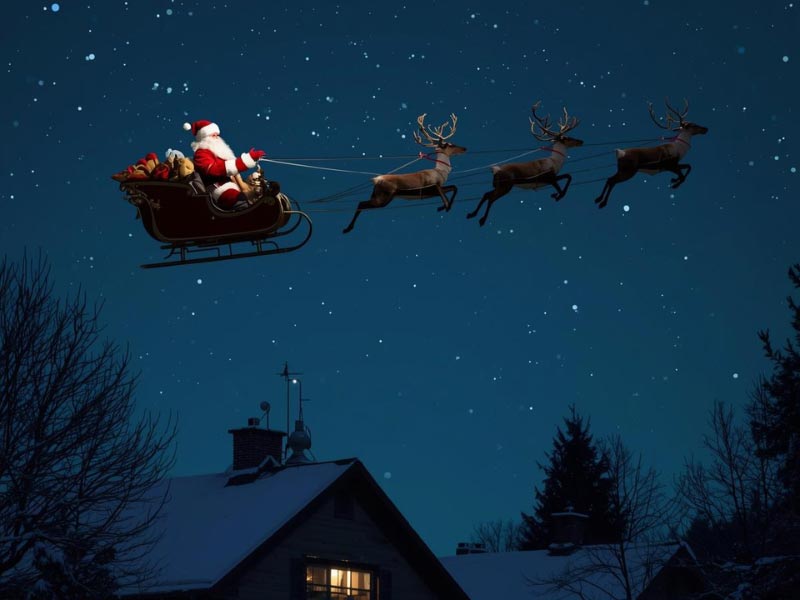
Christmas Eve 2025 marks seventy years of one of the world’s most unusual military operations. While most defense organizations spend their time monitoring airspace for potential threats, the North American Aerospace Defense Command has a different mission each December twenty-fourth: tracking a man in a red suit flying through the sky in a sleigh pulled by reindeer.
This year, millions of children and adults around the world will log onto their computers, tablets, and phones to follow Santa Claus as he makes his annual journey delivering presents to homes across every continent. The tradition combines cutting-edge military technology with childhood wonder, creating an experience that has become as much a part of Christmas as decorated trees and stockings hung by the fireplace.
The logistics of Santa’s journey boggle the mind when you break down the numbers. With over eight billion people on Earth and countless children waiting for presents, Santa must visit approximately 390,000 homes every single minute to complete his route. His total journey covers more than forty million miles, roughly equivalent to the distance between Earth and Mars. To accomplish this feat, he travels at speeds that make him essentially invisible to the naked eye, streaking across the night sky faster than any human eye can detect.
Yet despite this incredible speed and the impossibility of spotting him directly, families don’t have to wonder where Santa is or when he might arrive in their neighborhood. Technology and tradition have combined to create multiple ways to track his progress throughout Christmas Eve, turning what was once pure imagination into an interactive experience that brings the magic of Christmas to life in new ways.
The Accidental Beginning of a Tradition
The story of how a major military defense organization ended up tracking Santa begins with a simple mistake in 1955. A department store in Colorado Springs ran a newspaper advertisement encouraging children to call Santa Claus. The ad included a phone number children could dial to speak with Santa himself. Unfortunately, the number printed in the advertisement was wrong.
Instead of reaching a Santa hotline set up by the store, the misprinted number connected to the Continental Air Defense Command operations center in Colorado Springs. This was not a number that random members of the public were supposed to have access to. It was a direct line to officers responsible for monitoring North American airspace for potential threats during the height of the Cold War.
When the phone started ringing with children asking to speak to Santa, the officers on duty faced an unexpected situation. Colonel Harry Shoup, the director of operations at the time, could have simply explained the mistake and hung up. Instead, he and his staff decided to play along. They assured the calling children that yes, they were tracking Santa on their radar and he was safely on his way.
The calls kept coming as more children saw the advertisement. Rather than treating it as an annoyance, the military personnel embraced the opportunity to bring joy to children during the holiday season. They provided updates on Santa’s location based on their radar systems, creating spontaneous Christmas magic through an accidental wrong number.
The experience could have been a one-time event, forgotten after that Christmas season ended. But the military saw value in continuing the tradition. It provided positive public relations, showcasing a lighter side of serious defense operations. More importantly, it gave personnel an opportunity to connect with the communities they served and bring happiness to children during the holidays.
By 1958, when CONAD merged with Canadian air defense forces to form the North American Aerospace Defense Command, the new organization inherited the Santa tracking tradition. NORAD has continued the practice every year since, expanding and modernizing it as technology evolved. What began with a handful of phone calls in 1955 has grown into a massive operation that reaches millions of people worldwide each Christmas Eve.
How NORAD Actually Tracks Santa
The official explanation for how NORAD tracks Santa mixes playful military-speak with Christmas magic in a way that delights children while giving adults a smile. According to NORAD, the process begins long before Christmas Eve when their defense systems detect Santa’s departure from the North Pole.
The organization explains that satellites equipped with infrared sensors designed to detect missile launches actually pick up the heat signature from Rudolph’s famous red nose. These Space-Based Infrared System satellites continuously scan the entire Earth, providing twenty-four-hour surveillance capabilities. While their primary purpose involves detecting ballistic missile launches, they apparently also work quite well for spotting glowing reindeer noses.
Once Santa enters North American airspace, NORAD claims that fighter pilots in jets occasionally intercept the sleigh to confirm visual identification. These pilots report back on Santa’s speed, heading, and general wellbeing, ensuring that everything remains on schedule for Christmas morning deliveries. The mental image of military jets flying alongside Santa’s sleigh has become part of the tradition’s charm.
Ground-based radar systems also contribute to tracking efforts. NORAD operates a network of radar installations across North America designed to detect aircraft and missiles. These systems allegedly track Santa as he moves across the continent, providing continuous location updates that get relayed to the operations center and ultimately to the public through the Santa tracker website.
Of course, the reality behind the scenes involves hundreds of volunteers and sophisticated mapping software rather than actual military tracking systems being repurposed to follow a magical sleigh. But the blend of real military technology and Christmas fantasy creates an experience that feels authentic while maintaining the wonder and magic that makes Santa special for children.
The technology supporting the tracker website has evolved dramatically since those first phone calls in 1955. Early years involved operators manually updating Santa’s position and sharing information through phone calls and radio broadcasts. Today’s operation uses real-time mapping software, animated graphics, video content, and interactive features that create an immersive tracking experience accessible from anywhere with an internet connection.
Following Santa Online This Christmas Eve
The primary way to track Santa’s journey is through the official NORAD Santa Tracker website at noradsanta.org. The site launches its full tracking features on Christmas Eve, though it includes games, videos, and other content throughout December to build excitement for the main event.
On Christmas Eve, the website displays a three-dimensional map of Earth with Santa’s current location marked clearly. The animated sleigh moves across the map in real time, showing exactly where Santa is at any given moment. The tracker updates continuously as Santa progresses through his route, visiting different countries and major cities around the world.
The website provides more than just location tracking. Visitors can see how many presents Santa has delivered so far, which location he’s currently visiting, and where he’s headed next. Fun facts about different destinations appear as Santa visits various countries, teaching children about global geography and different cultures while they follow his journey.
NORAD’s site includes a countdown clock showing exactly how much time remains until Santa begins his journey from the North Pole. As Christmas Eve approaches, anticipation builds watching the hours and minutes tick down. Once Santa takes flight, the countdown transforms into the active tracker showing his progress across the globe.
The tracker experience has expanded beyond just the website. NORAD offers a mobile app available for both iOS and Android devices, allowing families to track Santa from phones and tablets. This mobile accessibility means children can check Santa’s location from anywhere, even if they’re traveling themselves during the holidays.
Social media has also become part of the tracking experience. NORAD maintains active presence on platforms like Facebook, Twitter, Instagram, and YouTube, posting updates about Santa’s journey throughout Christmas Eve. These posts include photos, videos, and location updates that supplement the main tracker website. Following NORAD’s social media accounts adds another layer to the tracking experience, with content designed to engage audiences across different platforms.
For families who prefer more personal interaction, NORAD operates a phone line on Christmas Eve where volunteers answer calls from children asking about Santa’s location. Dialing 1-877-HI-NORAD connects callers to volunteers who provide personalized updates about Santa’s whereabouts. These volunteers, numbering over a thousand each year, donate their Christmas Eve to answering calls in multiple languages, making the experience accessible to children around the world.
The phone line adds a human element that websites and apps can’t quite replicate. Speaking with a real person who confirms that yes, Santa is on his way and will definitely reach your house creates memories that last beyond childhood. Many adults remember calling NORAD as children, and now continue the tradition with their own kids, creating multi-generational connections to this unusual Christmas tradition.
Google Gets In On the Tracking Fun
While NORAD pioneered Santa tracking, they’re not the only organization offering this service. Google launched its own Santa tracker in 2004, bringing the search giant’s mapping technology and playful approach to following Father Christmas’s journey around the world.
Google’s tracker lives at santatracker.google.com and offers a different take on the tracking experience. The site uses Google Maps technology to display Santa’s route across the planet, showing his current location with the same mapping interface familiar to anyone who’s used Google Maps for directions or navigation.
Beyond just tracking, Google’s site has grown into an extensive collection of Christmas-themed games and activities. Throughout December, new games unlock each day in an advent calendar style format. These games range from coding challenges to geography quizzes to arcade-style entertainment, all themed around Christmas and Santa’s workshop. Children can play these games while waiting for Christmas Eve, building anticipation for the main tracking event.
Google’s tracker shows Santa visiting 419 different locations across every country over the course of twenty-five hours. Yes, twenty-five hours, not twenty-four. The extra hour accounts for time zone differences and the way Santa’s journey works across the international date line. Starting in the earliest time zones and working westward, Santa gains time as he travels, allowing him to squeeze in more deliveries than seems physically possible in a single night.
The destinations Santa visits on Google’s tracker include interesting historical and cultural locations. He stops at the ruins of Myra in Turkey, where Saint Nicholas, the historical figure who inspired Santa Claus legends, served as bishop. He visits Rovaniemi, Finland, which many consider the official home of Santa Claus. He makes a quick pass through Santa Claus, Indiana, presumably to honor the American town that shares his name.
Each location Santa visits comes with facts and information about the place, turning the tracker into an educational experience. Children learn about different countries, cities, and cultures as they follow Santa around the world. This educational component gives the tracker value beyond just entertainment, exposing kids to global geography and diversity in an engaging, interactive format.
Google’s tracker also shows a running tally of how many presents Santa has delivered so far. The number climbs rapidly as he moves from house to house, reaching into the billions by the time his journey completes. Watching this counter increase makes the enormous scale of Santa’s mission more tangible, helping children visualize just how much work goes into Christmas Eve deliveries.
The Technology Behind the Magic
Creating a smooth, engaging Santa tracker requires significant technical infrastructure behind the scenes. Both NORAD and Google employ teams of developers, designers, and volunteers who work throughout the year preparing for the big event on Christmas Eve.
The websites must handle enormous traffic spikes. Millions of people from around the world visit simultaneously on Christmas Eve, all checking Santa’s location at the same time. This creates technical challenges similar to major online retailers during Black Friday sales or streaming services during hit show releases. Servers must scale to accommodate the load without crashing or slowing down.
The tracking animations need to update in real time across all those simultaneous users. Everyone seeing the website at the same moment needs to see Santa in the same location. Synchronizing this across millions of connections requires careful programming and robust server infrastructure. The experience must feel seamless, with Santa’s sleigh moving smoothly across the map without glitches or delays.
Mobile apps add additional complexity. Apps must work across different phone models, operating systems, and screen sizes. They need to function even when internet connections are slow or unstable, as many families track Santa from rural areas or while traveling. Offline features and cached data help ensure the app remains usable even with connection issues.
Volunteers answering phones need scripts, training, and support systems. NORAD’s phone operation involves over a thousand volunteers working shifts throughout Christmas Eve. They need talking points about Santa’s location at different times, answers to common questions, and guidance for handling various caller situations. Coordinating this many volunteers requires significant logistical planning and management.
The mapping systems need to be accurate but also entertaining. Santa’s route must make geographic sense, progressing logically across time zones and continents. But it also needs to hit interesting, recognizable locations that children will find exciting. Balancing realism with entertainment value requires thoughtful route planning and careful consideration of what makes the experience engaging.
Security and reliability matter enormously. Websites going down on Christmas Eve would disappoint millions of children and families. Both NORAD and Google implement redundant systems, backup servers, and careful testing to ensure nothing fails when it matters most. The stakes might seem low compared to other technology operations, but the cultural importance and the potential for disappointing children creates genuine pressure to get everything right.
The Global Reach of Santa Tracking
Santa tracking has become a truly international phenomenon. While NORAD is a North American organization and Google is an American company, their trackers reach audiences across every continent. The tradition has spread far beyond its origins, becoming part of Christmas celebrations in countries around the world.
The tracker websites support multiple languages, making them accessible to non-English speakers. NORAD’s site offers content in eight languages including French, Spanish, German, Italian, Japanese, Portuguese, and Chinese. Google’s tracker supports even more languages, reflecting the company’s global presence. This linguistic accessibility has helped the trackers become worldwide traditions rather than just American or North American ones.
Volunteers answering NORAD’s phone line speak multiple languages, allowing children from different countries to call and receive updates in their native language. This personal touch in various languages makes the experience feel more inclusive and less centered on any single culture or nation.
Different cultures bring their own traditions to tracking Santa. In some countries, families gather around computers together to follow his journey as a communal activity. Others check periodically throughout the evening between other Christmas Eve traditions. Some use the tracker as a way to convince children it’s time for bed by showing that Santa is getting close to their location.
The tracker has influenced how different cultures think about Santa Claus and Christmas delivery traditions. Countries with their own gift-bringing figures sometimes adapt the tracker concept to their local traditions. The global spread of the tracker has, in some ways, helped standardize the American version of Santa Claus internationally, though local variations and traditions certainly persist.
Time zones create interesting dynamics in the tracking experience. Santa begins his journey in the earliest time zones, visiting places like New Zealand, Australia, and parts of Asia first. Families in these regions can track Santa arriving while children in North America are still in the middle of their December twenty-fourth afternoon. By the time American children are going to bed on Christmas Eve, Santa has already visited much of the world.
This time zone progression means the tracking experience differs depending on where you live. Children in Australia might track Santa approaching their region, while children in California are watching him work through Asia and Europe, still hours away from North American deliveries. The global nature of the tracker makes this visible in a way that wasn’t possible before real-time tracking technology existed.
What Keeps the Tradition Going
Seventy years after that first accidental phone call, the Santa tracking tradition shows no signs of slowing down. If anything, it has grown more elaborate and reached more people with each passing year. Several factors explain why this unusual mashup of military technology and Christmas magic continues to thrive.
The tradition connects generations. Adults who called NORAD as children now track Santa online with their own kids. They remember the excitement of knowing where Santa was, and they want to share that experience with the next generation. These multi-generational connections give the tradition staying power beyond just novelty or entertainment value.
Technology keeps the experience fresh and engaging. What began with phone calls and radio updates has evolved through internet websites, mobile apps, social media integration, and interactive games. Each technological advancement has added new dimensions to the tracking experience, keeping it relevant and interesting even as digital entertainment options have multiplied enormously.
The human element remains crucial despite the high-tech presentation. Volunteers donating their Christmas Eve to answer calls, developers working to ensure smooth website performance, and military personnel lending their organization’s name to spreading holiday joy all contribute personal touches that pure automation couldn’t replicate. Knowing that real people are making this happen adds authenticity that purely commercial operations might lack.
The tradition costs nothing for participants. In an era where so much Christmas activity involves spending money, tracking Santa remains completely free. Anyone with internet access can participate fully without paying for apps, subscriptions, or special features. This accessibility means the tradition reaches families across all economic situations, making it genuinely inclusive in ways many Christmas activities are not.
It provides shared experiences in an increasingly fragmented media environment. Families might watch different TV shows, play different games, and consume different content most of the year. But on Christmas Eve, millions of people around the world are doing the same thing at the same time: tracking Santa. This collective experience creates a sense of connection and shared tradition across vast geographic and cultural distances.
The tradition also offers something rare: unambiguous positivity. In a world full of conflicts, problems, and concerns, tracking Santa is pure, simple fun with no downside or controversy. It exists solely to bring joy to children and families. That straightforward goodness appeals to people looking for breaks from more complicated aspects of modern life.
How Christmas Eve Tracking Unfolds
Understanding the typical timeline of Christmas Eve tracking helps families plan their tracking experience. While specific timing varies by time zone and year, the general progression follows similar patterns.
Santa’s journey begins when Christmas Day first arrives somewhere on Earth. The first places to reach December twenty-fifth are small islands in the Pacific Ocean near the international date line. According to the trackers, Santa departs the North Pole in the hours before these earliest time zones hit midnight, ready to begin deliveries the moment Christmas officially arrives.
His first stops occur in the South Pacific, visiting countries like Kiribati, Tonga, and parts of New Zealand. He then progresses westward through Asia, visiting Australia, Japan, China, India, and other Asian nations. These deliveries take up much of the early portion of his journey, covering enormous populations across vastly different cultures and geographies.
From Asia, Santa moves into Europe, Africa, and the Middle East. The tracker shows him visiting major cities across these continents, dropping presents in countries from Norway to South Africa, from Ireland to Egypt. The European portion of his journey occurs while North American children are typically still awake on their December twenty-fourth evening.
The Atlantic crossing brings Santa to South America and eventually North America. By the time he reaches Canada and the United States, it’s typically late evening or night in those regions. Children across the Americas can track him getting progressively closer to their neighborhoods, building excitement as his arrival approaches.
The journey concludes in the latest time zones, places like Hawaii and small Pacific islands where Christmas Day arrives last. By the time Santa completes his final deliveries, Christmas Day has fully begun across the entire world, and children everywhere are waking up to presents under their trees.
The entire journey, despite covering forty million miles and billions of deliveries, somehow compresses into roughly twenty-five hours of tracking time. This impossible feat is explained away through Christmas magic, time zone manipulation, and the incredible speed of Santa’s sleigh. The logistics don’t need to make literal sense because the magic is the point.
Why We Track Someone Who Doesn’t Exist
The obvious question underlying this entire tradition is: why do we track someone we know isn’t real? Adults clearly understand that Santa Claus doesn’t actually fly around the world in a sleigh pulled by reindeer. Children eventually learn this too. Yet the tracking tradition persists and even grows, embraced by people who rationally know there’s nothing actually to track.
The answer lies in what the tradition represents beyond its literal content. Tracking Santa creates shared experiences between parents and children. It provides opportunities for families to gather around screens together, engaged in the same activity at the same time. In an era of individual devices and personalized entertainment, these collective experiences have become more rare and therefore more valuable.
The tradition maintains childhood wonder in an age where information and reality are constantly accessible. Children today grow up with unprecedented access to facts, data, and real-world information. The mystery and magic that previous generations experienced more naturally requires more intentional creation now. Tracking Santa provides a framework for maintaining that sense of wonder and possibility that makes childhood special.
It teaches children about global geography and cultural diversity in an engaging context. Following Santa around the world exposes kids to place names, maps, and different countries. They learn where things are located and that the world extends far beyond their immediate surroundings. This educational component justifies parent investment of time in what is fundamentally a game of pretend.
The tradition also demonstrates that serious organizations and adults can embrace playfulness and joy. NORAD’s participation shows that military professionals can engage in something purely fun without it diminishing their serious work. This sends valuable messages to children about maintaining capacity for joy and play throughout life, not just in childhood.
For adults, participating in Santa tracking connects them to their own childhoods. It recreates feelings and experiences they remember from younger years, providing nostalgic comfort while creating new memories with their children. This multi-generational aspect makes the tradition meaningful for parents beyond just entertaining their kids.
The tracking also extends Christmas magic later into childhood. Children who might be questioning Santa’s existence get evidence that seems to confirm he’s real. The tracker provides tangible proof that can sustain belief a bit longer. While some might question whether prolonging a fiction is appropriate, many families value the extra years of childhood wonder that tracking enables.
Ultimately, tracking Santa on Christmas Eve has become a tradition because traditions don’t require rational justification. They exist because communities value them, because they create meaning and connection, and because each repetition strengthens their place in cultural consciousness. The tracking tradition has reached that status, becoming self-sustaining through its own momentum and the collective investment millions of families make in it each year.
As Christmas Eve 2025 approaches, millions of people worldwide will once again log onto noradsanta.org or santatracker.google.com to follow Santa’s progress across the globe. They’ll watch the animated sleigh move across digital maps, check how many presents have been delivered, and learn facts about different countries Santa visits. They’ll call phone lines to ask volunteers where Santa is right now. They’ll share tracker screenshots on social media and talk with their children about when Santa might reach their neighborhood.