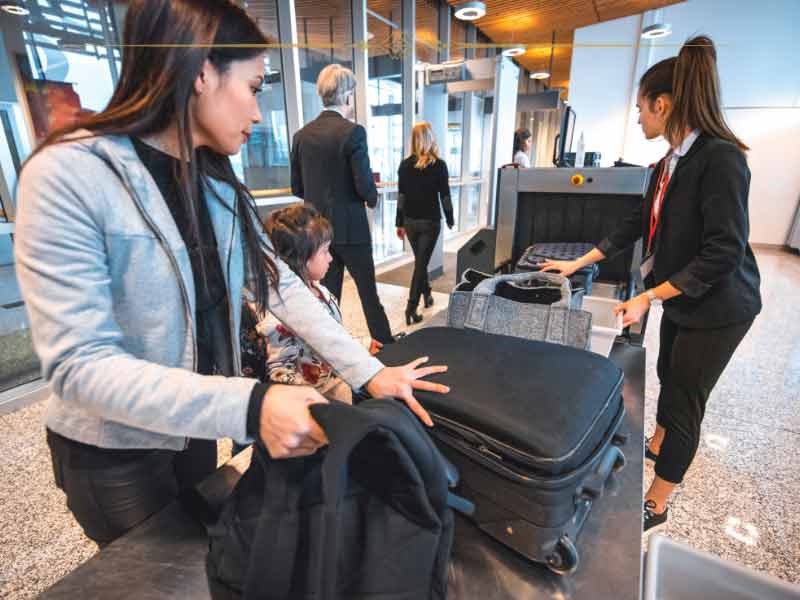
It does not have an official name in any airport rulebook, but it has been happening at security checkpoints across every major American airport for years, and the people it affects have strong feelings about it. The behavior is simple to describe: a traveler reaches the end of the security conveyor belt, collects their laptop, shoes, belt, and carry-on bag, and then walks away without doing anything with the plastic tray they just used. They leave it sitting on the unloading table, or worse, abandon it directly on the belt, where it immediately starts creating a pileup that slows down everyone behind them.
This habit now has a name. It is called belt bumping, a term that captures exactly what is happening: the responsibility for dealing with the tray gets bumped from the person who used it onto everyone else in the line. Security staff have to interrupt what they are doing to clear backed-up trays. The next passenger cannot access the belt. The whole choreography of one of the most time-pressured environments in modern travel gets disrupted by someone who simply decided that putting a tray back was not their problem.
It sounds like a minor thing. Anyone who travels through airports regularly knows it is not.
Why This Matters More Than It Might Seem
Airport security is one of the most logistically compressed environments that ordinary Americans move through on a regular basis. There are flights to catch, connection windows to protect, and queues that can stretch back far enough to create genuine time pressure for travelers who arrived with what seemed like adequate buffer. Everything in the security process is sequenced: belts move, trays flow, staff scan, passengers collect. When that sequence gets disrupted at the collection end, it creates a backup that propagates backward through the entire system.
When someone leaves a tray on the belt rather than moving it to the designated return area, it does not just create a minor inconvenience. It forces the conveyor to either stop or start stacking trays in ways they were not designed for. Other passengers’ belongings, which are still moving through the X-ray machine, have nowhere to go at the other end. Security staff who should be monitoring screens and processing bags have to physically intervene to clear the jam. The delay created by a single abandoned tray can cascade through multiple passengers and eat into the time that people calculated very carefully when they booked their airport arrival.
For American travelers dealing with an already-stressed security environment, one that has been operating under TSA staffing challenges that have generated headline-making wait times at major airports this year, the additional friction created by belt bumping is not trivial. It compounds an existing problem rather than adding a fresh one to a frictionless baseline.
How Travelers Feel About It
The people who travel through airports regularly and notice this behavior have developed fairly strong opinions about it, and the consistent thread running through those opinions is that belt bumping reads as a statement about the person doing it rather than simply a lapse in awareness.
The most common comparison made by frequent travelers is to the shopping cart problem, a parallel that most Americans will immediately recognize. Returning a shopping cart to the designated corral at the end of a store visit is not legally required, does not directly benefit the person doing it, and takes about thirty seconds. Whether someone does it anyway is widely understood as a small but reliable indicator of whether they consider the inconvenience they create for others when they do not. Belt bumping operates on the same principle. The tray return takes ten to fifteen seconds, creates a cleaner flow for everyone behind you, and is visibly requested by airport staff and signage throughout the security area. Choosing not to do it is a choice, and it is one that other travelers notice and remember.
Some frequent flyers have reached the point where they actively compensate for belt bumpers by collecting abandoned trays themselves and returning them to the stack, a behavior that gets positive reactions from security staff who are typically managing too much to address every abandoned tray proactively. The impulse to do this reflects how strongly some travelers feel about the cumulative effect of the behavior rather than any individual instance of it. When enough people leave trays, the section of the airport between the X-ray machine and the belt return becomes a cluttered obstacle course that everyone in the vicinity is navigating around.
The social media response to belt bumping content reflects the same frustration. When travelers post about the behavior or about cleaning up abandoned trays, the comments fill with people sharing their own experiences and reactions. Airport security workers who weigh in on these conversations consistently express appreciation for the passengers who take the thirty seconds to do the tray return, not because it saves them significant labor in any individual instance, but because it represents an acknowledgment that security is a shared process and that everyone moving through it has a role to play in keeping it functional.
The Germ Question That Makes the Tray Situation Even More Complicated
There is a biological dimension to the airport security tray that most travelers prefer not to think about in too much detail, but that has real relevance to the belt bumping conversation in an unexpected way.
Research conducted several years ago by scientists studying disease transmission in public environments found that airport security trays are among the more heavily contaminated surfaces in the travel environment. The study, conducted by researchers including scientists from the University of Nottingham, identified traces of rhinovirus, the primary cause of the common cold, on airport security tray surfaces. This finding was consistent with what anyone with common sense would expect from surfaces that are handled by thousands of people per day, rarely wiped down between uses, and passed directly between strangers in a high-throughput environment.
The relationship between this information and belt bumping is not immediately obvious, but it exists. Some travelers who are aware of security tray contamination use it as a reason to avoid touching the trays more than necessary, including avoiding the tray return step. From a personal hygiene perspective, the reluctance is understandable. From a practical standpoint, anyone who has touched a security tray for the purpose of putting their belongings in it has already made contact with whatever is on the surface, and the marginal additional contact involved in moving the tray to the return stack is not meaningfully different from the contact already made.
What the germ research does not justify is leaving the tray where others are more likely to bump into it, reach across it, or handle it in unintended ways. The solution to not wanting to handle a contaminated surface at an airport is washing your hands after the security process, a step that is good practice regardless of tray handling. Hand sanitizer at the other end of the security area is available at most major American airports for exactly this reason. The contamination issue is a real one, but it does not generate a logical case for belt bumping as a response.
The Etiquette Question: Is This Actually Bad Manners or Just a Personal Preference?
There is a legitimate debate to be had about where personal responsibility ends and shared social obligation begins in environments like airport security. Etiquette experts who have weighed in on the belt bumping question have generally drawn a distinction between what is considerate behavior and what constitutes a genuine breach of social obligation.
The considerate position is clear: able-bodied travelers who have time to return a tray should return the tray. It takes fifteen seconds, it improves the experience of every person behind them in the queue, and it is directly and visibly requested by the airport through signage and, in many cases, staff instructions. Doing it is straightforwardly good airport citizenship.
The breach-of-obligation question is where things get more nuanced. Travelers managing young children, elderly family members, mobility challenges, or the particular chaos of getting through security with multiple family members simultaneously are in a genuinely different situation from a solo traveler with a single carry-on. Expecting someone who is simultaneously managing a stroller, a toddler, shoes, a laptop, and carry-on bags to also navigate the tray return without external help is not a realistic standard of behavior. The social grace in those situations arguably falls to nearby travelers without those constraints to give a hand where possible rather than to silently judge.
What the etiquette conversation makes clear is that belt bumping as a consistent personal habit, practiced by able-bodied solo or small-group travelers who simply choose not to engage with the tray return, is a different matter from the situationally understandable lapses that occur in genuinely difficult circumstances. The frustration that the behavior generates is aimed at the former category rather than the latter, and that distinction is worth making explicitly because it prevents the conversation from becoming unreasonably demanding of people in genuinely difficult circumstances while still holding the line on what considerate behavior looks like from those who have no excuse.
What Airport Security Staff Actually Experience
The perspective of the people who work in airport security and deal with the downstream effects of belt bumping every shift is worth including in this conversation, because they experience the behavior in a way that travelers only observe.
Security workers at busy American airports are managing a high-volume, time-pressured process that requires continuous attention to the screening functions they are trained and responsible for. When trays pile up at the collection end because passengers are not returning them, someone has to physically address that pileup. In many cases, that someone is a security officer who is simultaneously supposed to be watching a screen or managing the flow through the checkpoint. The diversion of attention is not dramatic in any individual instance, but it is real and it compounds across a shift in ways that affect both the officer’s ability to do their job effectively and their experience of a shift that is already demanding under normal conditions.
Security workers who have commented publicly on the belt bumping phenomenon have been consistent in expressing appreciation for the passengers who make a point of returning trays, not in a sycophantic way, but in the genuine and practical way of someone whose workday is made measurably easier by travelers who acknowledge that the security process is a shared responsibility. The fact that doing the right thing earns visible gratitude from airport staff rather than simply being an expected baseline behavior reflects how low the baseline has drifted.
The Simple Fix That Would Make Every Airport Experience Better
The solution to belt bumping is not a new policy, a regulatory change, or a technology intervention. It is a behavioral norm that, if widely adopted, would improve the flow and experience of airport security for millions of travelers every day without requiring any infrastructure change or additional cost.
Return the tray. It takes fifteen seconds. It involves moving a lightweight plastic container from the point where you are standing to a rack that is generally located within a few feet. It does not require special knowledge, physical strength, or any equipment. It is something that anyone who is capable of managing their own belongings through a security checkpoint is capable of doing with essentially no additional effort.
What makes it genuinely difficult is not the physical act but the social one. Doing the tray return when others around you are not creates a small moment of doing something more than the minimum when the minimum is going completely unpunished. That social dynamic is exactly why the behavior has become as common as it is. Nobody stops a belt bumper at the checkpoint. Nobody calls it out in the moment. The consequences fall on the next traveler, and on the one after that, and on the security staff, but never on the person who created them.
The travelers who consistently return their trays, regardless of what those around them are doing, are making a decision to prioritize the shared experience of a space they move through briefly over the thirty seconds it would take to navigate a slightly smoother personal exit from the security area. That decision is invisible in any individual instance and meaningful in aggregate. It is also, by nearly universal agreement among frequent travelers, the difference between being the kind of airport citizen that makes the process work and being the kind that makes everyone else’s morning slightly worse for no reason at all.