

No trip to Tuscany is complete without learning how to cook by taking an Italian cooking class, and where best to experience the local cuisine than Florence?
I always found it funny how some people go to Italy and prefer to eat at McDonalds or other fast food as such. I also wondered why there is Mc Donald’s in a country with such a rich food culture, with so many delicious dishes that it would probably take a lifetime to discover all. Each region of Italy has its own cuisine based on the local fruits, vegetables and herbs. I can imagine that every Italian has a small herbs corner somewhere in their house. The Italian cuisine is not only about pizza or pasta! During my month in Tuscany I have discovered amazing fish dishes, premium cuts of beef, the pecorino cheese and the bresaola ham, the local dips and sauces, the crostata or the jam biscotti.

The Tuscan cuisine
The traditional Tuscan cuisine is based on simplicity and flavour, with most of the dishes having only a couple main ingredients. Olive oil is at the base of the Tuscan cuisine and the best way of tasting it, especially if it’s new, in autumn, is by having it on bread. Fettunta is grilled Tuscan bread (without salt), rubbed with garlic and generously drizzled with olive oil. Another typical dish is Ribolita, a traditional soup made out of beans and stale bread. If we’re thinking about dessert, then I’ll have to mention castagnaccio, a cake made out of chestnut flour, raisins, rosemary and olive oil.

Cooking classes in Florence
What should you take in consideration when you book a cooking class in Firenze, you might ask, confused by the high number of companies that offer them. The first criteria you should look at is how authentic the cooking class is. Is it run by locals? Is it outside a touristy area? Does it include a visit to the market? How much will be your contribution to the actual cooking? What kind of food will you make and how many dishes?

Based on all of these questions I have decided that the best cooking class in Florence for me would be the one offered by Eating Europe Food Tours. I have taken a food tour of Soho with them before and I was so impressed by the quality that I decided to choose them again on my trip to Italy. It was actually very hard to choose what I would like to go for because all their Florence food tours are amazing and involve getting to know the local cuisine and culinary traditions the city has to offer. There is nothing touristic in their tours and everything is locally sourced, supporting the local community. You can book this same cooking class by clicking here.
Visit the local market
I’ve met Paulo, our guide for the day, in Piazza Santo Spirito of the local Oltrarno neighbourhood and because I was the first one to arrive, he did give me a few recommendations about the part of Tuscany I was staying at, advising me not to miss the upcoming truffle festival. Soon the other cooking “students” joined and we headed towards the local market, to buy fresh ingredients for our lunch. Paulo explained how to buy vegetables in Italy, which ones to choose in summer and which ones to go for in winter. Italians cook different dishes, depending on the season. As it was autumn, he recommended us the cauliflower, the cavolo nero, sprouts, fennel and spinach. He told us that when you go to the market you are not allowed to touch the vegetables yourself, you need to let the seller bag them for you.

For our menu, Paulo gave us a choice for the filling of the ravioli: spinach and ricotta or zucchini. As the spinach was almost eyeing us, with its beautiful green colour and the perfect shape, while the zucchini was not really in season anymore, we went for the first option.
Out next stop was to a local bakery, from where we bought freshly made olive oil schiaciatta (the Tuscan focaccia).

I mentioned before that the Tuscan bread doesn’t have salt. Do you wonder why? Back in the middle ages, when Tuscany was divided into communes (Florence, Pisa, Lucca, Siena, Arezzo), Pisa tried do make Florence to surrender in one of their battles, so it stopped the salt reaching the town. Florence didn’t surrender and started to bake without salt, and this is how the Tuscan bread was born.
Our last shopping stop was at a local cheese shop, from where we bought ricotta for the ravioli, and prosciutto. The owner of the tiny shop was a cheese connoisseur, working with it since he was a child, learning all the secrets from his father. He shared with us a plate of pecorino and told us all about the different types and tastes of this Tuscan cheese. Pecorino tastes different, depending on how much time it was aged for. The fresh Pecorino is almost white, with a creamy texture while the stagionato Pecorino (matured) is crumbly and has a nutty taste. Shall I say that I filled my bag with Pecorino on my return from Italy?

Regarding ricotta, there are also three different types that come from three different animals: goat, cow and sheep. The goat’s ricotta is quite strong, and you would want to use it in combination with honey or fruits, or in salads. Cow’s ricotta is milky, with a hint of sweetness and is the one to use in desserts. We used sheep’s ricotta in our ravioli because of the milky but still cheesy taste.
Learn how to make pasta from scratch
After our local products shopping spree, we arrived at the cooking studio, where wet also met Giorgio, the chef who was going to teach us how to make delicious Italian food. We washed our hands, put our aprons on and drank a shot of espresso for encouragement.
Each of us had in front 2 bowls of flour (0 and durum grain), eggs, and a pasta rolling machine. We didn’t wait too much before we got our hands in and make the dough for the pasta. When the dough became smooth, we wrapped it in cling film and let it rest for half an hour, while we made the sauce for it.
Fast forwarding, the best part of making pasta was actually rolling it through the machine. I am not going to lie, it is not easy when you keep rolling and it stretches to over one meter long, but it’s surely fun.

Depending what are you making, you cut or not the pasta. We’ve made ravioli and tagliatelle and whilst for the first one we left the pasta as it was, for the second one we passed it through the cutting end of the machine. As soon as the pasta comes out cut we had to coat it in flour, so it doesn’t stick. Then let it rest until we boiled it.
Mamma’s secret tomato sauce
Every Italian mamma has her own secret tomato sauce and probably this is the reason why the homemade food in Italy tastes so delicious. Now I can’t tell you what the secret is, but you should know that the sauce should be as thick as possible. And for this, you must boil it quite a lot. While our pasta was resting, we moved from the studio into the kitchen and learned how to correctly cut onions and garlic. Did you know that the fastest way of cutting an onion is by slicing it almost all the way through the end then turning it around and chop it? Or that you should use the entire blade of the knife to chop garlic very small?

The onions and garlic went into the pan drizzled with olive oil and cooked for a few minutes. As the tomatoes season was gone, Giorgio told us that it’s ok to use good quality canned tomatoes as they are much better than the out of season flavourless fresh ones. Another secret of the tomato sauce is to add a pinch of sugar, to balance the acidity.
Bruschetta
The next step was to make the topping for our bruschetta. We chose cherry tomatoes from the market and we chopped them tiny-tiny.

Bruschetta is one of the most flavoursome simple Italian appetisers, where a grilled slice of bread is rubbed with garlic and then topped with tomatoes and basil. An explosion of flavours inside your mouth!
Ravioli
I would have never ever imagined that I would make ravioli with my own hands. I always finded them delicious but impossible to even think how to make them. And what a surprise did I have when I realised it is not that hard at all.
The first step into making ravioli is the filling (while the dough is resting). A crushed garlic goes into a pan in which we previously added olive oil, after which the spinach goes in. The goal is to cook the spinach and squeeze all the water out of it. Once cooled down, we chopped it and mixed it with the ricotta cheese but also with parmesan. We seasoned it with salt, pepper and nutmeg, and put it aside.

The secret of making ravioli is to seal the pasta so that there is no air trapped inside with the filling. For this to happen we had to put the filling in the middle and then fold it from the back towards the front, pressing with our fingers on the sides. The last step is to seal the ravioli with a bit of water in the front, making sure there is no air left inside and that the margins of the dough touch the filling. It is much easier than I’m trying to explain.

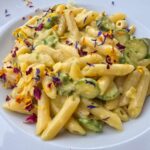
For the sauce, Giorgio chose sage and butter, to compliment delicately the flavour of the spinach and ricotta inside the ravioli. Shall I say that after the cooking class I’ve made sage and butter sauce every time I cooked pasta at home?
Panna cotta
Another Italian classic that looks intimidating and hard to make is Panna cotta. I always wondered how to achieve that perfect steady look and shape, while still creamy and soft. The secret is in the gelatine leaves.
Giorgio made the panna cotta in about 5 minutes while we all gazed astonished at how easy it is. He then made a caramel and chocolate sauce to go above it, topped with nuts, while we were outside enjoying prosecco. Yummy!

Prosciutto and homemade prosecco
The cooking class in Florence took place in a beautiful building with a terrace on top, where the chef is growing his own herbs. The terrace is surrounded by the traditional old buildings of Florence and we were told that the community is very connected together, everyone knowing their neighbours and helping each other when they need something. They often chat from one window to another.
While we took a break from cooking, we climbed the stairs to the terrace where Paolo brought 2 bottles of homemade prosecco and a platter of the prosciutto that we bought earlier. Yes, Italians do make their own prosecco and it tastes delicious! It is not as fizzy as the one you buy in a store, but it surely has a unique flavour and texture.

Overall, I was extremely happy with the cooking class in Florence organised by Eating Europe Food Tours. It was not only exceptional, with a skilled and local chef, but also very entertaining and it included so much more than it was written on the website. I highly recommend it to everyone who wants to learn how to cook Italian food in Tuscany! And if you are searching for something a little bit different, check out their unique food tours of Florence, where you can taste artisan food but also the famous Fiorentina steak while watching the sunset.

Disclaimer: Please note that this post has been written in collaboration with Eating Europe Food Tours and I was their guest on the food tour. However, all the opinions and thoughts in this article are my own.
Some of the links on this website are “affiliate links.” This means that if you click on the link and do a purchase, I will receive an affiliate commission at no extra cost for you. This helps me keep my website running and continue to share my traveling knowledge with you. I thank you for booking your flights or hotels using the links on my website. Regardless, I only recommend products or services I use personally and believe will add value to my readers.


I love pasta, especially those with red sauces. I also like to make my own sauces from scratch from time to time. I have yet to try making the pasta noodles myself. That would one adventure! I would love to learn Italian cooking from an Italian chef.
Wow! I learned so many things from your post – from saltless Tuscan bread to secret tomato sauce to techniques in cutting onions! Very informative! I am also happy with you attending this cooking class in Florence! I will check Eating Europe Food Tours and know more about them. But for now i can only share this to my friends. I can’t go to Europe this time. Thanks for this post!
That sounds and looks amazing! I visited Florence briefly in the summer, but only spent half a day here. We are planning to return next year so will look into taking a cooking class.
I LOVE Italian food, its full of taste, culture and gives you this warm lovely feeling. Cooking classes in Florence seems to be a great idea, I think no trip is complete unless you actually grab a part of their culture and bring it back home, and what a better way to do it. Impress your friend and family with your new cooking skills!! THANKS PINNING IT 🙂
What an awesome experience! I would love to have this experience this too. The panna cotta with caramel sauce seems good to me. I love that dessert 🙂 Anyway, I enjoyed your post. Thank you for this.
Ah, what an evocative phrase- food culture!
And what a perceptive article too !
Your post has alo reminded of the state of affairs in India. We too have a rich food culture like in Italy but I wonder why there are so many McDs here.
Italian cuisine are like foods from heaven haha they are foods made with perfection. I love Italian cuisine especially their wide range of pasta and bread dishes!
Why simple dine with famous restaurants if you can actually learn how to cook your favorite Italian dishes through cooking classes right? I guess the experience of learning how to cook them will make a trip to Italy even more memorable!
it’s like when you finally applying what you learned at home and serving it with your guest.. you can brag about it and tell it with confidence saying.. “I learned that from Italy” haha
kidding aside, it must be a great learning experience!
I love Italian food and learning how to cook one seems like a good course to take. Seeing those veggies made my head thinking on what food to serve my family next. Currently, my child is teething and he barely eats. It was and still is a struggle. Now, by seeing this, I think I should serve him some pasta. He likes it.
this is actually my idea of the perfect day and the perfect day trip to Italy!!! I so need to do this x
How fun is this! I wouldn’t think to take a cooking class while I’m in another country…but I love it, and will have to look into this the next time I travel abroad!