
A couple of weeks ago I visited Valencia for the first time. I knew nothing about the city beforehand, I just found some cheap flights and off I went. And I absolutely loved it! Valencia is such a great city, with both a great urban and a beach, it’s green, vibrant, and full of cafes and restaurants spreading their terraces on the pavements.
But the food! Let me tell you about the amazing dishes you can try in Valencia. Patatas bravas and tortilla, as delicious as you are, move aside! Valencia introduced completely new dishes to me that I now crave enough to book a flight back. If when you are thinking about what to eat in Valencia only paella comes to mind, keep reading. This is why I decided to write this delicious Valencia food guide, and share it all with you.
About the Food in Valencia
When it comes to typical food in Valencia, everyone’s mind will go to Paella. Obviously. But not many other dishes will come to mind. Maybe some good seafood. And this is where I come in, to introduce you to some amazing traditional dishes to try in Valencia.
Yes, Valencia is the birthplace of paella. And yes, you should absolutely try it here, at least once. But to stop at it would be missing the point entirely. The cuisine in Valencia has been influenced by its surroundings: the sea, the fertile farmland, the rice fields, the mountains. One moment you’re eating something simple, like freshly opened oysters at the market, the next you’re discovering dishes you’ve never even heard of before like eels in a smoked garlic sauce.
In this Valencia food I tried to include everything else, beyond paella, based on my own experience in the city. You have probably never heard of most of them, and I take it as my mission to introduce you to some of the most memorable flavours Valencia has to offer.
What to Eat in Valencia
Paella Valenciana
Of course, we have to start with paella, as the number one on the list of what to eat in Valencia. Because Valencia is the birthplace of paella, and there is no better place to try it anywhere else in Spain.
The first time I had a proper paella here, it was nothing like I expected. No seafood piled on top, no overly rich flavours, and no “everything in the pan”. Instead, it arrived in a wide, shallow pan, the rice perfectly golden, with pieces of rabbit and chicken nestled between green beans and large white butter beans.
Paella is, at its heart, a rice dish cooked slowly in a wide, flat pan, designed so that the rice cooks evenly in a thin layer. It usually starts with olive oil, followed by meat and vegetables, then tomatoes and paprika, before the rice is added and left to simmer gently in a rich broth. One of the most important elements is the socarrat, that slightly crispy, caramelised layer of rice at the bottom of the pan, which locals will tell you is the best part.
An authentic paella Valenciana is very specific. It’s made with rabbit and chicken, farm vegetables from the region, and rice grown in the nearby Albufera Natural Park. There is no seafood in the traditional version, and definitely no chorizo. The cooking method matters just as much as the ingredients too, over an open fire, which gives it a subtle smoky flavour that’s hard to recreate elsewhere.
And now that we’ve finished with paella, let’s see what other amazing foods Valencia is known for.
Arroz Meloso

If you think paella is the only rice dish worth trying when deciding what to eat in Valencia, then arroz meloso will quickly prove you wrong.
Arroz meloso sits somewhere between a paella and a risotto. It’s a rice dish, made with the same short-grain varieties like bomba or senia, but instead of being cooked until dry, it retains a rich, silky consistency. The grains are tender and coated in a deeply flavoured broth, creating a very creamy result.
I had it as part of a €15 menú del día, as a starter, which, in itself, already felt like a bargain. But what arrived at the table completely exceeded expectations.
Can you imagine that on my plate, alongside plenty of mussels, prawns, and pieces of fish, there was an entire lobster front leg? An actual lobster claw staring back at me from the plate!
Unlike paella, which is left undisturbed to form that dry layer and socarrat at the bottom, arroz meloso is meant to be stirred and enjoyed with all its moisture intact. It’s usually served in a deeper plate, and the result is almost spoonable, with every bite packed with flavour.
Fideua
Fideuà is often described as paella’s lesser-known cousin but after trying it in Valencia, I’d say it deserves just as much attention when deciding what to eat in Valencia.
At first glance, it looks similar to a seafood paella, but instead of rice, fideuà is made with short, thin noodles. The dish actually originates from the coastal areas around Valencia, where fishermen are said to have created it as an alternative to rice-based dishes, using what they had on hand.
The cooking method is very similar to paella. It’s prepared in a wide, shallow pan, starting with a base of olive oil, garlic, and often seafood such as prawns, squid, or fish. The noodles are then added and cooked in a rich, flavourful broth, absorbing all those deep, savoury notes as they soften.
Just like with paella, the pan is left undisturbed towards the end, allowing the noodles at the bottom to crisp up slightly, creating a bit of texture. The top layer stays tender, while the bottom develops that lightly toasted finish.
It’s usually served with a spoonful of allioli on the side, which adds a creamy, garlicky kick that works perfectly with the seafood flavours.
Arroz Negro

Arroz negro is one of the most striking dishes you’ll come across when exploring what to eat in Valencia, and not just because of its colour.
As the name suggests, this is a black rice dish, its deep, inky shade coming from squid ink. It might not look the most inviting at first glance, but one bite is enough to understand why it’s so popular. The flavour is rich, slightly briny, and intensely savoury, with a depth that feels very different from other rice dishes.
Like many of Valencia’s specialities, arroz negro is closely tied to the Mediterranean and the region’s fishing traditions. With easy access to fresh seafood, dishes like this naturally became part of the local cuisine, evolving alongside classics like paella and fideuà. It’s especially common along the Valencian coast, where seafood-based rice dishes are a staple.
The preparation is similar to paella. It starts with a base of olive oil, garlic, and seafood, usually squid or cuttlefish, often combined with fish stock to build flavour. The rice is then added and cooked in the broth, with the squid ink stirred in to give it that distinctive black colour and deep taste. Like paella, it’s cooked in a wide, shallow pan and left undisturbed towards the end, allowing the rice to absorb all the liquid and develop texture.
Horchata and Fartons

I have had horchata before, in Central America but the Spanish version tastes completely different. And trying it in Valencia, where it originates, felt like discovering a completely new drink altogether.
Whilst you can try horchata in plenty of places around the city, from small street stalls to modern cafés, I chose to go somewhere a bit more traditional: Horchatería de Santa Catalina, a historic horchatería that has been serving this local speciality for centuries.
I have to say, the service was quite cold and rushed. The bill arrived almost at the same time as my order, with the card machine pushed towards me before the tray had even properly landed on the table. But I guess that is part of the charm of this place.

What truly makes this place special, though, is the interior. It’s absolutely stunning. Even though there’s a sign on the wall forbidding photos, I couldn’t resist sneaking one of the beautiful staircase leading upstairs, where there were no diners, just the toilets. The entire space is covered in traditional ceramics from Manises, depicting different local scenes.
Valencian horchata is made from chufa (tiger nuts), which are grown in the nearby countryside. Unlike the versions I had before, which were rice-based and often spiced, this one is creamy, slightly nutty, and incredibly refreshing served ice cold, which makes it perfect for the Valencian heat.
It’s traditionally paired with fartons, long, soft pastries designed specifically for dipping. I ordered one filled with chocolate, which was very soft, very sweet, and indulgent. But dipped into the cold horchata, the sweetness was perfectly balanced, cut through by that light, refreshing drink.
Fresh Seafood in Mercado Central

Mercado Central was a highlight of my trip to Valencia. I loved it so much that I returned several times, including before heading to the airport to fly back home.
Was there a paella pan inside my backpack? Yes, there was. Were there fresh black tomatoes, white asparagus, courgette flowers? Yes, there were. Did I travel with a tomato and a padrón pepper plant in my hand, all the way to England? Also yes. That’s the kind of place Mercado Central is.
I did briefly consider buying some fresh boquerones to take home, but in the end, common sense kicked in. As tempting as it was, I knew they wouldn’t be quite the same after a few hours in the plane’s hold. So instead, I did what you’re supposed to do here, enjoy everything on the spot and hope for a return visit soon.
The seafood section is incredible. Counters are lined with the freshest catch of the day, and many of the vendors will prepare it for you right there. I found myself hopping from one stall to another, sampling whatever caught my eye: plump prawns, oysters freshly shucked in front of me and handed over with a simple wedge of lemon, sea urchins cut in half, their bright orange centres glistening, as well as scallops and tender slices of octopus.
If you’re wondering what to eat in Valencia beyond the classic dishes, this is exactly where you come to taste the city at its freshest.
Valencian Allipebre

Allipebre is a traditional recipe that comes from the small, picturesque towns surrounding Albufera Natural Park, particularly places like El Palmar and Catarroja, where life has always been closely tied to the lagoon. The name allipebre comes from two key ingredients: all (garlic) and pebre (paprika). The dish itself is a rich, rustic stew, typically made by slowly cooking fish in a sauce of garlic, paprika, olive oil, and sometimes potatoes, creating something deeply flavourful and comforting.
You might see it written as allipebre de… followed by the name of a specific fish. But when it’s simply called allipebre, without anything added, it’s always understood to refer to eel which is the most traditional and authentic version of the dish, and a true Valencian speciality.
I didn’t try the classic stew version, though. Instead, I had a reinterpreted take on allipebre, served as a fritter, and it was incredible. The eel had been blowtorched, giving it a slightly smoky edge, then combined with a smoked allipebre sauce. It was served on a cream of roasted garlic and almonds, and I really don’t think I can do it justice describing how good it was.
Titaina

Titaina is one of those dishes you’re unlikely to stop at on the menu, unless you’re really looking for what to eat in Valencia beyond the obvious. At its core, titaina is a simple combination of roasted red peppers, tomato, pine nuts, garlic, and tonyina de sorra, a salted tuna belly that has been a staple in the local Valencian fishing communities for generations.
The origins of titaina are deeply rooted in the old maritime neighbourhoods of Valencia, particularly in El Cabanyal, where fishermen would prepare it using preserved tuna and whatever vegetables they had on hand. It was practical, humble food.
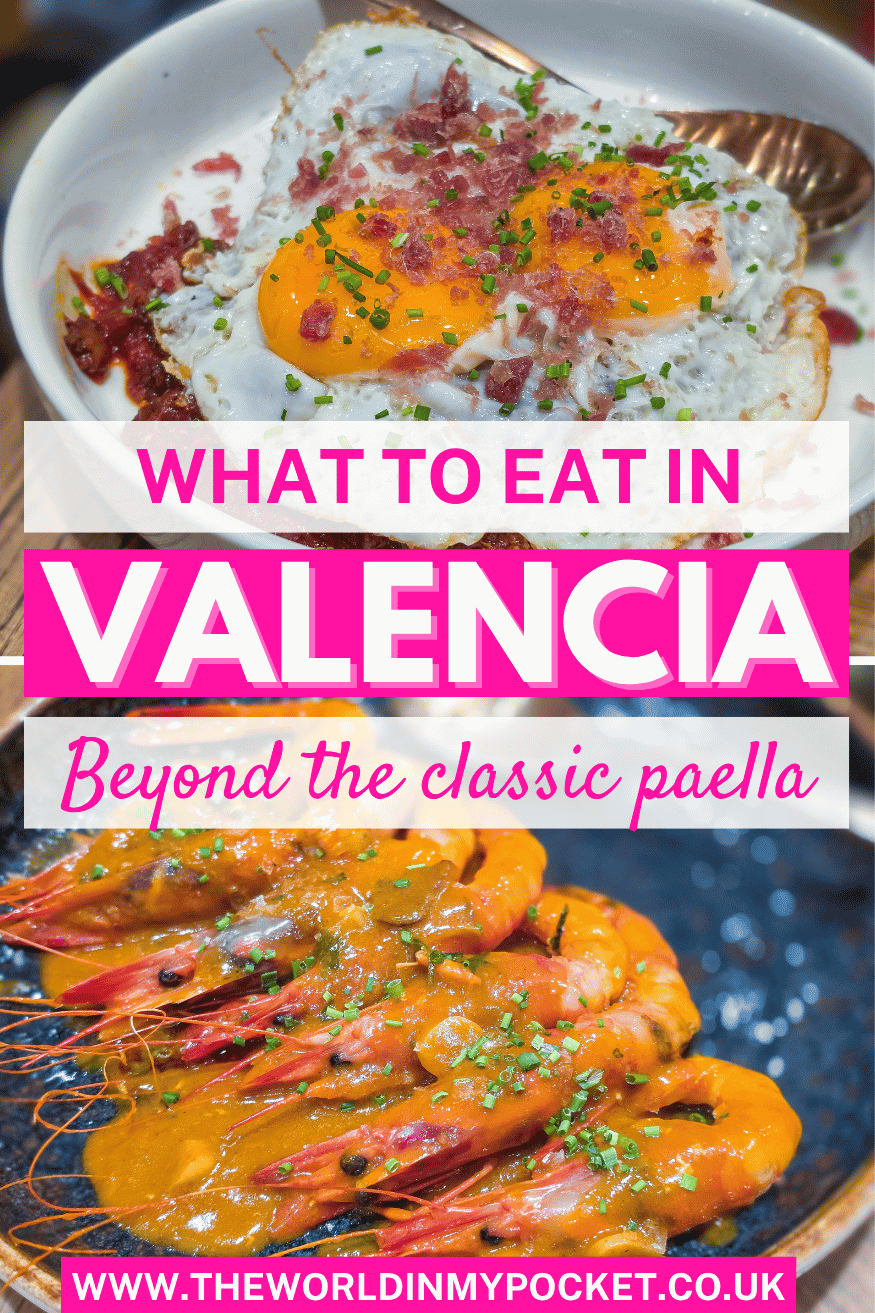
When I ordered it, it came with a double yolk fried egg on top, still soft and golden. Breaking into them and mixing everything together made the dish even better.
Valencian Red Pawns

Red prawns are another must-try when deciding what to eat in Valencia, especially if you love seafood. Thanks to Valencia’s location along the Mediterranean, the city has access to some of the freshest shellfish in Spain, and these prawns are one of the true highlights.
Known locally for their intense flavour and delicate texture, red prawns are typically caught along the eastern coast, where the deep waters help develop their distinctive taste. They have a beautiful deep red colour, even before cooking, and a sweetness that sets them apart from the more common varieties you’ll find elsewhere.
They’re often prepared very simply, grilled with just a touch of salt, so nothing interferes with their natural flavour. But when I had them, they came with a rich red sauce infused with smoked garlic, and the result was something else entirely. Unreal flavour!
Tellinas

Tellinas are tiny shellfish, similar to very small clams, found along the sandy Mediterranean shores, particularly around the Valencian coast. They’re traditionally hand-harvested right from the shallow waters, which makes them deeply tied to the local seaside culture. Because of this, tellinas are very much a seasonal delicacy, depending entirely on when they are available and allowed to be collected.
Simple as they may look, they are packed with flavour. When cooked, they open up to reveal tender, slightly briny meat that tastes like the sea in the best possible way.
The version I had was served with a Galician Mery Sauce, a classic in Spanish kitchens, especially in the northwest region of Galicia. It’s a simple combination of olive oil, garlic, parsley, lemon juice, and sometimes a splash of vinegar, all gently warmed to bring the flavours together.
Pumpkin Donuts

Pumpkin donuts are a local treat that doesn’t always make it onto the typical Valencia food guide, but they absolutely should when considering what to eat in Valencia.
They’re a very traditional dessert, yet surprisingly easy to miss if you don’t know what to look for. You won’t usually find them listed on restaurant menus. Instead, they tend to appear more casually, displayed in the window of a small café or even an ice cream shop, often next to a whole pumpkin as a quiet hint that they’re freshly made that day. If you spot them, take it as a sign and don’t hesitate.
These donuts are made from a dough that includes pumpkin purée, which gives them a soft, slightly airy texture and a subtle sweetness. The dough is piped directly into hot oil, forming rustic ring shapes, then fried until golden and crisp on the outside while staying light inside. Once ready, they’re typically dusted generously with sugar.
They’re best eaten warm, straight after frying, when the contrast between the crisp exterior and fluffy centre is at its peak. Sweet, simple, and incredibly satisfying, they make for the perfect on-the-go sugar boost while wandering through the streets of Valencia.
Turron

Turrón is one of the most famous sweets in Spain, something you’ll see everywhere, especially around Christmas, but it also has a strong connection to the region when exploring what to eat in Valencia.
At its core, turrón is a traditional nougat made from almonds, honey, sugar, and egg whites. Depending on the type, it can be either hard and crunchy (turrón duro) or soft and almost creamy (turrón blando), with the almonds playing the main role in both texture and flavour. Over time, many modern variations have appeared, from chocolate to more experimental flavours, but the classic versions remain the most iconic.
While you’ll find turrón sold all over Spain, its true origins are closely linked to the nearby town of Jijona (Xixona in Valencian), just south of Valencia. This is where the soft version of turrón was perfected, using locally grown almonds and traditional techniques that have been passed down for generations. In fact, Jijona is still considered the heart of Spain’s turrón production today.
Even outside the festive season, you’ll often come across shops in Valencia proudly displaying different varieties.
Agua de Valencia

You can’t visit Valencia and not have at least one glass of Agua de Valencia.
Agua de Valencia is a cocktail made with freshly squeezed orange juice, cava, vodka, and gin. The drink was actually invented right here in Valencia, at Café de Madrid, and that’s still the best place to try it. Despite the name, it’s not really a café, but more of a cosy, old-school cocktail bar with a nostalgic feel to it. There are comfy armchairs scattered around, walls lined with vintage posters framed in gold, dark wood panelling, and a classic wooden bar that has clearly seen decades of stories unfold. And then there’s the scent in the air, subtle but unmistakable, of orange blossoms.
The original Agua de Valencia drank here was light and fresh, not like the others I tried in other places around the city. Tangy. It didn’t taste it, but I felt it: it was quite strong.
For more similar articles, check out my recommendations below:
Like it? Pin it!
Disclaimer: Some of the links on this website are “affiliate links.” This means that if you click on the link and do a purchase, I will receive an affiliate commission at no extra cost for you. This helps me keep my website running and continue to share my travelling knowledge with you. I thank you for booking your flights or hotels using the links on my website. Regardless, I only recommend products or services I use personally and believe will add value to my readers.