
The day started very early for me, as my body couldn’t adapt to the Cuban time, so at 5am I was already awake. I rolled over in my bed for some time and then decided it’s time to finally get up. My room was tiny, bust cosy, with a covered window that led to the courtyard. I got ready for the day and went out of the room, to find Bethan already in the dining area, reading a book. Our host prepared breakfast and I got a chance to know Bethan better.
Prepare your trip to Cuba with the Lonely Planet guides. Click on the photos see the more details:
[showad block=12]
Everybody was staying in different casas. In Cuba, the Government has recently adopted a law that allows home owners to rent up to two of their spare rooms to tourists. For them, renting their rooms is an extra income but for tourists it’s a way of getting to know the real life in Cuba and stay with a family instead of in a boring state owned hotel room. You get to know more about the locals and you also get to be a participant in their lives. The families that rent their spare rooms are taking a lot of care of their guests and by staying with them you can experience their hospitality and kindness. They will always cook breakfast themselves and put on the table everything they can afford to. It is also important to know that the state will not support them. As I said before, every Cuban is entitled to a ration card, with which, for example, they can buy 5 cheap eggs a month from September to December. But these people offer their guests 2 eggs every day for breakfast, which most of the time they have to buy from the tourist stores, in CUC (the tourist currency). So, when you are visiting a casa, don’t ask for more food that you can eat and also, if you have any spare toiletries or clothes or something that you don’t need anymore, they will be more than happy if you gift it to them.
After breakfast, our group met with out guide, Danny, in order to explore Cienfuegos, as the night before we arrived to late and only had time to walk along the Malecon for 20 minutes, after dinner.
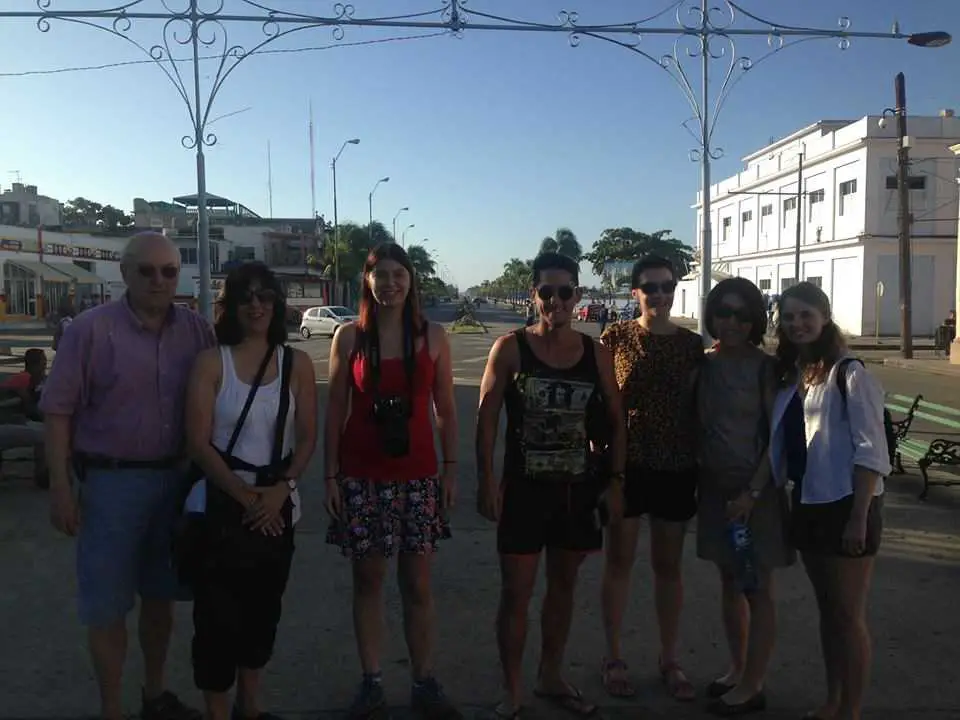
Cienfuegos (translated as “100 fires”) is part of the Unesco World Heritage List for its historic centre, as the best example of early 19th century Spanish Enlightenment implementation urban planning. We started walking towards the centre and I was keeping my eyes wide open to see the differences between the countryside and the capital. Before we crossed the street and head over to the Plaza de Armas, we stopped at the statue of Benny More, a famous Cuban singer born in Cienfuegos.
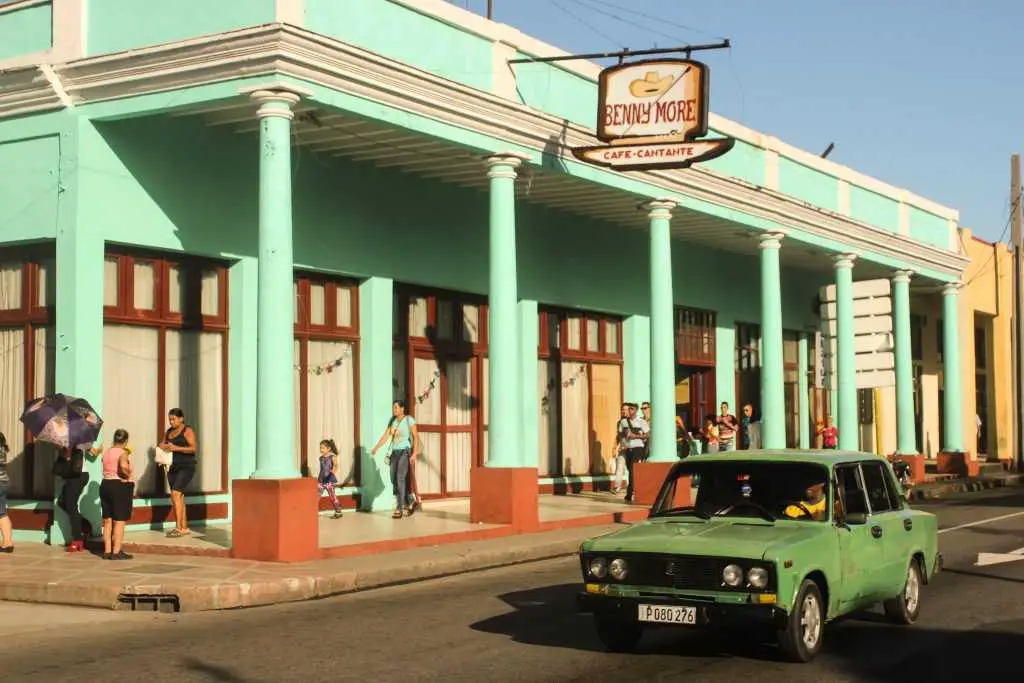
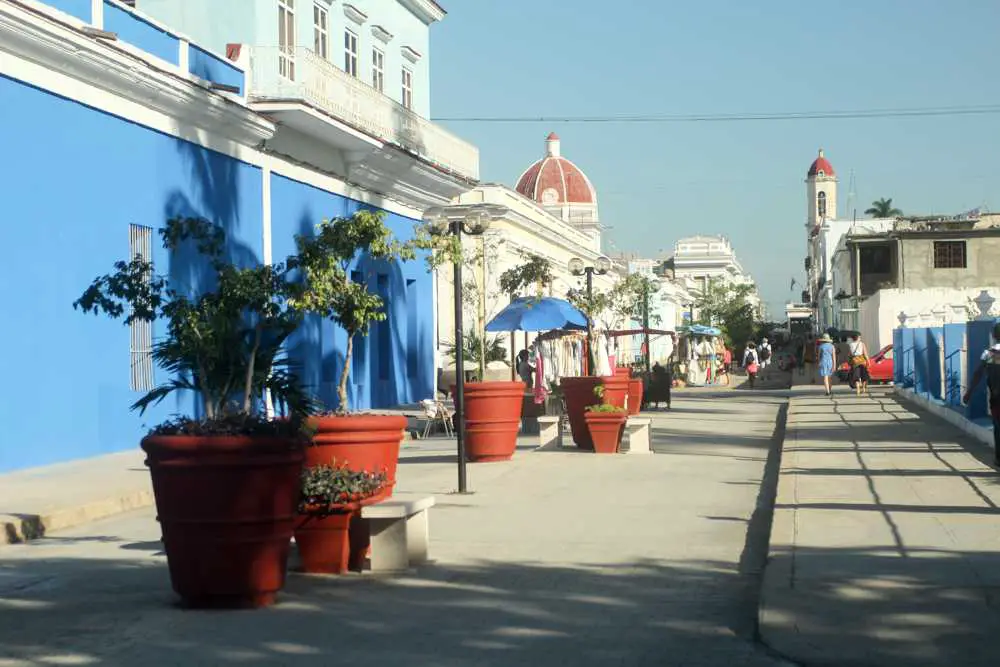
We moved on to the Pedestrian Boulevard, where I could see for the first time the queues of people waiting for the ration shops to open. The town was very clean and bright, with light colored colonial buildings, nicely decorated with French motifs.
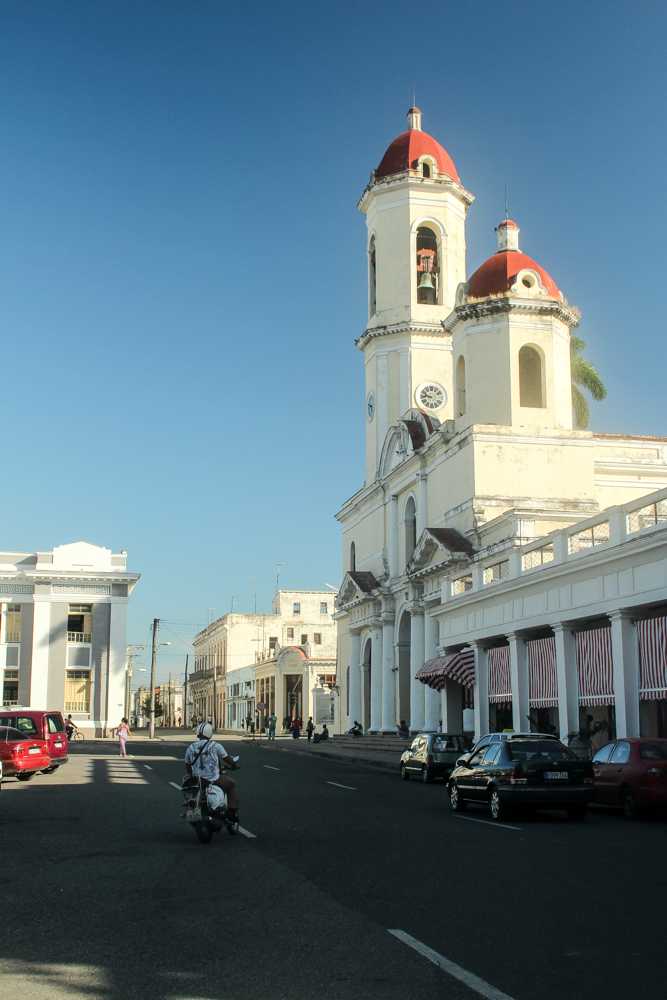
We seemed to be the only tourists, almost blending in perfectly with the locals. We admired the church in Plaza de Armas, which reminded me of a small village church from the southern part of Peru, and then we turned left, heading towards the lake.
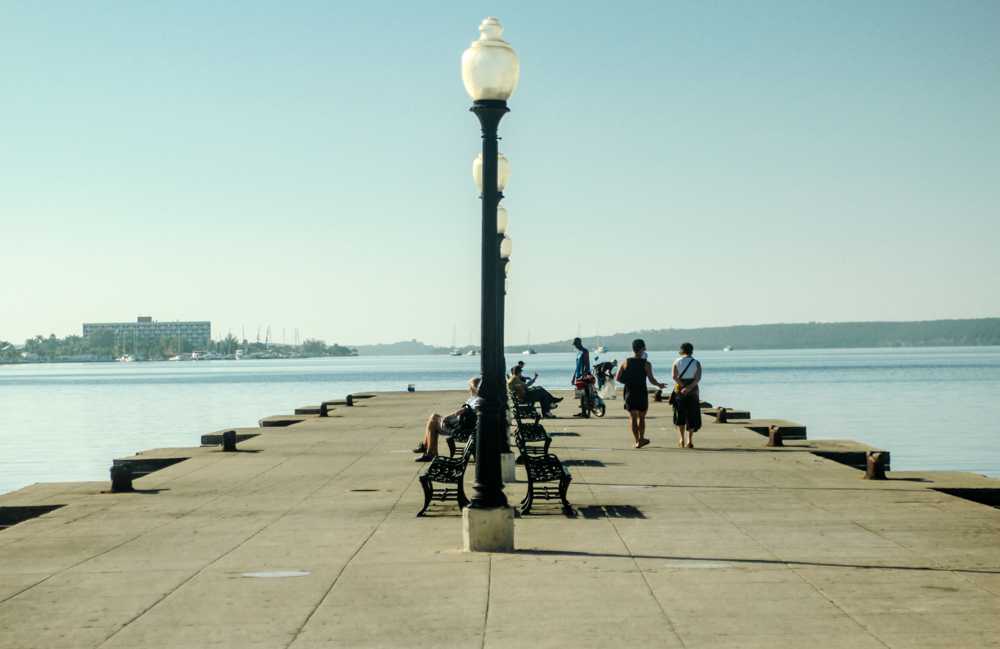
The weather was beautiful, clear blue sky, high temperatures and a light breeze. The nearby buildings were painted blue and they made perfect sense to the city’s architecture.
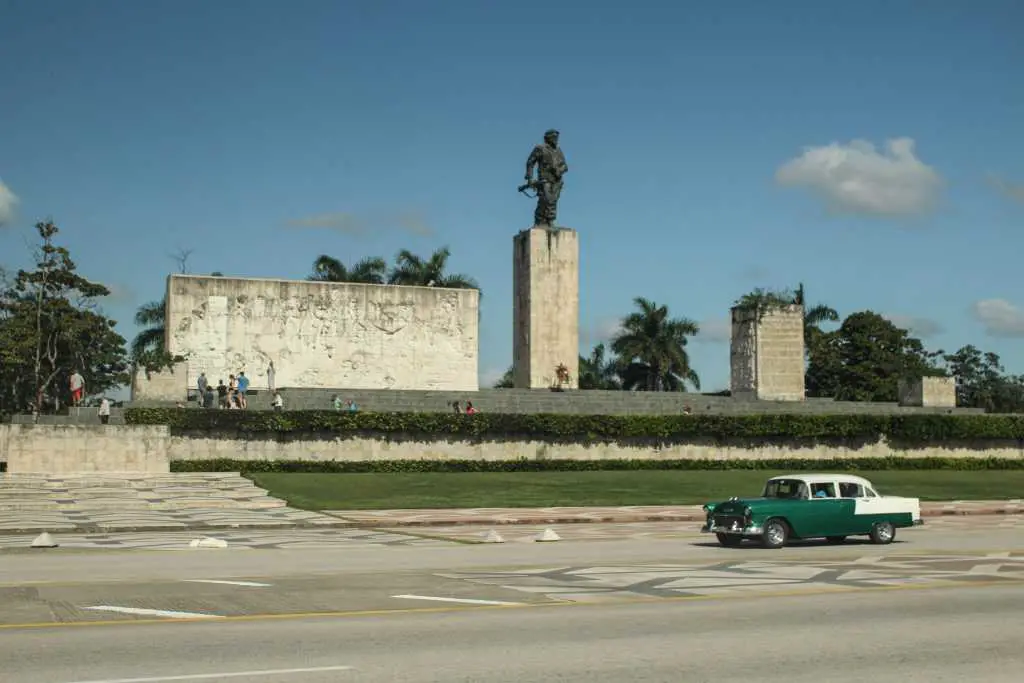
Unfortunately we didn’t have a lot of time to explore the town better, as the bus was waiting for us to take us to Santa Clara, to see the Che Guevara Mausoleum. You have probably heard the name of Che Guevara at least once in your life. He was an Argentinian doctor who, after his trip to South America, shocked by the poverty, disease and hunger that he saw, decided to do something about it. He became a symbol of Cuba and their most beloved leader, after he fought together with Fidel and Raul Castro to bring down the dictatorship regime of Fulgenico Batista, in 1958.
The Mausoleum has two parts, one where his remains are kept and another one which is a museum with his personal items.
Not many people are allowed to enter the Mausoleum in the same time, and as a result we had to wait for about half an hour in the powerful sun. It is not allowed to get inside if you are not wearing decent clothes and you have to take off your sunglasses and hat, as a sign of respect. The part where his remains are kept is designed to represent the Bolivian jungle, the place where he died. When you get inside you notice straight away the high humidity and the plants from the back (real?). The room is dark, the only light coming from the eternal flame, lit by Fidel in Che’s memory. On the left wall there are 38 stars, each representing the remains of a soldier found in the same place as Che’s, in Bolivia. Che’s star is in the middle, but is not bigger or different than the others.
Once we stepped in the other room we noticed a cool breeze coming from the air conditioned. Here, the walls are covered with pictures from different moments of Che’s life, starting with his childhood and medical studies. On both sides of the room there are cases with different items that belonged to him: a bowl, a syringe, his medical license, his motorcycle helmet, even his writing desk. As you advance through the room, you get to see his evolution from a medical student to a fighter. The innocent objects now change, and you can recognise now his uniform, binoculars and lots of hand guns.
Unfortunately, it is forbidden to take pictures inside the Mausoleum.
Back on the bus, Danny gave us a copy of the letter that apparently Che Guevara wrote to Fidel before leaving Cuba. After the Revolution, Fidel took over the role of the country’s leader but after a while, Che disappeared. People have started to wonder and ask questions, comparing the sudden silence with a past event, involving Fidel and Camilo Cienfuegos, the Chief of Staff of the Cuban Army. Rumors say that Fidel might have been involved into Camilo’s death, after the plane he was in disappeared and was never found.
A few weeks after Che’s noticeable disappearance, Fidel said that he was left a letter in which Che was saying that he wants to move on to help other countries too, that he gives up the Cuban citizenship as a sign of respect and that he does not want to leave anything to his wife and children. You can find the full text of the letter here.
It is not known if this letter is real or not.
From the Mausoleum we continued our way to Trinidad, one of the pearls of Cuba.
That’s a real shame you can’t take pictures from the inside, whenever that’s the case I’d love to have a photo to keep on to the memory forever. I also clicked through to read the farewell letter, I wonder if that’s true!
Look at those blue skies! Amazing! You really take us on the journey with you in your writing Joanna. I would probably be a bit stand off-ish staying with someone I didn’t know, but you make a very good point. Your photography as always is fantastic, looking forward to seeing the next part of your journey.
I love reading about personal experiences of travellers. I mean, I like to read articles that feature tips and suggestions when travelling to a certain place, but write ups like this makes me feel like I was there in Cuba with you. I love the pictures too. And the idea of renting a place with a local looks a lot more favorable than staying in a hotel especially if you’re travelling alone. Thank you so much for sharing your experience. More power to you!
I have a friend from Cuba. This time when I talk to her, I will be alittle more knowledgable about the place. thanks to your post. 🙂
So many places to visit, and I hope I could do all those trips before I hit 60. And seems like Danny is such a nice and knowledgeable tour guide. Most of the time, trips become enjoybale because of the side comments and extra tips coming from tour guides.
Those photos are beautiful. I love that shade of blue on one of the buildings. I also never knew about the Che Guevara Mausoleum. How interesting that photography is not allowed inside. I suppose it is a mark of respect? I’ve always wanted to go to Cuba, but this post just made me more eager to do so.
There is so much to learn from this article. You know, the media will only show and tell you what they want you to see and here, I see that a lot when reading or watching news about Africa. I love the turquoise building with the old car driving by, a really great shot.I too am unsure about the validity of that letter……
From my perspective, you are such a great storyteller. I love the scenery, the captures (the way you immortalized it). I just hope other historical sites would be as nice as this.
The way of life in Cuba is interesting! I think it would be great to be able to stay with the locals and really get to know how their life is. You get to know people on a different level when you stay with them and also get a chance for them to know you and learn about a different culture. I liked when you told about the history. I wonder if that letter is true or not. I wonder if we will ever know what happened to him.
I would have been put off at the thought of staying in someones house but seeing it from your point of view it makes more sense. I enjoyed the article and history I didn’t know.